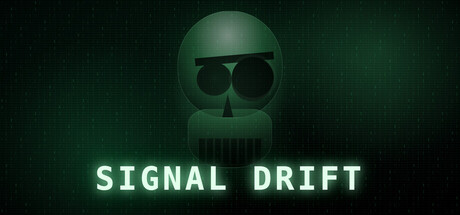
Official game
Play Signal Drift
This game is hosted by Steam. Continue to the official page to play or download it.
Wishlist on SteamWhat Is Signal Drift?
Signal Drift is a CRT-noir hacking thriller developed and published by Alcove Research LLC, released June 29, 2026 on Steam (ID: 4524510) for Windows, Mac, and Linux at €10.25 (~$10.99).
"Trust is what desperate people call an unfavorable reserve." "They told you to hack the planet. Nobody told you the planet keeps receipts."
You are a fixer — someone who takes dirty contracts from people who never use their real names. Make evidence disappear, compromise institutions, and navigate cold wallets, access brokers, and hostile operators. Every contract leaves a trace. And every trace can be followed back to you.
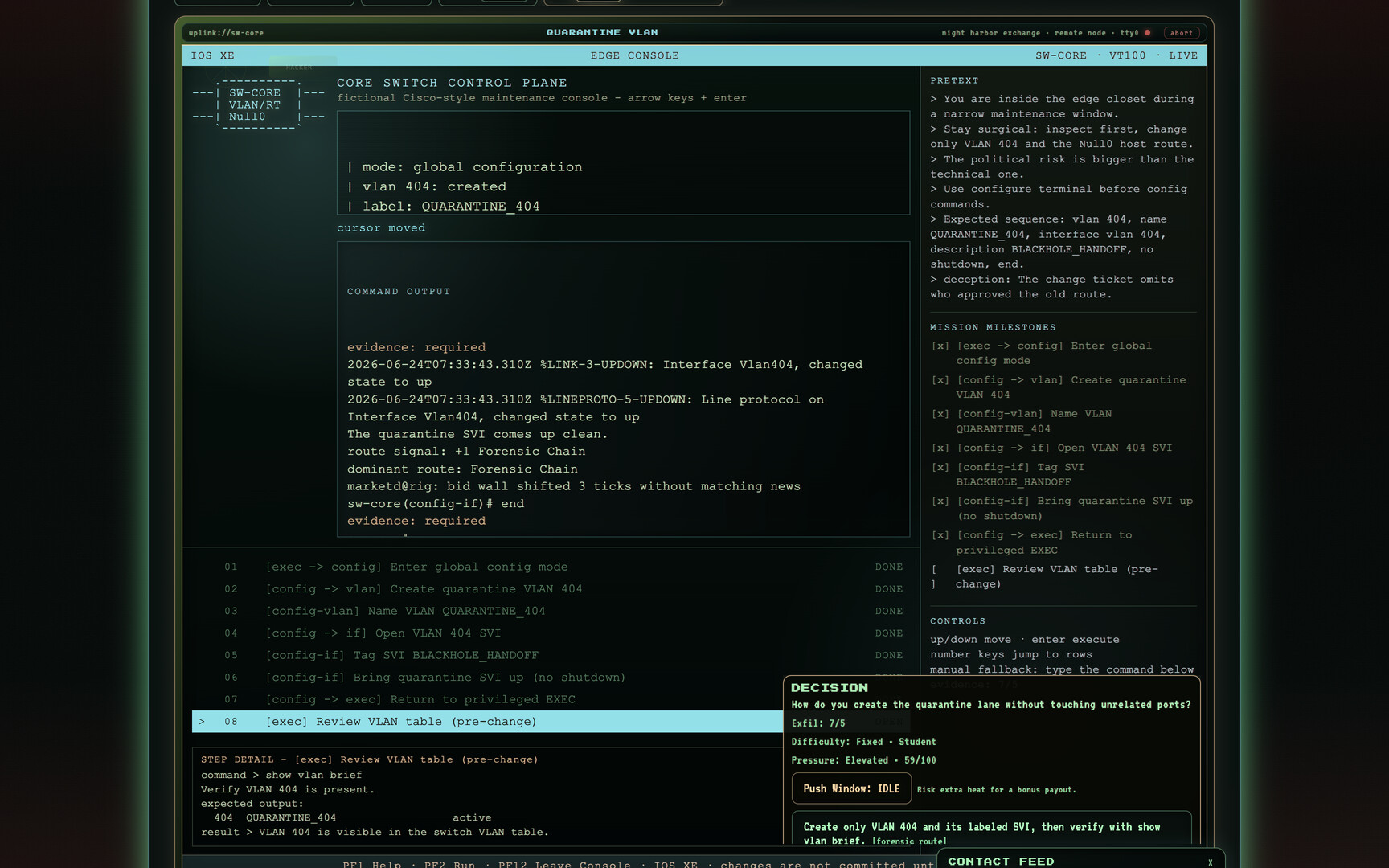
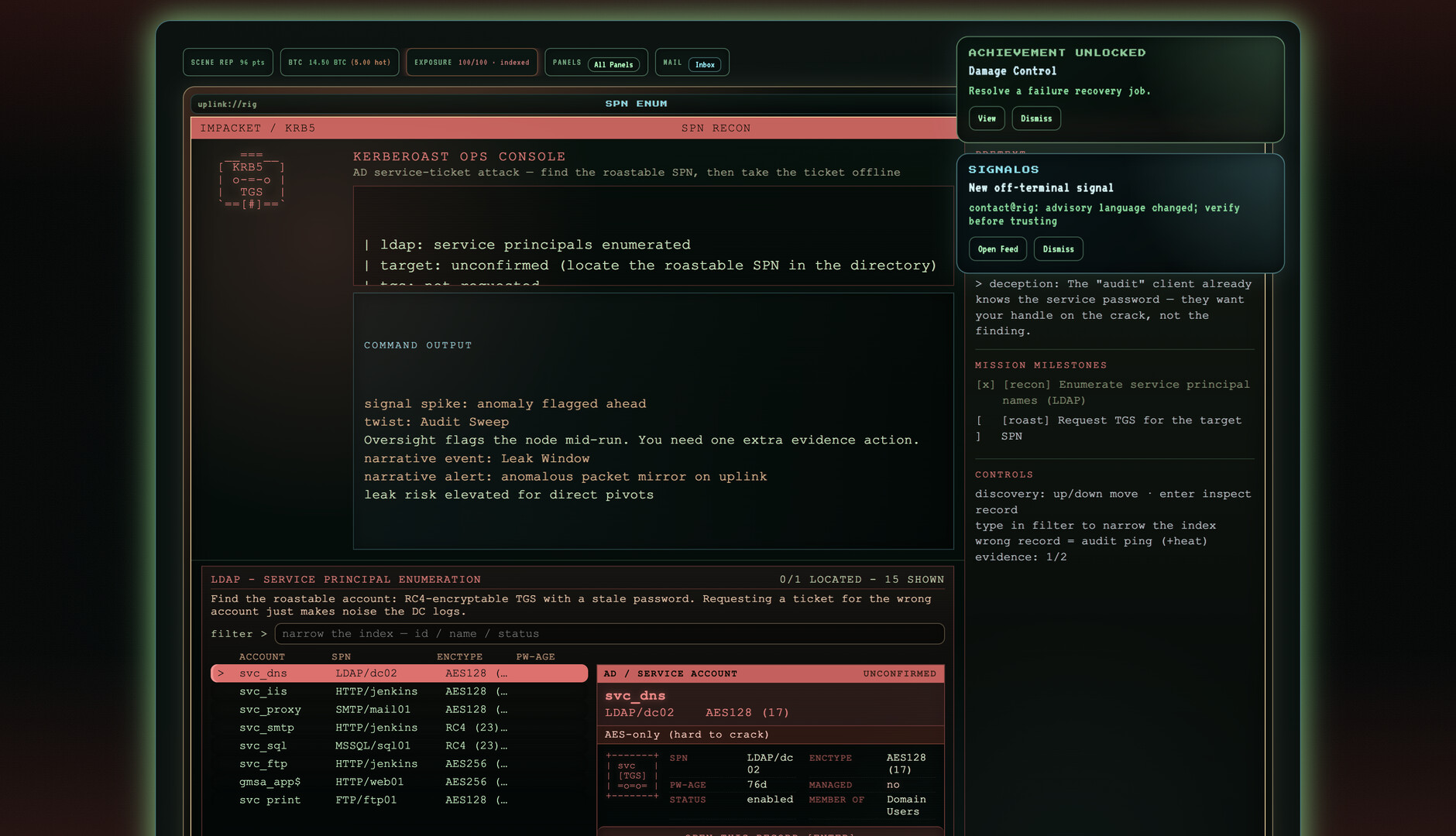
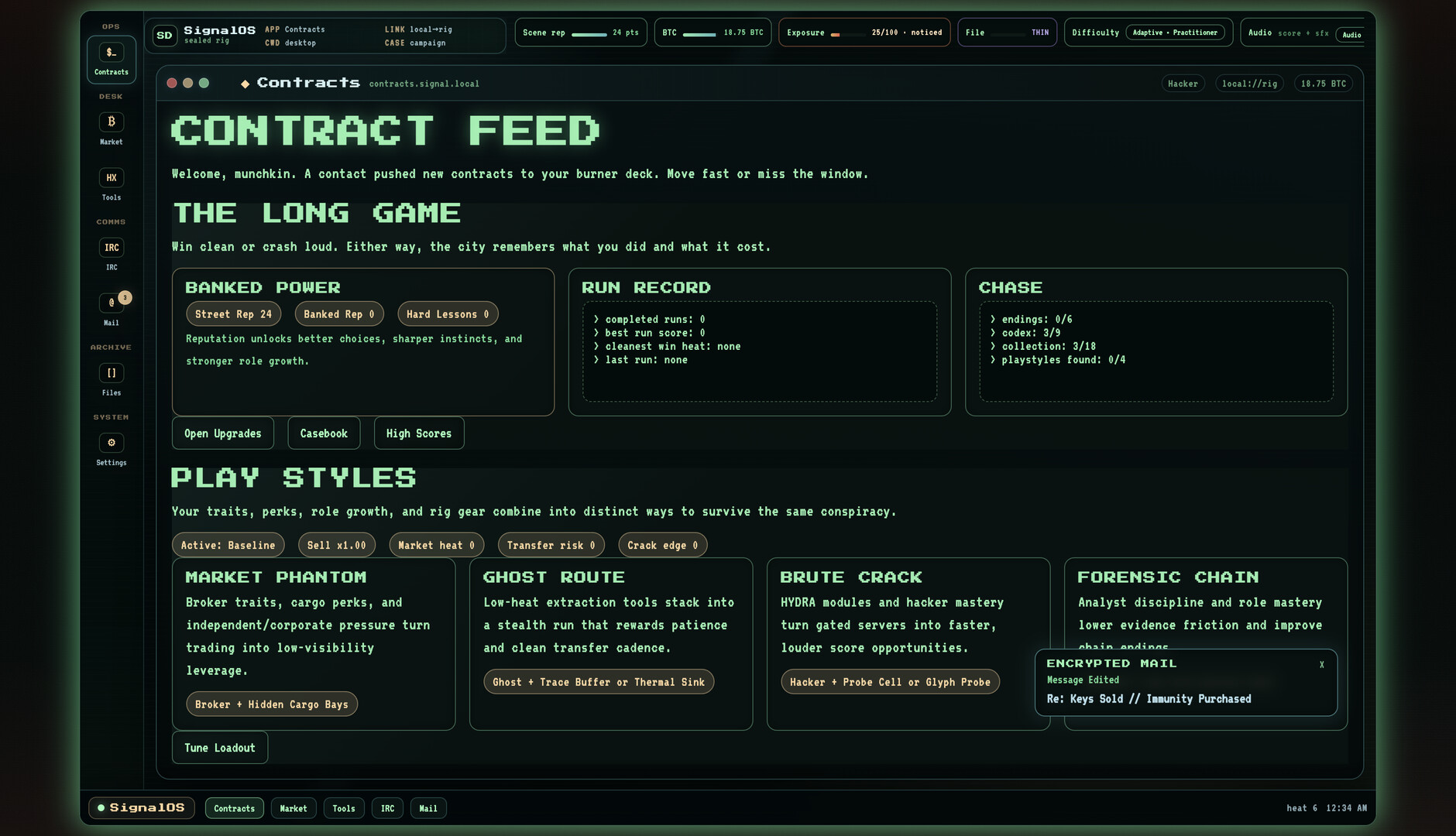
The game plays entirely through SignalOS, a fictional desktop environment and command-line interface. You'll type commands, read encrypted emails, browse dark web marketplaces, forge documents, and decide who to trust — or who to burn. One wrong move and the trace leads back to your terminal.
Signal Drift draws inspiration from Uplink, Orwell, and Her Story, with a tighter focus on narrative consequence and dirty-work morality, powered by a character-driven local AI layer.
Story and Setting
You operate in the shadows of a fully networked society — corporate databases, government records, private servers, and underground marketplaces all exist as targets, tools, or traps. Signal Drift weaves each contract into an evolving web of relationships, debts, and consequences. Every job changes your standing with the underground, and every decision ripples forward.
Multiple endings depend on which contracts you take, who you trust, what evidence you destroy or preserve, how much heat you accumulate, and which characters you build rapport with (or betray).
Key Features
SignalOS Desktop Environment
- File System: Browse directories, read documents, inspect logs. Hidden files reward thorough exploration.
- Terminal Emulator: The primary way you interact with remote systems — navigate, extract, plant, erase.
- Email Client: Encrypted messages from clients and contacts. Your inbox is mission hub, warning system, and trap.
- IRC Client: Real-time chat with contacts. Build relationships, gather intel, get betrayed. The underground lives here.
- Marketplace: Buy/sell tools, credentials, and access. Prices shift based on supply, demand, and vendor relationships.
- Wallet: Manage crypto earnings for tools, services, and bribes.
- Record Systems: Public and private databases for researching targets, clients, and contacts.
Signal Ghost AI Layer
Signal Ghost powers the living world — character-driven AI that drives IRC chatter, private DMs, mission fallout, market rumors, threats, and dynamic relationship conversations. Characters remember your history, react to pressure, and shift tone based on trust, heat, and betrayal. Ask for help, push too hard, accuse someone, flirt with the wrong person — the world reacts. It makes Signal Drift feel occupied, not scripted.
Core Gameplay Loop
- Discover hosts, credentials, files, logs, and evidence across fictional systems.
- Access remote machines with shell commands — explore, extract, plant, erase.
- Complete Contracts — each job has objectives, complications, and optional goals.
- Manage Heat — every action leaves a footprint. Cover your tracks or get traced.
- Build/Burn Relationships — contacts are lifelines and liabilities.
- Upgrade & Survive — invest in better encryption, tools, and anonymization.
- Face Consequences — choices accumulate. Endings branch on your actions.
Systems You'll Explore
The game features a variety of fictional system types, each with unique conventions and security postures:
- Workstations — personal computers with documents, emails, and credentials
- Servers — corporate databases, application servers, file shares
- Routers/Switches — network configs, logs, access control lists
- Legacy Linux Boxes — forgotten credentials and historical data
- Windows Shares — SMB shares with spreadsheets and misconfigurations
- Embedded Devices — IoT and industrial control systems
- Record Systems — government and corporate databases
- Internal Tools — custom apps and admin panels with vulnerabilities
Character Origins — Pick Your Poison
Hacker
Anti-corporate conscience with a talent for making enemies.
Started in the activist scene. Strong offensive tools and sympathetic contacts, but hostile relations with corporate-aligned operators and higher baseline heat. Best for players who want to fight the system.
Independent
A private rig, dirty money, and a contact list full of liars.
Solo operator — no affiliations, no safety net. Maximum freedom, neutral reputation, diverse contracts. No faction support and weaker starting tools. Best for players who want total narrative freedom.
Spy
A handler, a directive, and deniability aimed at your back.
Answer to an agency. Institutional resources and advanced tools, but limited contract freedom and a handler with their own agenda. Best for players who enjoy layered loyalties and intrigue.
Operator
Institutional access, executive pressure, and everyone above you is expendable.
Inside the machine — legitimate credentials, cover identity, and insider knowledge. Dual life creates double risk; internal oversight and high-stakes exposure scenarios. Best for players who enjoy high-risk corporate infiltration.
How to Play Signal Drift
Getting Started
- Launch and choose New Game
- Select your origin — this shapes your entire run
- Complete the tutorial contract — learn basic commands and navigation
- Check your inbox — first real contracts arrive via encrypted email
- Visit the marketplace — buy essential tools with starting crypto
- Explore SignalOS — learn the filesystem, IRC, and record systems
Terminal Commands
Commands are inspired by real Unix/Linux shells:
| Command | Function |
|---|---|
ls | List files/directories |
cd <path> | Change directory |
cat <file> | Display file contents |
grep <pattern> <file> | Search within files |
find <name> | Locate files |
ssh <user>@<host> | Connect to remote system |
scp <file> <host>:<path> | Copy files remotely |
ps | List running processes |
netstat | Show network connections |
ip | Network configuration |
journalctl | View system logs |
dmesg | Kernel log messages |
sudo <command> | Elevated privileges |
cp, mv, rm | File operations |
mkdir, chmod | Directory/permission mgmt |
whoami | Current user |
history | Command history |
clear | Clear terminal |
help | List available commands |
Tip: Tab auto-completes commands, paths, and hostnames. Arrow keys scroll command history.
Interface Overview
SignalOS is a multi-window desktop with:
- Taskbar/Dock — switch between Terminal, Email, IRC, Marketplace, Wallet, Files
- Terminal Window — primary workspace, multiple tabs for different systems
- Notification Area — messages, contract updates, system alerts
- Status Bar — crypto balance, heat level, active connections
- File Browser — graphical filesystem view
Supports mouse navigation and keyboard-only play.
Contracts and Missions
Each contract includes briefing, primary objectives, optional objectives, complications, payment, and heat estimate.
Contract Types: Data Theft, Credential Harvesting, Evidence Tampering, Surveillance, Sabotage, Exfiltration, Social Engineering.
Progression System
Advance along Crypto (currency), Reputation (opens/closes contracts), Heat (draws hunters), Tool Quality (better gear = cleaner ops), Relationships (NPC standing), and Scars (past failures affect future runs).
Controls
| Action | Input |
|---|---|
| Type Commands | Keyboard (primary) |
| Confirm / Execute | Enter / Return |
| Auto-Complete | Tab |
| Navigate UI | Mouse click or Tab/Shift+Tab |
| Scroll History | Mouse wheel, Page Up/Down |
| Pause / Menu | Escape |
| Save Game | Auto at story beats + Manual Anywhere |
| Command History | Up/Down arrow keys |
| Switch App | Click taskbar or Alt+Tab |
| Quick Save / Load | F5 / F8 (default) |
Fully keyboard-only with adjustable text size and color alternatives.
Tips and Strategies
Information Management
Read everything — every email, file, log, and contract contains useful information. Keep external notes — the game has no in-game notebook; client names, wallet addresses, passphrases, and hostnames must be remembered or written down externally. Cross-reference — details from one source unlock meaning in another.
Operational Security
Cover your tracks after every job — delete temp files, clear logs, rotate access points. Use encrypted channels — unsecured communications can be intercepted. Diversify infrastructure — don't reuse access points or credentials. Know when to walk away — not every contract is worth the heat.
Relationship Management
Don't trust anyone — clients lie, contacts double-cross, friendly warnings can be setups. Pay attention to tone — subtext in writing hints at traps before they spring. Build deliberately — cultivate useful contacts but never depend on a single source. Betrayal has consequences — burning a contact is permanent.
Financial Strategy
Diversify income — maintain multiple brokers and contract types. Invest in quality tools — prioritize encryption, secure comms, and anonymization. Save for emergencies — bribes, extraction, replacement tools.
Save Management
Save before major decisions — accepting contracts, contacting clients, high-stakes infiltrations, accusations. Use multiple save slots to explore alternatives and recover from unexpected outcomes.
Embracing Failure
Failure is interesting — getting caught or burned isn't the end. Some of the best narrative moments come from recovering from mistakes. Your scars matter — the game tracks failures and weaves them into the story.
Achievements
Signal Drift has 20 Steam Achievements. Notable ones:
| Achievement | Description |
|---|---|
| First Contract | Complete your first contract |
| Shadow Courier | Successfully exfiltrate sensitive data |
| Market Flipper | Turn a profit on the marketplace |
| Market Maker | Dominate a market sector |
| Codex Initiate | Unlock a significant piece of lore |
| Codex Complete | Uncover the full story |
| Kernel Hunter | Exploit a critical system vulnerability |
| Heat Spike | Operate at maximum heat and survive |
| Archive Collector | Accumulate a substantial data archive |
| Clean Exit | Complete the game with minimal heat |
Achievements reward optional objectives, deep exploration, and system mastery. Several require specific narrative choices or origin playthroughs.
FAQ
Is Signal Drift free? No. €10.25 (~$10.99 USD) on Steam.
What platforms? Windows, Mac, Linux — full cross-platform support.
When was it released? June 29, 2026. Available now on Steam.
Multiplayer? No. Single-player narrative experience.
System requirements? Minimum: 64-bit OS, 4 GB RAM, 1 GB storage. Recommended: 8 GB RAM. Lightweight — runs on almost any modern computer.
Need command-line knowledge? No. The terminal is fictional and intuitive — auto-complete and on-screen guidance are provided.
Length? 3-5 hours per playthrough. Multiple playthroughs encouraged for different origins, contracts, and endings.
Replay value? High. Branching narrative paths, four origins, variable contracts, multiple endings, and 20 achievements.
Combat? No. Tension comes from information warfare — digital footprints, trust networks, and high-stakes decisions.
Does it teach real hacking? No. Fictional and self-contained. Does not target real systems or teach real-world intrusion.
AI-generated content? Pre-generated AI artwork was used in the game, as disclosed by the developer.
Mature content? Strong language, crime themes, betrayal, implied violence, drug references, simulated gambling, and charged romantic/sexual themes (no explicit content). All text-based — no gore, nudity, or real-money gambling.
Steam Cloud / Family Sharing? Yes to both.
Developer? Alcove Research LLC. Contact: [email protected]
Technical Information
- Engine: Custom, lightweight terminal-based
- Display: Fictional CRT-terminal aesthetic with adjustable text size and color alternatives
- Save System: Auto-save at story beats + manual save anywhere (multiple slots)
- Input: Keyboard (primary), Mouse (UI navigation)
- Audio: Ambient soundtrack, terminal sound effects
- Accessibility: Adjustable text size, color alternatives, keyboard-only, no timed input, camera comfort features
- Steam Features: 20 Achievements, Steam Cloud, Family Sharing
- DRM: Steam DRM
Steam Tags: Simulation, RPG, Strategy, Puzzle, Exploration, Stylized, Dark, Noir, Choices Matter, Story Rich, Text-Based, Singleplayer
Final Thoughts
Signal Drift is a focused, reactive hacking thriller that prioritizes narrative consequence over mechanical complexity. Its strength lies in dense writing, AI-driven world reactivity, and genuine tension from reading text, managing relationships, and making irreversible choices. It rewards patience, attention to detail, and a willingness to live with consequences. Whether you're an idealistic hacker, a cold operator, a layered spy, or a solo survivor, Signal Drift respects your intelligence and punishes your mistakes.
Last reviewed by Game How To Editorial — July 2026.
Screenshots