Daily Pick
One deeply researched guide worth reading today.
A practical route through the systems that matter most, written to help new players make confident decisions quickly.
What Is Rite of the Veilstorm?
Rite of the Veilstorm is a free, browser-based narrative adventure by solo developer EmptyPotatoSack, built in Godot and playable directly on itch.io. You play Myrin, a soul summoned before five ancient Keepers. The Codex holding the world together is failing, and the Rite will judge what comes next. Each Keeper guards an elemental domain with its own small trial. Answer their questions, clear their challenges, face the mirror, and the Rite decides which of three endings your story earns.
There is no combat, no health bar, and no way to lose. The entire game is a sequence of honest choices. Every Keeper asks one philosophical question and your answer, all five combined, silently determines your ending. One run takes 15 to 25 minutes. The whole thing was made without generative AI, and it shows: the questions rhyme with each other, and the endings quote your exact choices back to you.
The current build is the In-development version live on the itch.io page as of October 2026. Everything in this guide was verified against that build, including every dialogue line, every counter, and all three ending scripts.
Quick facts
| Fact | Value |
|---|---|
| Price | Free |
| Platform | Browser only (HTML5/WebGL2), no download |
| Engine | Godot 4.6, Dialogue Manager addon |
| Developer | EmptyPotatoSack (solo) |
| One run | 15-25 minutes |
| All three endings | About 3 runs, 60-75 minutes |
| Endings | Preserve, Echo, Reject |
| Fail states | None |
Getting Started
Open the itch.io page and click Run Game. The build is around 56MB and loads in under a minute on any modern connection. The title screen shows Start and Credits over animated cloud layers. Click Start.
Your first screen is a grassy field with a stone dais in the middle and four rune stones arranged around it: fire, water, air, and earth. A speech opens the game:
"Find us and answer with truth. Only then will the Rite judge."
A fifth domain, the Spirit Keeper, waits beyond the four visible stones. A sixth location, Mirror Island, sits at the edge of the map.
Controls
| Input | Action |
|---|---|
| WASD / Arrow Keys | Move |
| E / Space | Interact (talk, examine, confirm) |
| Escape | Pause menu (Resume / return to Title) |
| Mouse | Title and Credits menu |
The interact prompt reads "Press E to Interact" whenever you stand next to something usable. That prompt is your compass: if nothing displays, nothing here can be touched yet.
Your First Ten Minutes
- Walk off the dais in any direction.
- Approach any rune stone and press E. The Keeper asks their question.
- Pick whichever answer feels true. There is no wrong one.
- The trial for that element loads automatically. Clear it.
- You return to the field. Talk to the Keeper again and answer Yes when asked if you are ready to leave.
- Repeat for all five Keepers, then visit Mirror Island before touching the final stone.
One habit matters more than any walkthrough: answer the Keepers the way you actually would, not the way you think the game wants. The endings quote your choices directly, and the payoff lands hardest when the verdict surprises you.
The Five Keeper Questions and Every Answer
Each Keeper asks exactly one question with three possible answers. Behind the scenes, each answer adds a point to one of three hidden counters: preserve, reject, or echo. The table below lists every question and every answer, with the counter each one feeds. This is the complete set as shipped in the current build.
Fire Keeper
Question: "Is it noble to burn for others, even if they never see your light?"
| Answer | Counter | Theme |
|---|---|---|
| "If it brings warmth to even one life, the fire is worth it." | Preserve | Self-sacrifice with meaning |
| "No. What good is sacrifice if it leaves nothing behind?" | Reject | Refuse pointless loss |
| "I don't know. Maybe the fire only matters to the one who carries it." | Echo | Honest doubt |
Water Keeper
Question: "If a memory brings peace but hides the truth, should it be kept?"
| Answer | Counter | Theme |
|---|---|---|
| "Yes. Not all truths are meant to surface." | Preserve | Protective silence |
| "No. Truth must rise, even if it drowns what came before." | Reject | Truth over comfort |
| "What if memory and the truth are both real, in their own way?" | Echo | Both can coexist |
Air Keeper
Question: "If you must choose between freedom and peace, which will you carry forward?"
| Answer | Counter | Theme |
|---|---|---|
| "Peace. Even if it means fewer paths to walk." | Preserve | Calm over possibility |
| "Freedom. I'd rather loose comfort than choice." | Reject | Choice over calm |
| "Can peace ever last if freedom is left behind?" | Echo | The question behind the question |
Earth Keeper
Question: "Do we owe loyalty to what has always been, even when the ground shifts beneath us?"
| Answer | Counter | Theme |
|---|---|---|
| "We stand firm. The old ways hold us steady." | Preserve | Tradition as anchor |
| "We adapt or crumble. The old ways can't hold forever." | Reject | Change or collapse |
| "Loyalty isn't to stone or soil - but to what we choosse to build atop them." | Echo | Loyalty to what we make |
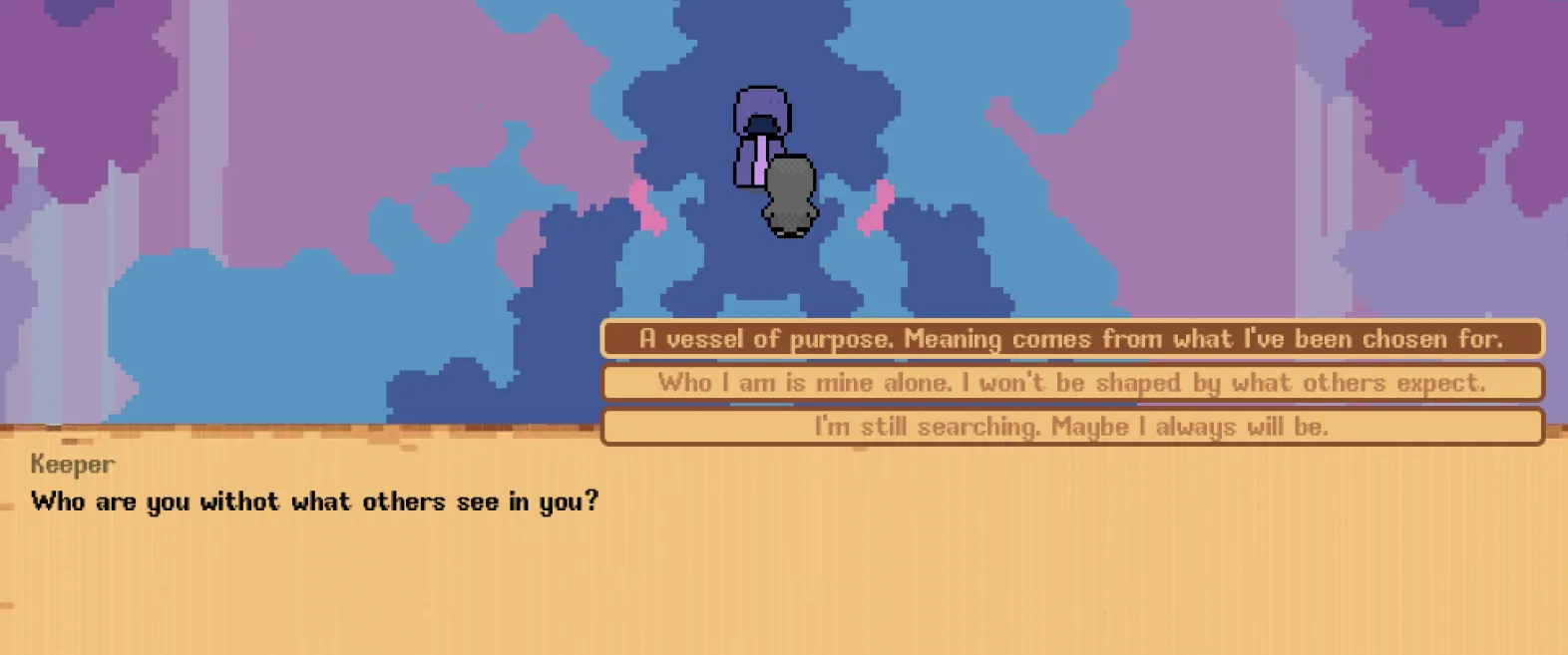
Spirit Keeper
Question: "Who are you without what others see in you?"
| Answer | Counter | Theme |
|---|---|---|
| "A vessel of purpose. Meaning comes from what I've been chosen for." | Preserve | Duty as identity |
| "Who I am is mine alone. I won't be shaped by what others expect." | Reject | Self over role |
| "I'm still searching. Maybe I always will be." | Echo | The open question |
Two details worth knowing. After your answer, every Keeper says "I see ..." and asks "Are you ready to leave?" Answer Yes to return to the field, or No to hear "Remember, you have much left to do." You can re-talk to any Keeper at any time; repeat visits skip straight to the leaving prompt.
The two spelling quirks above ("loose comfort", "choosse") are in the shipped game, not transcription errors. Small indie builds carry small typos. They are part of the charm.
The Five Trials: How Each Mini-Game Works
Talking to a Keeper drops you into their domain's challenge. None of them can kill you. Each has a one-line instruction, quoted here exactly as the game shows it.
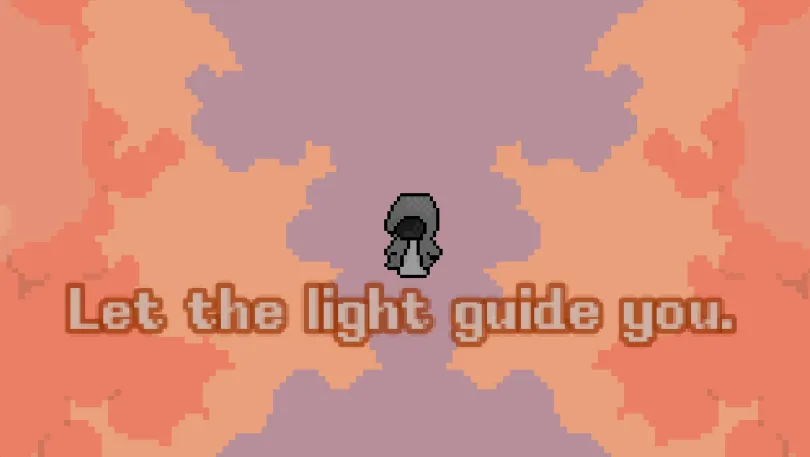
Fire: "Let the light guide you."
A dark maze. Your torch carves out a small circle of visibility while everything else sits in blackness. The maze borders push you back if you press into them. Pick a wall and follow it; mazes yield to wall-followers. Getting lost costs seconds, not lives.
Practical route: keep your left shoulder on a wall and walk. The exit glows faintly warm against the dark. When the screen brightens, you have cleared it and return to the field automatically.
Water: "The waves control the way."
A rhythm challenge. Waves cross the path in repeating patterns, and you press the tempo input in time with them. The game tracks your timing against eight wave animations. Miss the beat and the wave simply sweeps you back to try again.
Practical route: watch one full wave cycle before pressing anything. The pattern repeats. Tap on the beat two or three times and the sequence completes.
Air: "Pause with the wind."
Gusts blow across the path at intervals. Each gust shoves you backward and can reset your position. Move in the gaps between gusts, or time a dash so the gust carries you across a long gap instead of fighting it.
Practical route: stand still and count the rhythm of the visible gust animation. Move immediately after one passes. For the long gaps, walk into the gust's edge and let it push you the distance.
Earth: "Not all ground is formed equal."
Cracking platforms. Some tiles hold, some crumble underfoot a half-second after you step on them, and broken ones drop you back to a respawn point. The floor visually shakes before it fails.
Practical route: keep moving. Standing still is the only way to fall. If a tile trembles, you are already across it or already gone.
Spirit: "Reflection brings new paths."
A memory pattern, Simon-says style. Five orbs sit on pedestals. The game flashes a random sequence, then you repeat it by interacting with each orb in order. Sequences grow one step longer as you complete each round.
Practical route: speak the positions out loud as they flash, in your head or under your breath. Left-to-right positions, named aloud, survive short-term memory far better than colors do.
The Mirror on Mirror Island
Past the four stones, the map's edge holds Mirror Island. Walking onto it fades the screen and brings you before a standing mirror. It asks one question:
"Would you shatter the mirror if you feared what looked back?"
| Answer | Result flag | Meaning |
|---|---|---|
| "Yes. I would break it." | mirror_shattered | You refused to look at yourself |
| "No. I would face it" | mirror_faced | You accepted your reflection |
The mirror can only be answered once per run. Your choice does not feed the three counters. It changes the ending scene instead: which version of Myrin appears, whether glass cracks across the final image, and one extra line of text.
Return to the mirror later and it remembers:
- If you faced it: "you meet eyes with your reflection, but something looks a little different"
- If you shattered it: "glass shards lay scattered on the ground, but the mirror remains untouched"
Which should you pick? Neither is rewarded over the other. Facing the mirror pairs naturally with honest, doubting answers; shattering it pairs with refusal. Pick the one that matches the run you are playing and the line you want to read at the end.
How the Rite Decides: The Ending Logic
The game tracks five answers plus one mirror choice. The counters decide which ending plays. The mirror decorates it.
The Three Counters
Every Keeper answer adds exactly one point to exactly one counter:
- preserve_count grows when you choose stability, duty, protective silence, tradition, purpose
- reject_count grows when you choose refusal, change, truth over comfort, self over role
- echo_count grows when you choose doubt, nuance, questions over answers
After all five Keepers are answered, the final stone compares the three totals and sends you to one of three ending scenes. The comparison runs in a fixed order with preserve checked first, so the safest way to guarantee a specific ending is a clean sweep: give the same-counter answer at all five Keepers.
Ending 1: Preserve
How to get it: choose the preserve answer at every Keeper. Five stability answers guarantee it.
The Keepers send you off with "May your end bring everlasting calm." The final card reads:
"Balance was kept. You were the cost."
Myrin appears whole if you faced the mirror, and shattered if you broke it. The Codex endures; the price was you. This is the ending for runs where every answer chose the world over the self.
Ending 2: Echo
How to get it: choose the echo answer at every Keeper. Five honest-doubt answers guarantee it.
This ending is a litany. Each element speaks to how you answered, in sequence:
Air: "You danced with wind, but would not choose a direction" Fire: "You acted. Then hesitated. Flame cannot wait." Spirit: "And so...you walk again. As all memories do." Water: "You changed...and yet changed nothing." Earth: "We asked for grounding, you gave us drift." Mirror: "You left the questions open, the silence grows louder."
If you faced the mirror, the game adds "You dared to look." If you shattered it: "You left something behind." The echo ending refuses to punish or reward you. It walks beside you instead. Most first-time players, answering honestly, land here.
Ending 3: Reject
How to get it: choose the reject answer at every Keeper. Five refusal answers guarantee it.
The Keeper's verdict: "So be it, breaker of pages". The final card reads:
"Every ending is a new beginning."
Shattering the mirror overlays cracked glass on this ending's final image; facing it keeps the frame whole. The Codex falls, and the game calls that a beginning instead of an ending.
Mixed Answers
Split your answers and the counters compete, with the highest total winning and preserve winning any tie at the top. A 3-2 split of preserve and reject, for example, ends in Preserve. Because the game quotes your exact answers back inside the Echo litany and the ending scenes, mixed runs still feel personal. They just resolve to whichever philosophy you leaned toward most.
The mirror choice never affects which ending you get. It only changes how the ending shows Myrin: faced, whole, and seen, or shattered behind cracked glass.
Step-by-Step: Three Runs to Full Completion
Run 1: Answer honestly. Do not consult anything. Pick what feels true, clear the five trials, face or shatter the mirror as you please. Note which ending you receive. This run is the emotional core of the game and it only works once.
Run 2: Sweep the opposite philosophy. If Run 1 felt preserve-leaning, give all five reject answers. The fastest sweep:
- Fire: "No. What good is sacrifice if it leaves nothing behind?"
- Water: "No. Truth must rise, even if it drowns what came before."
- Air: "Freedom. I'd rather loose comfort than choice."
- Earth: "We adapt or crumble. The old ways can't hold forever."
- Spirit: "Who I am is mine alone. I won't be shaped by what others expect."
- Mirror: pick the option you did not pick in Run 1.
- Touch the final stone, watch the ending.
Run 3: Sweep echo. Same route, all five doubting answers:
- Fire: "I don't know. Maybe the fire only matters to the one who carries it."
- Water: "What if memory and the truth are both real, in their own way?"
- Air: "Can peace ever last if freedom is left behind?"
- Earth: "Loyalty isn't to stone or soil - but to what we choosse to build atop them."
- Spirit: "I'm still searching. Maybe I always will be."
Optional Run 4: the mirror completionist pass. Replay your favorite philosophy with the opposite mirror choice. You now hold all three endings in both mirror variants, every line the game can say.
Repeat Keeper visits skip the question entirely, so runs 2 and 3 move at two or three minutes per trial once you know the mini-games.
Trial Shortcuts for Fast Runs
The mini-games repeat identically across runs. Learn them once and every replay gets faster:
| Trial | Failure possible? | Fastest approach |
|---|---|---|
| Fire maze | No, only slow | Left-hand wall rule until the exit glow appears |
| Water tempo | No, retry loops | Watch one full wave cycle before tapping |
| Air gusts | No, pushback only | Move right after each gust passes; ride the long ones |
| Earth crumble | No, respawn is instant | Never stop moving; shaky tiles are already behind you |
| Spirit orbs | No, pattern restarts | Name positions aloud while the sequence flashes |
Total trial time on a practiced run: about six minutes for all five. The dialogues add three more. A full sweep run, mirror included, lands around fifteen minutes.
Advanced Tips: What Experienced Players Know
- The journal is a save-file audit. Every hidden entry you unlock is proof of a specific choice combination. Missing one? Work backward from what you chose.
- Dialogue choices are not all equal. Flavor lines that advance conversation do not set flags. Flagged choices usually restate a position — "I accept," "I refuse," "I don't know" — rather than ask a question.
- Asking questions is a strategy. The "ask why" options in Trials 1-3 unlock the hidden path in Trial 4 and the "I don't know" ending variant. A run where you ask questions is a different game than a run where you answer them.
- The artist's fragment matters. The token from the Forgotten Artist in Trial 3 appears in the final scene. Preserve it and the ending cutscene shows Myrin holding it — the only physical object that carries across the entire game.
- The mist silhouettes are choice-sensitive. Which silhouettes stay depends on your Trial 1 answers. A "Neither" run shows different silhouettes than an "accept both" run.
- No wrong answers, but there are locked doors. Certain journal entries are mutually exclusive across runs. "The First Keeper's Regret" requires reading all seven tablets; "The Architect's Question" requires the hidden path, which requires question-heavy choices. Plan runs accordingly.
FAQ
Does my first answer lock anything? No. The counters only matter once all five Keepers are answered. Nothing is missable within a run, and the title screen starts every run fresh.
Can I see all three endings in one run? No. The Rite judges once per run. Three clean-sweep runs is the minimum.
Is there a fourth secret ending? Not in this build. The code ships exactly three ending scenes. The mirror variants make six distinct presentation combinations, which is where the replay value lives.
Does the mirror choice matter? For the ending selection, no. For how the ending looks and its extra line, yes. Faced versus shattered changes Myrin's sprite, adds cracked glass, and swaps one line of text.
I answered Yes to leaving and got stuck back at the field mid-trial. What happened? Nothing broke. "Are you ready to leave?" only appears after your answer is recorded. You still need to clear that domain's trial before the Keeper counts it complete.
What does "Remember, you have much left to do." mean? You told a Keeper No when asked if you were ready to leave. It is flavor, not a blocker. Talk again and answer Yes whenever you like.
The game runs slowly or the keys stop responding. Click once inside the game window to return keyboard focus to it, and make sure your browser has hardware acceleration enabled. The WebGL2 build is light, but focus loss after clicking outside the canvas silently eats WASD input.
Do saves carry between sessions? The browser build keeps state in the page's local storage. Closing the tab mid-run keeps your progress in that browser; clearing site data or playing incognito wipes it. Private windows do not keep saves.
Will there be more content? The page is marked In development with no devlog to follow. Treat any update as a surprise. If a future build adds Keepers or questions, the counter logic here is the spine; new answers will feed the same three totals.
Who made the art and music? The Keeper, player, and rune stone sprites plus the echo ending background are the developer's own work. The credits list the rest: cloud and forest tiles from craftpix.net, water tiles from kenney.nl, the ruins background from cainos, and music by Purrple Cat, Alexander Nakarada, Scott Buckley, Keys of Moon, and Spheria, among others. The dialogue system is Nathan Hoad's Dialogue Manager addon, and the font is Oleaguid by Arynoc.
Quick Reference Card
| Item | Value |
|---|---|
| Move | WASD / Arrows |
| Interact | E / Space |
| Pause | Escape |
| Keepers | Fire, Water, Air, Earth, Spirit |
| Answer types | Preserve / Reject / Echo (one counter point each) |
| Ending rule | Highest counter wins; preserve wins ties at the top |
| Mirror | Faced or Shattered; changes the ending scene, not the verdict |
| Trials | Dark maze / wave tempo / gust gaps / crumbling tiles / orb patterns |
| All endings | 3 clean-sweep runs, about 75 minutes total |
| Typos to smile at | "loose comfort", "choosse" |
The one-line strategy: pick one of the three answer styles, give it to all five Keepers, choose your mirror honestly, and the Rite will name exactly the ending you built.