Official game
Play Swordcery
This game is hosted by Steam. Continue to the official page to play or download it.
Add to Wishlist on SteamOverview
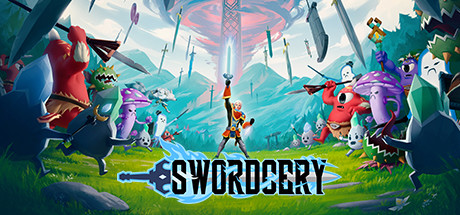
Swordcery is a rogue-lite, melee-based action RPG developed and published by Temple Door Games (a duo of ex-Sony Santa Monica animators). Set in the fantasy world of Armorial, the game begins when a colossal blade plunges from the heavens, shattering the land and raining enchanted swords across the kingdom. You play as Colt, an unlikely hero who gains the ability to wield these fallen blades. Armed with a growing arsenal of magical swords — each with its own unique Swordcery ability — you must fight through procedurally generated biomes, defeat corrupted enemies, and confront the Celestial evil at the source of the corruption.
The game blends fast-paced real-time combat with roguelite progression. Each run offers new sword discoveries, relic combinations, class upgrades, and shifting dungeon layouts. With full controller support, a chunky melee feel, and a vibrant pixel-art inspired art style, Swordcery is shaping up to be a standout indie action RPG when it releases on August 11, 2026.
Details Table
| Attribute | Value |
|---|---|
| Title | Swordcery |
| Developer | Temple Door Games |
| Publisher | Temple Door Games |
| Steam App ID | 1817030 |
| Release Date | August 11, 2026 |
| Price | TBA (Not Free) |
| Genre | Action, Indie, RPG |
| Subgenre | Rogue-lite, Melee ARPG |
| Platforms | Windows PC via Steam |
| Controller Support | Full (including DualShock) |
| Multiplayer | Single-player only |
| Languages | English (full audio) |
| Minimum Specs | Windows 10 64-bit, Intel Core i3, 4 GB RAM, GTX 960M, DirectX 10, 8 GB storage |
| Recommended Specs | Windows 10 64-bit, Intel Core i5, 8 GB RAM, GTX 1650, DirectX 10, 8 GB storage |
| Developer Team | Mike Henriet (animator, God of War), Don Thurakichprempri (animator, God of War / Call of Duty: Black Ops 3) |
| Composer | Adam Bow |
| Demo Available | Yes (Steam App ID 4747730) |
| Website | https://swordcerygame.com/ |
| Contact | [email protected] |
| Rating | USK 12 (Germany), DEJUS 10 (Brazil), IGRS 13 (Indonesia) |
| Steam Features | Family Sharing, Full Controller, Single-player |
Target Audience
Swordcery is designed for players who enjoy:
- Action roguelites like Hades, Dead Cells, or Enter the Gungeon
- Melee-focused combat with weighty hits, combos, and dodge-rolling
- Weapon discovery and experimentation — every sword plays differently
- Build-crafting via relics, upgrades, and Sword Class synergies
- Challenging boss fights with telegraphed attack patterns
- Procedural exploration — no two runs are the same
- Pick-up-and-play sessions with permanent meta-progression between runs
It appeals to both roguelite veterans and action-RPG fans looking for a tightly designed, sword-centric experience with a whimsical yet dangerous world.
Getting Started — 7 Essential Steps for New Players
Step 1: Play the Demo First
Swordcery has a free demo on Steam (App ID 4747730). The demo lets you experience the first few biomes, sample several sword classes, and get a feel for the combat flow. Progress from the demo does not carry to the full game, but the muscle memory and class knowledge you build will give you a huge head start.
Step 2: Bind Your Controls Comfortably
Default controls (keyboard + mouse):
| Action | Keybind |
|---|---|
| Move | WASD |
| Attack (Melee) | Left Click |
| Swordcery Ability | Right Click |
| Switch Sword | Q / E or Mouse Scroll |
| Quick Slots (Items) | 1–4 |
| Dodge Roll | Space |
| Interact | F |
| Menu / Pause | Escape |
With full controller support, a gamepad is strongly recommended for the analog movement and responsive dodge-rolling. The developers (both action-game veterans) tuned the controls to feel snappy on both setups — try both and choose what clicks.
Step 3: Understand Sword Classes, Not Just Swords
Every blade belongs to a Sword Class — a category that determines its moveset, combo strings, attack speed, range, and damage profile. A Greatsword-class weapon hits hard but swings slowly; a Rapier-class weapon is fast but does lower damage per hit. Your Sword Class determines your neutral-game options, while the sword's individual Swordcery ability adds a unique magical tool to your kit.
Do not judge a sword by its stats alone — its class dictates its combat rhythm, and its Swordcery may solve a problem you haven't encountered yet.
Step 4: Experiment with Every New Sword
The game rewards curiosity over optimization in the early game. A seemingly weak dagger found in a chest might have a Swordcery that stuns flying enemies or applies a DoT (damage-over-time) that shreds bosses. Swords you find in secret areas tend to have rarer abilities. Carry at least two swords at all times — one for horde clearing and one for single-target burst.
Step 5: Learn Enemy Telegraphs Immediately
Every enemy in Swordcery broadcasts its attacks with a visual or audio tell. The key differentiator from other action games is that enemy telegraphs are tight — the window between the tell and the hit is short. Your primary survival tool is the Dodge Roll (Space), which has generous i-frames when timed correctly.
- Small enemies: Quick, swarm-based, go down fast but punish greed
- Medium enemies: Slower, armored, require two or more hits to stagger
- Elite enemies: Health-gated phases, multi-hit combos, environment hazards
- Bosses: Multi-phase fights with new attack patterns unlocked at health thresholds
Step 6: Spend Essence Freely, but Strategically
Essence is the primary upgrade resource dropped by enemies. Use it at rest points to upgrade your swords' base stats (damage, attack speed, special damage). The game is balanced so that unupgraded swords fall off sharply by mid-game. If you're stuck on a boss, you probably have too much unspent essence.
A good rule: upgrade your main sword to at least tier 3 before entering a new biome. You can always find more essence, but you cannot clear harder content without spending it.
Step 7: Explore Every Corner
Procedurally generated dungeons in Swordcery include hidden rooms, breakable walls, and environmental puzzles. Look for:
- Cracked walls — destroy them with a charged attack
- Secret chests — often behind waterfalls or in alcoves
- Alternate paths — a branching dungeon may offer a relic instead of a sword
Exploration is the best way to find legendary-tier swords and rare relics that define your run's build.
Advanced Tips
| # | Mistake | Why It Hurts | What To Do Instead |
|---|---|---|---|
| 1 | Hoarding essence "for later" | Unupgraded swords deal pitiful damage mid-game; you hit a wall hard. | Spend essence at every rest point. Prioritize your primary sword. |
| 2 | Ignoring Sword Classes | Using a Greatsword like a Rapier (trading blows) gets you killed. | Learn the class moveset. Play to its range/speed strengths. |
| 3 | Dodge-rolling away from attacks | Many enemies have lunging attacks that punish backpedaling. | Roll into or through attacks. Abuse i-frames. |
| 4 | Carrying only one sword | You have no backup if your sword's class/speed is wrong for the encounter. | Always carry at least two swords. Swap mid-combo for mix-ups. |
| 5 | Skipping secret areas | You miss the best swords, relics, and essence caches. | Check for cracked walls, unusual geometry, and dead ends. |
| 6 | Mashing attacks | Many enemies have parry windows or damage-reflect auras. | Observe first, then commit. Punish recovery frames. |
| 7 | Ignoring the Swordcery cooldown | Your special ability is your strongest tool; using it off-cooldown without purpose wastes its potential. | Time your Swordcery for crowd control or burst windows. |
| 8 | Neglecting relic synergy | Relics amplify specific playstyles; picking randomly dilutes your build. | Read relic descriptions. Stack effects (e.g., fire damage + burn duration). |
Core Mechanics
1. Sword Classes — The Foundation of Combat
Every sword you find belongs to a Sword Class, which defines its fundamental moveset. While Temple Door Games has not published a full class list (more are added during development), confirmed class archetypes include:
| Sword Class | Playstyle | Strengths | Weaknesses |
|---|---|---|---|
| Greatsword | Slow, heavy hits with wide arcs | High stagger, big area damage, breaks armor | Slow recovery, leaves you open |
| Rapier | Fast thrusts, high mobility | Quick pokes, low commitment, high crit rate | Low per-hit damage, poor vs armor |
| Curved Sword | Balanced speed/range | Jack-of-all-trades, good crowd control | No standout advantage |
| Dagger | Extreme speed, short range | DPS monster up close, quick Swordcery charge | Requires proximity, no reach |
| Longsword | Standard versatile class | Reliable damage, good reach | Predictable, no gimmick |
Each Sword Class has a unique combo string (e.g., Light-Light-Heavy for a launcher, Heavy-Light for a gap closer). Master the combo rhythm of your equipped class to maximize DPS and control.
2. Swordcery Abilities — The Magic System
Each individual sword (not class) comes with a Swordcery — a unique magical ability tied to that specific blade. Examples confirmed by the developers:
- Boomerang Blade — Hurl your sword in a wide arc that returns to you, hitting enemies twice
- Thunderstrike — Transform into a bolt of lightning and crash down on enemies
- Hellfire Fissure — Open a fiery rift in the ground that deals damage-over-time to enemies in a line
- Icy Swordflakes — Summon a ring of protective frozen swords orbiting you, damaging nearby enemies and slowing them
Swordcery abilities are activated with Right Click (or mapped controller button) and have a cooldown. The cooldown varies per sword. Some Swordcerys are offensive, some are defensive, and some provide mobility. Your Swordcery defines your "oh-@#$%" button — learn each one's timing and use case.
Swordcery abilities can be upgraded using essence to reduce cooldown, increase damage, add secondary effects, or extend duration.
3. Combat System — Dodge, Combo, Adapt
Swordcery's combat is built around three pillars:
-
Reactive Defense: The Dodge Roll (Space) has generous invincibility frames. You can roll through enemy attacks, projectiles, and even some boss-wide AoEs. The game rewards learning enemy patterns and punishing recovery frames rather than trading blows.
-
Combo Strings: Each Sword Class has light and heavy attack chains. Mixing light and heavy inputs creates different combo enders (launchers, knockdowns, gap closers, knockbacks). Experiment with input timing — delaying an attack can change the combo route.
-
Resource Management: You must manage both your health (limited healing between rest points) and your Swordcery cooldown. There is no stamina bar, so aggression is limited only by your health pool and your ability to dodge.
4. Relics — Build-Defining Passives
Scattered throughout each run are Relics — passive items that modify your character's stats and abilities. Examples include:
- Burning Heart: Your Swordcery applies a burn DoT
- Crystal Shell: Taking damage releases a shrapnel burst
- Windwalker: Dodge Roll leaves a damaging trail
- Essence Thief: Kills restore a portion of Swordcery cooldown
Relics stack, and certain combinations create powerful synergies. A build centered on fire relics + a fire-element sword can melt bosses, while a defensive relic build paired with a Greatsword makes you a slow-moving tank.
5. Procedural Dungeons and Meta-Progression
Each run takes you through a series of procedurally generated biomes (themed environments like forests, caverns, celestial ruins). Between biomes, you find:
- Rest Points — spend essence on sword upgrades, heal
- Merchants — trade essence for relics or new swords
- Challenge Rooms — risk-reward encounters for bonus loot
The permanent meta-progression carries over between runs:
- Account-wide essence unlocks new sword classes in the pool
- Discovered swords get added to future run loot tables
- Character upgrades (health, dodge distance, starting essence) improve baseline power
Death sends you back to the beginning, but every run — win or lose — progresses your account.
Advanced Strategies
1. The Two-Sword Dance
Master switching between two complementary Sword Classes mid-combo. Example: Engage with a Greatsword's heavy slam to break armor, instantly switch to a Dagger for a flurry of critical hits while the enemy is staggered. This requires memorizing both classes' combos and having a quick finger on the weapon-swap key (Q/E or Scroll Wheel). The payoff is burst damage that neither sword could achieve alone.
2. Relic Stacking for Build Identity
Do not pick relics randomly. By the third biome, you should know your build direction:
- Burn Build: Fire-element sword + Burning Heart + Essence Thief + any "+burn damage" relics
- Glass Cannon: High crit relics + Rapier/Dagger + damage-only Swordcery
- Tank/Sponge: Defense relics + Greatsword + lifesteal Swordcery + Crystalline Shell
Stacking 3+ relics of the same family creates exponential power spikes. A single relic is nice; three of the same type can trivialize encounters.
3. Boss Pattern Punishment Windows
Each boss in Swordcery follows a strict pattern cycle. The advanced technique is to identify the punishment window — the recovery after the boss's longest combo. Example pattern:
- Boss telegraphs (lift arm / glow / roar)
- Boss attacks (3-hit combo or AoE blast)
- Boss recovery (1–2 seconds of vulnerability)
Do NOT attack during phase 1 or 2 unless you are using a Swordcery. Wait for phase 3, then unleash your full combo + Swordcery. As the boss's health drops, phases may change (new attack added, recovery window shortened). Adjust accordingly.
4. Essence Economy Management
Advanced players plan their essence spending across the run:
- Biome 1: Spend 70% of essence on your primary sword (tier 2–3)
- Biome 2: Spend 50% on your secondary sword; save 50% for relic purchases
- Biome 3+: Spend all essence; you will find more before the boss
This ensures you are never underpowered for the current biome while retaining flexibility to pivot builds.
5. Environmental Awareness
Many arenas have interactive elements: explosive barrels, collapsing pillars, elemental pools, and grindable rails. Learn to kite enemies into hazards. A Hellfire Fissure Swordcery used near an oil pool creates a larger burn zone. A Thunderstrike aimed at a water surface electrifies a wider area. The environment is a force multiplier — use it.
FAQ
Q: When is Swordcery releasing? A: The full release is set for August 11, 2026 on Steam.
Q: Will Swordcery come to other platforms? A: Currently planned for Windows PC only. No Mac, Linux, or console versions have been announced.
Q: Is Swordcery a roguelike or roguelite? A: Roguelite — you keep permanent meta-progression between runs (unlockable sword classes, account-wide upgrades). Each run itself is procedural and death resets your gear.
Q: How many swords are in the game? A: Temple Door Games has hinted at dozens of unique enchanted swords, each with its own Swordcery ability and class identity. More are expected post-launch.
Q: Is there a demo? A: Yes! A free demo is available on Steam (App ID 4747730). It covers the first few biomes and a selection of swords and relics.
Q: Does the demo progress carry over to the full game? A: No — demo progress is separate from the full game's save data. However, the experience and knowledge gained transfer directly.
Q: What makes Swordcery different from other roguelite action games? A: The dual-layer weapon system (Sword Class + Swordcery ability) means every sword changes both your basic attacks AND your special move. This creates far more build diversity than games where weapons only change damage stats. Additionally, the celestial rain of swords mechanic is a unique narrative and gameplay hook.
Q: Does Swordcery support controllers? A: Yes, full controller support including DualShock controllers is confirmed. A gamepad is recommended.
Q: Who is developing Swordcery? A: Temple Door Games — a two-person indie studio in Los Angeles, CA. Co-founders Mike Henriet and Don Thurakichprempri previously worked as animators on God of War (Sony Santa Monica). Composer Adam Bow, from New Zealand, provides the soundtrack.
Q: Is Swordcery multiplayer or co-op? A: No — it is strictly a single-player experience.
Q: What are the PC system requirements? A: Minimum: Windows 10 64-bit, Intel Core i3, 4 GB RAM, NVIDIA GTX 960M, DirectX 10, 8 GB storage. Recommended: Intel Core i5, 8 GB RAM, NVIDIA GTX 1650.
Q: Will there be more content after launch? A: The developers have mentioned plans for post-launch content, including new swords, classes, and biomes, though specific DLC plans have not been detailed.
Q: What is the story about? A: A giant Celestial blade has pierced the world of Armorial, raining swords down endlessly and draining the planet's energy. You play as Colt, a hero who can wield these enchanted blades, and must defeat the Celestial evil responsible for the corruption.
Q: Is there difficulty scaling? A: The game does not have explicit difficulty modes, but the procedural nature of runs means some runs are naturally harder (bad relic RNG, unfavorable biome order). Meta-progression serves as the difficulty equalizer.
Final Tip & Verdict
Final Tip: Treat every run as a learning experience, not a win-or-lose sprint. The first few hours of Swordcery are about building your mental library of Sword Classes, Swordcery abilities, enemy patterns, and relic synergies. A failed run where you discovered a new sword or learned a boss's phase-two attack is a success. The meta-progression ensures you are always getting stronger, even when a run ends early.
Verdict: Swordcery is shaping up to be a must-play for fans of action roguelites. Its innovative dual-layer weapon system — where every sword changes both your melee moveset and your magical ability — creates a depth of buildcrafting rarely seen in the genre. Backed by a talented team with AAA pedigree and a soundtrack that channels classic adventure game energy, it is one of the most anticipated indie ARPGs of 2026. Wishlist it on Steam, play the demo, and prepare to master the art of Swordcery.
Guide written for game-howto. Data sourced from Steam Store API (App ID 1817030), official website (https://swordcerygame.com/), and developer materials from Temple Door Games. Based on pre-release build and demo (App ID 4747730). Details subject to change upon full release on August 11, 2026.