Official game
Play Settler's Domain
This game is hosted by Steam. Continue to the official page to play or download it.
Buy on Steam — $12.49Overview / Game Introduction
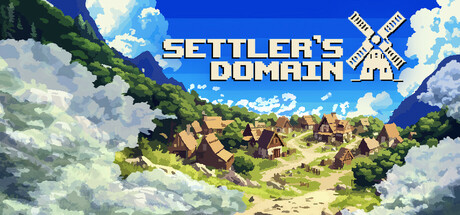
Settler's Domain is a strategy settlement-builder where you lead a fledgling group of settlers into an unknown, procedurally generated wilderness and build a thriving community from scratch. Developed over nearly two years by solo indie developer rick, the game combines classic city-building fundamentals — resource gathering, population management, construction, and research — with a dynamic diplomacy system that pits you against AI-controlled rival settlements.
Unlike many city-builders that focus purely on economic optimisation, Settler's Domain forces you to juggle internal stability (food, housing, morale, health) alongside external threats (rival settlements competing for the same resources, seasonal hardship, and territorial pressure). Every decision — from where you place your Town Hall to which diplomatic stance you take with a neighbour — has lasting consequences.
Settler's Domain launched on Steam on August 21, 2026 for $12.49 (the free Steam demo, AppID 3501740, remains available if you want to try before buying). The full game includes a large tech tree, deeper diplomacy mechanics, and more content than the demo offers.
| Detail | Info |
|---|---|
| Genre | Strategy / City-Builder / Settlement Management |
| Developer | rick (solo indie developer) |
| Publisher | rick |
| Platform | Windows (Steam) |
| Price | $12.49 (free demo available) |
| Players | Single-player (AI rival settlements) |
| Engine | Custom (Vulkan 1.2, x86_64 with SSE4.2 or ARMv8) |
| Release Date | August 21, 2026 |
| Demo Available | Yes (free, Steam AppID 3501740) |
| Steam Rating | Mixed — 57 of 87 reviews positive (as of September 2026) |
| Achievements | 26 |
| File Size | ~300 MB |
| Difficulty | Medium — accessible to city-builder newcomers but punishing if you neglect resource planning or diplomacy |
| Session Length | 1–3 hours per playthrough, highly replayable via procedural maps |
Target audience: This game is for you if you enjoy settlement-builders like Banished, Foundation, or Going Medieval but wish they had more emphasis on inter-settlement diplomacy and reactive AI neighbours. It also appeals to fans of indie survival-strategy games where resource scarcity is a real threat and every winter tests your preparation. If you prefer pure sandbox building with no external pressure, the rival-AI system may feel adversarial — but for players who like a living, reactive world, that tension is exactly the appeal.
Getting Started — First 30 Minutes
Your First Launch
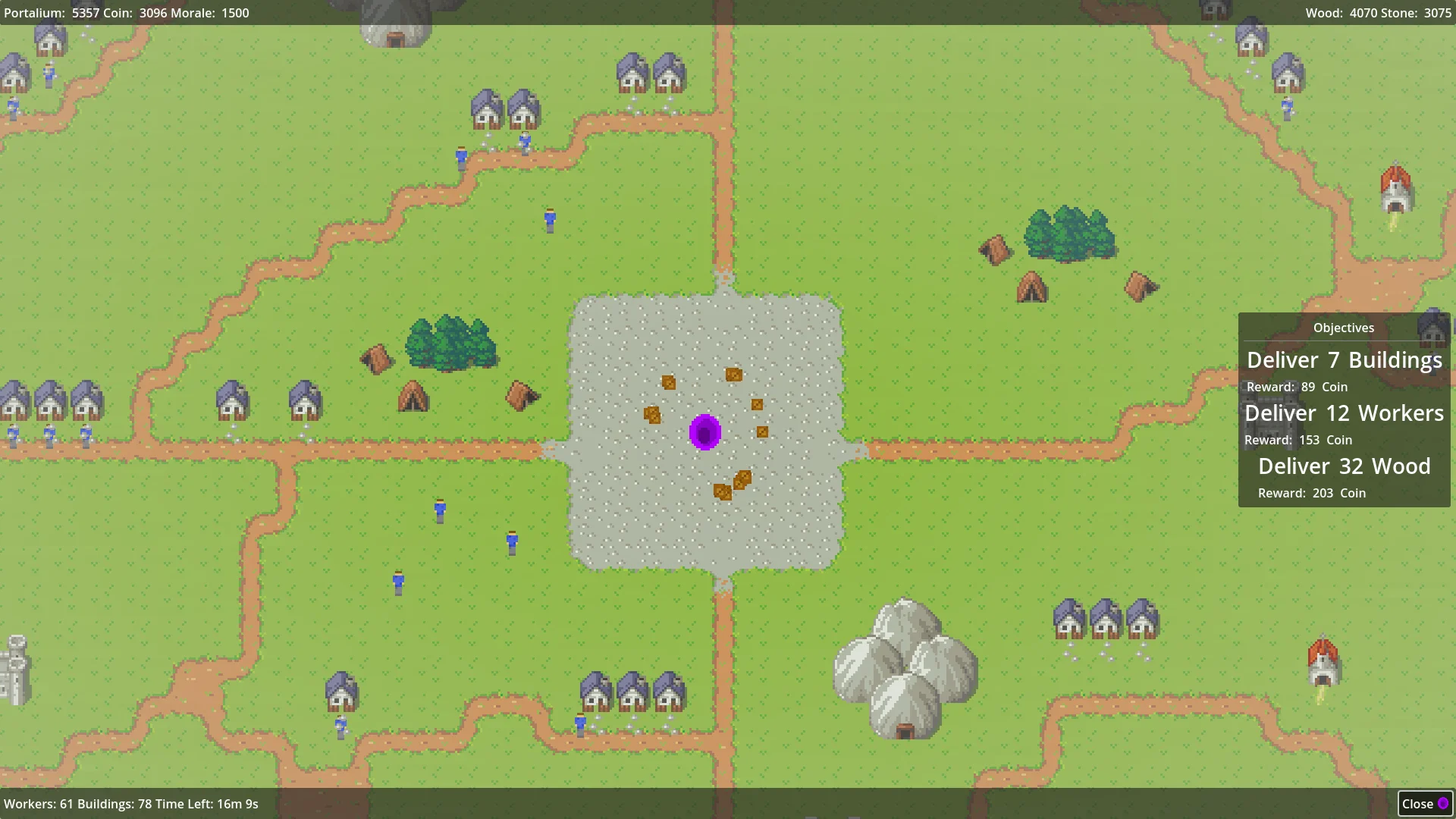
When you start Settler's Domain, you're greeted with a top-down view of a wild, forested map shrouded in fog of war. You begin with a small group of settlers — maybe 5–8 individuals — and a handful of starting resources. There is no tutorial overlay, so the game trusts you to explore and figure things out. The first critical step is picking a location for your Town Hall, the heart and command centre of your settlement.
Choosing Your Town Hall Site
Before placing anything, scout first. Use your initial settlers to explore the immediate vicinity. Look for:
- Proximity to water — settlers need drinking water, and some advanced buildings require water access.
- Forest coverage — wood is your primary early-game construction material. Being near trees cuts haul times dramatically.
- Stone deposits — visible as rocky outcrops on the map. You'll need stone for upgraded walls, roads, and advanced buildings.
- Flat terrain — building on slopes is possible but inefficient. Flat ground costs fewer resources to develop.
- Distance from rival settlements — the game places 2–4 AI settlements on the map. Placing your Town Hall too close to one invites early raids and territorial disputes.
Once you're satisfied, place the Town Hall. Your settlers immediately begin hauling the initial supplies toward it.
The First Build Order
Resources are scarce at the start. Spend them wisely. A solid opening sequence:
- Woodcutter's Hut (or equivalent gatherer building) — you need a steady trickle of wood before anything else.
- Houses (2–3) — your starting settlers need shelter. Without enough housing, population growth stalls and morale drops.
- Stockpile / Storage Yard — raw resources left on the ground degrade slowly. A storage building prevents loss.
- Gatherer's Hut / Forager — food is your second-most-critical resource after wood. Early food security is non-negotiable.
- Scout Post — unlocks the ability to send settlers beyond the immediate fog of war, revealing resource nodes, abandoned structures, and your neighbours.
What to Do in the First 30 Minutes
| Time | Goal | Why |
|---|---|---|
| 0–5 min | Scout area, place Town Hall | Foundation of your entire run |
| 5–10 min | Build Woodcutter's Hut + Houses | Secure basic resources and shelter |
| 10–15 min | Build food production + storage | Avoid starvation before first winter |
| 15–20 min | Assign settler roles | Specialisation boosts efficiency |
| 20–25 min | Build Scout Post, start exploring | Reveal map, find neighbours and resources |
| 25–30 min | Research first tech upgrade | Unlock better buildings or tools |
Controls Reference
| Action | Input |
|---|---|
| Move Camera | WASD / Arrow Keys or Right-click drag |
| Zoom | Scroll Wheel |
| Select Unit | Left Click |
| Move Unit | Right Click on destination |
| Build Menu | B |
| Open Town Hall Panel | H |
| Pause / Resume | Space |
| Game Speed | 1 (normal), 2 (fast), 3 (very fast) |
| Center on Town Hall | Space (double-tap) |
| Escape Menu | Escape |
Advanced Tips
Even experienced city-builder players can stumble on Settler's Domain's specific timing and pressure points. Here are the most common pitfalls and how to avoid them.
| Mistake | Why It Hurts | How to Fix |
|---|---|---|
| Placing Town Hall without scouting | You commit to a spot that may lack water, forests, or stone — forcing long resource hauls all game. | Spend the first 2–3 minutes exploring before placing anything. |
| Ignoring housing | Population growth stops, and existing settlers become unhappy, reducing work efficiency. | Build at least 1 house per 3 settlers in the first 10 minutes. |
| No food storage before winter | Excess food rots without a granary. Winter cuts food production by ~50%, so you need reserves. | Build a Granary or Food Storage before the end of autumn (around minute 20–25). |
| Making all settlers generalists | A settler who splits time between gathering and building does both poorly. Specialisation yields big efficiency bonuses. | Assign dedicated roles early: builders build, foragers forage, soldiers train. |
| Over-expanding too fast | Each new building and outpost stretches your defence line and resource network. Rival settlements raid weakly defended expansions. | Expand in controlled bursts. Fortify chokepoints before building outward. |
| Neglecting scouting | You have no idea where rivals are, what resources exist, or where danger lurks. Surprise raids hurt more when unprepared. | Build a Scout Post early and keep at least 1–2 settlers exploring constantly. |
| Hoarding Influence | Influence is used to recruit new settlers. Sitting on a full pool caps your growth. | Spend Influence to recruit settlers whenever your food and housing can support them. |
| Trading away strategic resources | Selling stone for gold is tempting, but you'll need stone for walls later. Trade surpluses, not essentials. | Only trade resources you have a steady surplus of. Never trade food. |
Core Mechanics
1. Resource Economy — The Four Pillars
Settler's Domain has four primary resources, each with distinct roles and pressures.
Wood — The backbone of early construction. Used for houses, workshops, walls, and tools. Wood is abundant in forested areas but depletes locally — you'll need to expand logging operations or research forestry upgrades as your settlement grows. Wood also fuels fires for heating in winter.
Stone — Required for advanced buildings, defensive walls, paved roads (which speed up settler movement), and upgrades. Stone is heavier and slower to transport than wood. A settlement near stone deposits has a massive early advantage. Stone can be quarried, and some abandoned structures on the map can be dismantled for stone.
Food — The non-negotiable survival resource. Every settler consumes food daily. Consumption rises in winter. Food comes from foraging, hunting, farming (once unlocked), and fishing (if near water). A food deficit triggers starvation, which kills settlers and crashes morale. Never let food drop below a two-season buffer.
Gold / Wealth — Used for trade, bribes, and certain high-tier buildings. Gold is generated through trade surpluses, taxing settlers (at a morale cost), and discovering treasure stashes while exploring. Gold is not essential for survival but unlocks diplomatic and economic advantages.
Pro tip: Resources left on the ground slowly degrade. Always build dedicated storage buildings (Wood Pile, Stone Yard, Granary) within the first 15 minutes.
2. Population & Influence System
Settler's Domain does not use a simple "houses = population" model. To grow your population, you must spend Influence — a secondary resource generated by your Town Hall and certain buildings.
How Influence works:
- Influence passively accumulates from the Town Hall and from morale-boosting buildings (taverns, shrines, markets).
- You spend Influence to recruit new settlers. Each recruit costs a fixed Influence amount, which scales up as your population grows.
- Recruited settlers arrive at your Town Hall after a short delay. They are adults ready to work.
Population limits:
- Each house supports a certain number of settlers. Overcrowding (more settlers than housing capacity) reduces morale and slows work speed.
- Homeless settlers will eventually leave the settlement, wasting the Influence you spent to recruit them.
Morale is a hidden-but-visible stat (shown as a smiley face icon in the UI). High morale boosts work speed, reduces the chance of settlers leaving, and generates bonus Influence. Low morale (caused by hunger, overcrowding, high taxes, or losses in battle) reverses these effects and can trigger a death spiral.
3. Exploration & the Procedural World
The map is procedurally generated each playthrough, meaning no two games play the same. The world is divided into two layers:
Revealed terrain — the area around your Town Hall and wherever your settlers have walked. This is safe and buildable.
Fog of war — covers the rest of the map. You must send scouts or explorers to reveal it. Behind the fog you can find:
- Resource clusters — dense forests, stone quarries, fertile soil for farming, hunting grounds.
- Abandoned structures — ruins that can be scavenged for resources or repaired and claimed.
- Rival settlements — AI towns with their own populations, militaries, and diplomatic dispositions.
- Special landmarks — shrines, caves, and other points of interest that provide buffs or lore.
- Danger zones — wolf packs, bandit camps, or hostile terrain that damages settlers.
Exploration is not optional. If you turtle inside your starting area, you will run out of resources. The game actively encourages outward expansion.
4. Research & Tech Tree
Your Town Hall grants access to a research panel where you can unlock new buildings, upgrades, and abilities. Research costs resources (usually wood + stone, later gold) and takes time proportional to the complexity of the tech.
Notable tech branches include:
| Branch | Unlocks | Priority |
|---|---|---|
| Agriculture | Farms, irrigation, crop rotation | High — food security |
| Defence | Palisade walls, watchtowers, barracks | Medium-High — needed if rivals are aggressive |
| Industry | Sawmill, stonecutter, forge | Medium — boosts resource throughput |
| Diplomacy | Trade post, embassy, tribute system | Medium — unlocks trade and alliances |
| Medicine | Herbalist hut, apothecary, hospital | Low-Medium — needed after population booms |
| Culture | Tavern, shrine, market square | Low — morale and Influence generation |
Prioritise Agriculture and Defence in your first playthrough. A fed, defended settlement can always pivot into industry and culture later.
5. Diplomacy & Rival Settlements
The AI-controlled settlements on the map are not static set pieces — they have their own economies, military forces, and diplomatic personalities. Each rival has a disposition meter that shifts based on your actions.
Diplomatic actions available:
- Trade — exchange goods (wood, stone, food, gold) at mutually agreed rates. Trade improves relations.
- Alliance — a formal pact. Allied settlements share vision of explored areas and will aid you if attacked. Alliances require high disposition.
- Tribute — pay resources to improve relations without a formal trade. Useful for buying time.
- Threaten / Demand — demand tribute or territory. High risk, high reward — if your military is stronger, they may comply. If not, expect war.
- Declare War — full military conflict. Siege weapons, raids, and territorial captures.
What affects disposition:
- Expanding too close to a rival's borders (territorial friction)
- Raiding their caravans or outposts
- Forming alliances with their enemies
- Trading favourably (improves relations)
- Offering gifts or tribute (improves relations)
Key insight: It's often better to have one strong ally and one neutral neighbour than to be at war with everyone. Pick your diplomatic battles carefully.
Advanced Strategies
Once you've survived your first few winters and have a stable economy, it's time to think about winning — whether that means economic dominance, military conquest, or a balanced approach.
1. The River Start (Optimal Opening)
If your procedural map generates with a river running through or near your starting area, build your Town Hall on the riverbank. Rivers provide:
- A natural defensive barrier on one side (enemies cross slowly)
- Access to fishing (reliable year-round food)
- Faster movement for boats/rafts if those techs are unlocked
- Irrigation bonuses for farms adjacent to the river
This start is so advantageous that some players restart until they get a river spawn. It's not strictly necessary, but it makes the first winter significantly easier.
2. Defensive Layering
Rival AI settlements become more aggressive as you grow. A single palisade wall won't cut it in the mid-game. Build in layers:
- Outer perimeter — basic palisade or wooden wall. Slows enemies down, gives you time to react.
- Kill zone — a gap between outer and inner walls where your archers/towers can fire down. No buildings here — let the enemy soak damage.
- Inner wall — stone wall (researched). Your last line of defence. Behind this wall: your Town Hall, granary, and最关键 civilian buildings.
Place watchtowers at overlapping intervals so no section of wall is undefended. A single tower with a 360° field of fire is less effective than two towers covering each other's blind spots.
3. Specialisation Is Everything
In the early game, your settlers are jacks-of-all-trades by necessity. By mid-game, you should have a fully specialised workforce.
| Role | Buildings Needed | Benefit |
|---|---|---|
| Forester / Woodcutter | Woodcutter's Hut, Sawmill | +40% wood output per specialist |
| Farmer | Farm, Granary, Irrigation | +50% food output, winter-resistant strains |
| Builder | Workshop, Tool Shed | Faster construction, ability to build advanced structures |
| Soldier | Barracks, Armoury, Watchtower | +60% combat effectiveness |
| Merchant | Trade Post, Market | Better trade rates, passive gold generation |
| Scholar | Library, Laboratory | Faster research speed |
A common mistake is keeping all settlers as "workers" who do whatever is needed. The efficiency gains from specialisation compound over time — a fully specialised mid-game settlement produces 2–3x more per capita than a generalist one.
4. Diplomatic Manipulation
You can manipulate rival settlements without spending a single resource on war. The key is divide and conquer:
- Find the weakest rival early (smallest territory, fewest buildings visible via scout).
- Trade favourably with them to build a positive disposition.
- Offer an alliance once disposition is high enough.
- Use your ally's border proximity to pressure your other neighbours. An ally's territory on one side means one fewer front to defend.
- Turn your ally against a common enemy by feeding them intel or resources. They'll weaken each other while you build up.
This approach lets you grow economically while your rivals exhaust each other. You can then swoop in diplomatically or militarily when they're weakened.
5. Winter Is a Weapon
Winter in Settler's Domain isn't just something you survive — it's something you can weaponise. Here's how:
- Stockpile for two seasons, not one. Your rivals also suffer in winter. A well-stocked settlement can wait out a siege while the attacker's army starves.
- Launch attacks in early winter. Enemy armies move slower in snow, and their food supply chains falter. If you've prepared (warm clothing tech, heated barracks), your soldiers fight at near-full strength while enemies are debuffed.
- Blockade trade routes before winter. If a rival relies on imported food, cutting their trade routes right before winter is effectively a death sentence for their population.
6. Endgame Win Conditions
Settler's Domain does not have a single victory condition — or at least, none imposed by the game itself. Players define their own win state. Common endgame goals include:
- Economic Victory: Become the wealthiest settlement with the largest trade network. All rival settlements depend on your goods.
- Military Victory: Conquer or vassalise all rival settlements on the map.
- Population Victory: Grow your settlement to a target population (e.g., 200 settlers) with full employment and high morale.
- Tech Victory: Unlock every research node in the tech tree.
- Survival Victory: Survive X number of years (seasons) with zero settler deaths.
System Requirements (Official, from Steam)
| Component | Minimum |
|---|---|
| OS | Windows 10 (64-bit) |
| Processor | x86_64 with SSE4.2 or ARMv8 — Intel Core i5-6600K / AMD Ryzen 5 1600 / Snapdragon X Elite |
| Memory | 4 GB RAM |
| Graphics | Vulkan 1.2 — NVIDIA GeForce GTX 1050 (Pascal) / AMD Radeon RX 460 (GCN 4.0) |
| Storage | 300 MB available space |
Steam lists only one official requirements tier — the game is lightweight by modern city-builder standards. Any desktop from the last decade with a GTX 1050-class GPU runs it comfortably, and the 300 MB footprint makes it one of the smallest games in the genre. There is no native macOS or Linux build; the ARMv8/SSE4.2 processor note and Vulkan 1.2 renderer are unusually modern for an indie strategy game.
FAQ
Q: When did Settler's Domain release? A: The full game launched on Steam on August 21, 2026 for $12.49.
Q: Is there a demo? A: Yes! The free Settler's Domain Demo is available on Steam (AppID 3501740). It gives you a representative experience with limited structures and resources unlocked.
Q: How much does Settler's Domain cost? A: The full game costs $12.49 on Steam. The pre-launch plan was a free release, but the shipped version is a paid title with a free demo — try the demo first if you're on the fence.
Q: What platforms are supported? A: Windows only at launch (requires 64-bit, Windows 10+, Vulkan 1.2 compatible GPU). The developer has not announced Mac or Linux support.
Q: Is there multiplayer? A: No. Settler's Domain is single-player only. The "other settlements" are controlled by the AI.
Q: How long is a playthrough? A: A single game typically lasts 1–3 hours, depending on your play style and chosen win condition. Procedural generation gives it high replay value.
Q: Who is developing this game? A: Solo indie developer rick, who has been working on the game for nearly two years.
Q: What are the minimum specs? A: Windows 10, x86_64 with SSE4.2 or ARMv8 (e.g., Intel Core i5-6600K / AMD Ryzen 5 1600 / Snapdragon X Elite), 4 GB RAM, NVIDIA GeForce GTX 1050 or AMD Radeon RX 460, 300 MB storage. See the full requirements table above.
Q: Will there be mod support? A: The developer has not confirmed mod support at launch. The community is active on the Steam forums requesting it.
Q: I'm stuck — where can I get help? A: Contact the developer at [email protected] or check the Steam community forums for Settler's Domain.
Final Tip & Verdict
Final tip: The single most important skill in Settler's Domain is timing your expansion with the seasons. Never start a major building project in autumn — it won't finish before winter, your settlers will work slower in the snow, and you'll waste resources. Plan construction in spring and summer, stockpile food and wood in autumn, and use winter for exploration, research, and diplomacy. If you master the seasonal rhythm, everything else falls into place.
Verdict: Settler's Domain is a remarkable achievement for a solo developer — a polished, deeply engaging settlement-builder that rewards careful planning and punishes reckless expansion. It doesn't reinvent the city-builder genre, but it refines the formula with smart systems (Influence-based population, procedural diplomacy, meaningful seasons) into a tight, satisfying package. At $12.49 with a free demo, it's an easy purchase to justify.
If you're a fan of Banished, Foundation, or Going Medieval, this is an easy recommendation. Play the free demo to get a feel for the rhythm, then grab the full game on Steam — your new settlement awaits.