Official game
Play Rustown
This game is hosted by Steam. Continue to the official page to play or download it.
Buy on SteamOverview
Rustown is a story-driven stealth adventure from the Korean indie studio Plotrick, launching June 30, 2027 on Steam, Microsoft Store, and Xbox Series. You play Jian, a young woman whose father caught the "idiot virus" during a global pandemic. The infection gutted his memory and intelligence, and then he disappeared. Three years after he vanished, a letter from him arrives at her door, postmarked from Rustown: a slum built by the infected, who were cast out of normal society as their minds declined. Beyond the reach of any authority, it is a lawless place where gangs of the uninfected clash with gangs of the infected. Jian goes in to find him.
The game's identity comes from three design commitments. First, stealth is built on observation and timing, not reflexes: Steam officially lists Rustown as "Playable without Timed Input," so no progress gate requires twitch execution. Second, Jian carries no weapons and shows no interest in gathering any. Every hazard is solved by watching, planning, manufacturing an opening with tricks and tools, and moving through it. Third, the city itself is the puzzle: a vertically layered quarter-view world of rooftops, basements, and building ledges where broken infrastructure means the direct route rarely exists.
This is a game for players who want stealth as problem-solving rather than action, and for players who care why they are sneaking. The infected are not monsters. They are neighbors with damaged minds, and the story treats them that way.
| Detail | Info |
|---|---|
| Developer / Publisher | Plotrick |
| Genre | Story-driven stealth adventure, environmental puzzles |
| Release | June 30, 2027 (announced at ID@Xbox Fall 2026 x IGN) |
| Platforms | Windows (Steam, Microsoft Store), Xbox Series |
| Perspective | Quarter-view, vertically layered 3D city |
| Players | Single-player |
| Combat | None. Jian is unarmed by design |
| Accessibility | Playable without Timed Input, Save Anytime, full controller support, custom volume controls |
| Minimum specs | Windows 10, Core i3-2100, 4 GB RAM, Intel HD 4000, 4 GB storage |
The Story Setup and What It Means for Play
The official premise: five years after the pandemic, society quarantined the cognitively impaired as "half-wits" and Rustown formed where they gathered. Jian's father was infected, went missing, then sent a letter. Two mysteries drive the whole game, and both shape how you should play.
Mystery one: the letter itself. A man with severe cognitive decline sent a coherent letter after three years of silence. That impossibility is the narrative engine. Expect clues about his condition, his location, and who helped him write it.
Mystery two: the city's factions. Rustown sits between armed groups. On one side, a vigilante organization that claims to keep the infected contained. On the other, Blue Fence, which blocks the uninfected from approaching the town. The preview build also shows ordinary thugs harassing infected residents, even on the train into the city. Faction territory is therefore your real difficulty map: where one group's authority ends and another's begins determines who watches for you and why.
A third fact matters more than players will expect: Jian claims to be immune. The details stay unclear early on, but immunity changes her relationship with every faction, because each one has a different use for someone who cannot be infected. Watch how characters react to her, not just to each other.
Getting Started
First session priorities
Rustown launches mid-2027, so the plan below is built from confirmed mechanics: observation-first stealth, manufactured openings, vertical traversal, and clue-chasing across faction territory. Work these in order on day one:
- Learn how the game shows you danger. Sightlines, audio cues, and patrol rhythm are the three signals every stealth system runs on. The opening area teaches them; do not skip or rush it, because every later district assumes you speak this language.
- Save before every approach, not after every success. Save Anytime is strongest used as a pre-commitment checkpoint. Drop a save where a route starts. If the plan collapses, you lose seconds, not progress.
- Map the vertical layering before you move through it. Roofs, ledges, and basements exist to bypass ground-level watchers. When you enter a new area, spend two minutes identifying the high route and the low route before committing to either.
- Talk to everyone between infiltrations. This is a clue-driven story game. Residents hand out the background that turns scattered clues into a picture, and in a city of factions, knowing who belongs where is survival information.
- Refrain from optimizing. The story is the game. A rushed first playthrough that skips conversations defeats the purpose of the stealth.
Beginner mistakes to avoid
- Moving on a schedule instead of a signal. New stealth players move when they feel it has been long enough. Rustown's loop is observe, choose your moment, move. The moment is something you see, not something you count.
- Retrying by going faster. If a section fails, the fix is almost never more speed. Watch longer, find the tool you missed, or take the detour you dismissed.
- Ignoring the environment between A and B. The quarter-view city rewards players who read clutter. A stack of crates, a broken sign, a ledge: all of it is either a route or a hiding spot.
- Treating being spotted as total failure. In a story game, a failed sneak changes how people behave, which is information. Note who reacted and where they came from; that is free intel for attempt two.
- Forgetting Blue Fence hates you specifically. You are uninfected. Whatever the vigilantes' rules are, Blue Fence's job is keeping people like Jian out, so their territory operates under different logic than everyone else's.
Core Mechanics Explained
The stealth loop: observe, choose, move
The official description lays out three verbs and they define every encounter. Observe your surroundings first: guard positions, patrol paths, and where the watchful eyes actually point. Choose your moment: movement is about windows, not speed, and the no-timed-input designation means those windows are generous or have alternatives. Stay hidden as you slip past: getting seen is the failure state the loop exists to avoid.
The practical skill being tested is information gathering. A player who watches a patrol for ninety seconds moves through once. A player who watches for ten seconds retries five times. Watch first, always.
Manufactured openings
The second layer is explicit in the store copy: "Use tricks and tools to create openings, then make smart decisions to put your plan into action." Parse that sentence carefully, because it describes a strict sequence:
- When no safe window exists, you create one. Distractions, tools, and environmental tricks exist specifically to make a moment that was not there.
- The trick fires before you move. An opening is the start of your plan, not the plan itself.
- What you do during the opening is where the play happens. The description says "smart decisions," which means the window has more than one right answer and timing your route through it is the actual test.
The discipline this rewards: trigger distractions only when you are already positioned to exploit them. A thrown stone that opens a gap you are ten seconds away from reaching is a wasted tool.
The vertical city
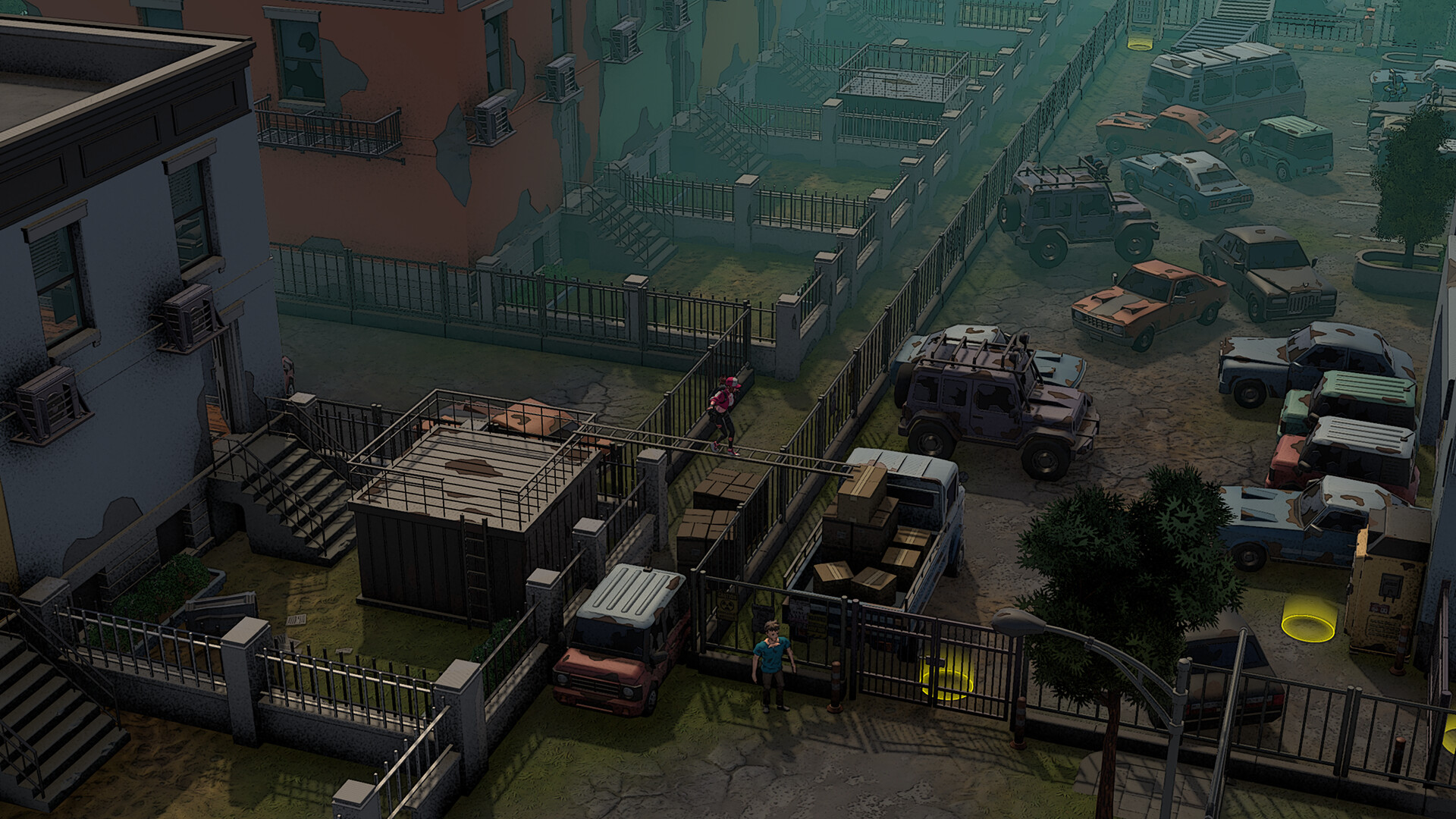
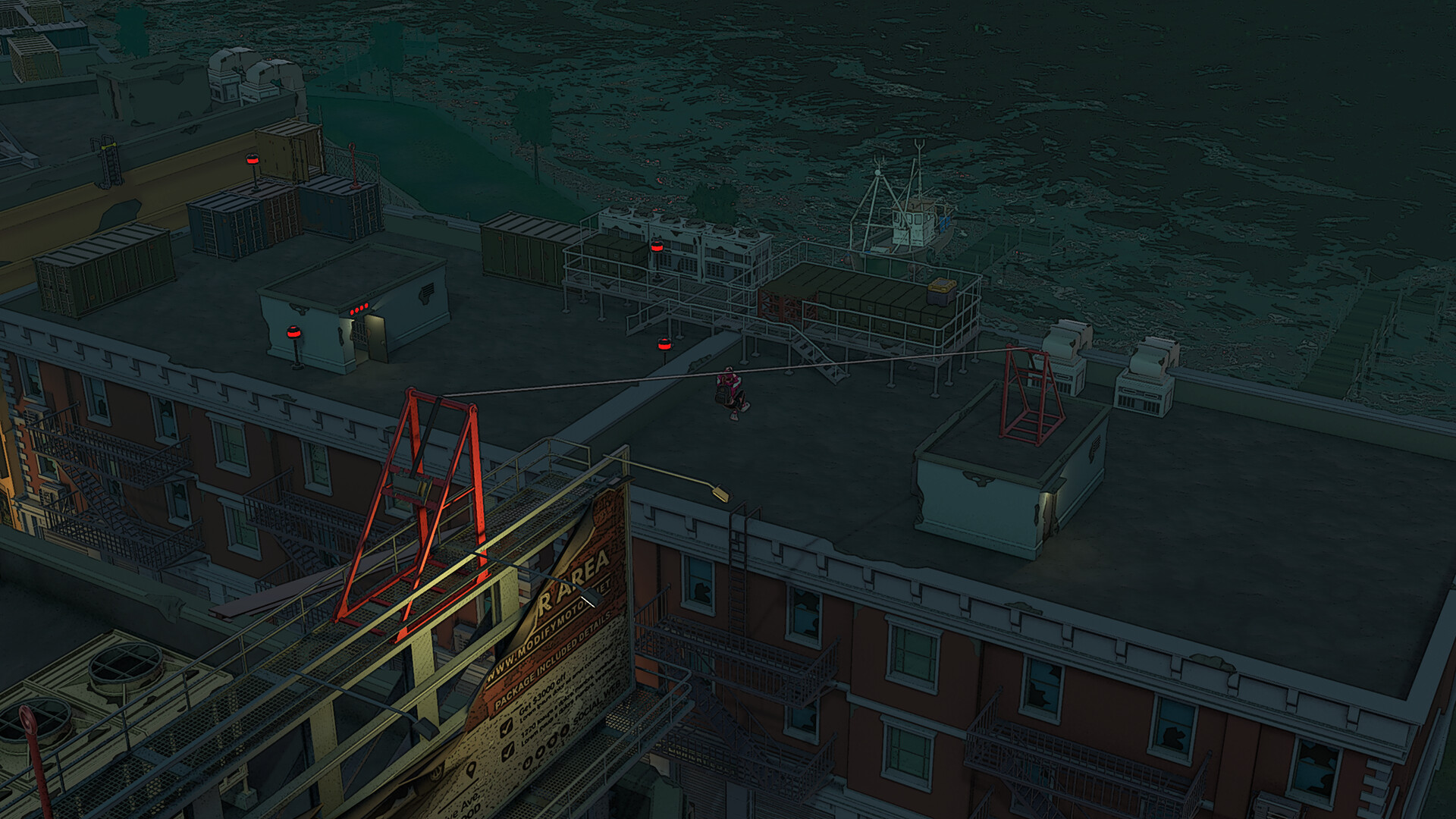
The quarter-view perspective is not just presentation. Preview coverage of the BIC 2026 demo describes a city in infrastructural collapse: roads broken and disconnected, buildings that must be crossed through rooftops, basements, and ledges, with shortcuts forged by reading the geometry. Most residents are cognitively impaired, so nobody fixed anything.
That makes route-planning a core verb. The direct street route is usually the watched route. The correct route often involves entering a building you did not need to enter, crossing its roof, and dropping down behind the watcher. When you scout a new district, ask two questions: where can I go up, and where can I go down. The middle layer belongs to patrols.
Factions and social stealth logic
Three groups share the city and each defines danger differently:
| Faction | Who they are | What they want | What it means for you |
|---|---|---|---|
| Vigilantes | Armed group claiming to keep the infected contained | Order through control | Patrol hardened areas; their patrols are regular, which makes them readable |
| Blue Fence | Organization blocking the uninfected from Rustown | No outsiders, period | Their watchers look for exactly what Jian is. Expect identity and route problems, not just line-of-sight problems |
| Local gangs (both kinds) | Uninfected and infected gangs in open conflict | Territory and reprisal | Crossfire zones are lethal to attention, but two groups watching each other watch each other, not you |
The strategic read: vigilante turf rewards patience and rhythm-reading, Blue Fence turf rewards misdirection and verticality, and gang borderlands reward knowing who is about to attack whom. Where factions overlap is where their eyes compete, and eyes that are busy are eyes that miss you.
Clues and conversations
The search for the father leads through a range of people and factions, and the official materials say piecing together conversations and clues reveals both the background of events and the connections between people. Treat every conversation as an evidence dump and every district as a chapter of the city's story. The preview build's most telling detail: an infected resident feeding a dog treats over and over because she forgets she already did it. That is the game telling you what its world notices. Details are the content.
Progression Strategy
Phase 1: The train and the threshold
The journey into Rustown is itself a tutorial in the city's cruelty: preview coverage describes thugs harassing an infected mother and child aboard the train while bystanders keep their distance. Learn the social rules here. Watch who holds power, who is safe, and who is prey. Jian arrives with nothing and that is correct; there is nothing to gather.
Phase 2: Learning the city's grammar
Early districts teach verticality and observation. Build the habit set now: save at every approach, scout high and low routes, exhaust conversations before infiltrating. Your first manufactured openings will feel clumsy. That is normal; the game's own sequence is trick first, decision second.
Phase 3: Faction deep-dives
Mid-game pushes you into each faction's home ground. Re-tune per territory: patience play in vigilante zones, verticality and misdirection in Blue Fence zones, opportunism in gang borderlands. Clues about the father start connecting here, and the faction stories begin explaining why he went missing.
Phase 4: The truth
Late game converges on the letter's central impossibility: how did a man with a broken mind write it? By now you know the city's people, and the answer will come through them, not through stealth skill. Keep talking to residents between infiltrations. The endgame gates on information, not execution.
Step-by-Step Strategies
1. The standard infiltration. Approach from cover. Watch one full patrol cycle, noting start and end points. Identify the high route and the low route. Pick the window where the watcher faces away, move during the first half of the window, and stop at the next cover point before the window closes. Never try to cross an entire zone in one window; cross it in cover-to-cover segments.
2. The manufactured opening. When no natural window exists: inventory your tools, pick the distraction that moves the watcher the farthest from your route, position yourself first, then trigger it. Move the instant the watcher reacts, because their reaction time is your actual window. Do not watch the trick work; watch your route.
3. The vertical bypass. For a zone too watched to cross at street level: enter the nearest accessible building, climb, and cross via roof or ledge. Drop down behind the watcher's sightline. Preview coverage confirms ledges and basements are traversal infrastructure, so treat every facade as a question: can I get up there, and what does the world look like from it?
4. The faction handoff. Crossing from one faction's territory into another's: stop before the boundary. The two groups watch each other, and their boundary is often the least-watched seam in the map, because each assumes the other has it covered. Read the seam. It is usually your cheapest crossing in the game.
5. The clue sweep. Entering any new area for story reasons: talk first, infiltrate second. Ask every available character about the father, the factions, and the district. Only then run the infiltration. Half the game's information never appears behind a locked route; it appears in mouths.
6. The spotted recovery. When a sneak fails: do not reload immediately if you can help it. Note who came, from where, and how fast. That response tells you the alert structure you will face on attempt two, and in a story game the aftermath itself may contain dialogue you would otherwise never hear. Reload only once the scene stops giving you anything.
7. The no-reflex run. Playing without timed input, build routes that need zero execution pressure: longer detours, more cover stops, distractions on cooldown. The game officially supports this and the stealth is designed to yield to patience. If a section feels like it demands speed, you have missed a tool or a ledge, not lacked reflexes.
Advanced Tips
- Watchers are people with patterns. In a game about cognitively impaired residents and territorial gangs, patrol logic will be more human and less algorithmic than typical stealth AI. Watch for quirks, loops, and blind habits; they are exploitable by design.
- Your immunity is a social tool. Jian claims immunity, and every faction has a different interest in that. Expect dialogue options that turn her status into access. Do not skip conversations assuming they are flavor.
- Save Anytime is a planning tool, not a safety net. Save at route start, not at route failure. The feature exists so you can attempt plans you would otherwise never dare.
- Audio mix matters. Custom volume controls exist because dialogue carries clues. Raise dialogue above music in the settings before you start; this is a game where overhearing is a mechanic.
- Blue Fence zones punish habit. If they are looking for the uninfected, your repeated route is your tell. Vary approaches even when one worked.
- The quarter-view is a reading surface. Clutter that looks decorative is usually functional. If the artists drew it, the designers placed it for a reason.
- The dog-treat principle. The preview build's residents repeat behaviors because their memories loop. NPCs who repeat themselves are handing you their patrol script for free. Listen for the repetition.
FAQ
When does Rustown release? June 30, 2027, on Steam and Microsoft Store for Windows PC, plus Xbox Series. Plotrick announced the date at the ID@Xbox Fall 2026 showcase with IGN.
Is Rustown a horror game? No. The pandemic setting is heavy but the game is a story-driven stealth adventure, not survival horror. The infected are people with impaired memory and diminished intelligence, and the story treats them as neighbors, not monsters.
Does Rustown have combat? No. Jian arrives unarmed and the preview build shows no interest in gathering weapons. Every hazard is solved through observation, timing, tricks, tools, and route choice.
Who is Jian? The protagonist: a young woman whose father caught the "idiot virus," declined mentally, and disappeared. Three years later his letter arrived, and she traveled to Rustown to find him. She claims to be immune to the virus, with the details unclear early in the story.
What is the "idiot virus"? The fictional pandemic behind the setting. It leaves survivors with impaired memory and diminished intelligence, and society responded by quarantining them as "half-wits" and casting them out. Rustown is the slum where the outcasts gathered.
I have slow reflexes. Can I play this? Yes, explicitly. Steam lists Rustown as "Playable without Timed Input," meaning the game is designed to be completed without reflex checks. Stealth here is observation and planning.
What are the factions? A vigilante group claiming to keep the infected contained, and Blue Fence, which blocks the uninfected from approaching the town. Local gangs of infected and uninfected clash across the city. Each controls different ground with different rules.
Is the city open world? It is a vertically layered, three-dimensional quarter-view city of connected districts: rooftops, basements, and ledges form routes across broken infrastructure. Expect structured clue-driven exploration rather than a checklist open world.
What platforms is it on? Windows PC via Steam and Microsoft Store, and Xbox Series. No Mac, Linux, or Switch versions announced.
Can my PC run it? Almost certainly. Minimum specs are a 2011-era machine: Windows 10, Core i3-2100, 4 GB RAM, Intel HD Graphics 4000, DirectX 11, 4 GB storage. If your PC runs Windows 10 at all, you are fine.
Does it have multiplayer? No. Single-player only, with Save Anytime and Family Sharing on Steam.
Who made Rustown? Plotrick, a Korean indie development team that self-publishes. The game was presented at BIC (Busan Indie Connect) 2026 and announced for release through the ID@Xbox program.
Was there a demo? A demo appeared at BIC 2026 showing the stealth navigation, building traversal, and the train arrival sequence. Whether a public demo comes to Steam before launch has not been announced; wishlist the game to catch it if so.
Final Tips
Rustown is a stealth game where the sneaking is the delivery system and the people are the payload. Watch longer than feels necessary. Save before you are brave, not after you are lucky. Take the roof, take the basement, and take the long conversation over the shortcut. The father's letter is a three-year-old question, and Rustown answers it one overheard sentence at a time.
Screenshots