Official game
Play Paper Shredder
This game is hosted by Steam. Continue to the official page to play or download it.
Wishlist on SteamManagement has classified this document as a workplace orientation supplement. Read it, shred it, sweep up the pieces.
Overview: What Kind of Job You Just Signed For
Paper Shredder is a physics-based incremental game from Embers, a small studio in Strasbourg, France. You play a new hire at a company with a "minor" paperwork backlog and a promise on the table: hit 100% disposal efficiency and collect a $1,000,000 payout. The loop is shred, sweep, upgrade, uncover. The satirical wrapper is the whole point. A Happiness Manager monitors your output, injects mandated positivity, and the deeper you dig into the paper mountains, the more you learn about what happened to the people who held your position before you.
The game blew up on announcement, crossing 100,000 Steam wishlists in 48 hours and 240,000 by October. A closed playtest ran in mid-October with roughly an hour of core content, and the full release is locked for winter 2026 on Steam, Xbox Series, and Microsoft Store. Expected price sits between $5 and $10.
Who this is for: incremental players who want tactile feedback instead of raw number spreadsheets, fans of corporate satire, and anyone who finds ASMR in office equipment. There is no co-op planned at launch. Difficulty is low-stakes by design; the challenge comes from optimizing throughput and deciding what to do with the secrets you find.
Getting Started: Your First Hour
The playtest established the opening rhythm, and the full game starts the same way.
- Carry your first sheet. You begin with no equipment. Walk to one of the paper piles scattered around the office, pick up a single document, and walk it to the shredder. This is intentionally slow. The game wants you to feel the baseline so every upgrade afterward lands.
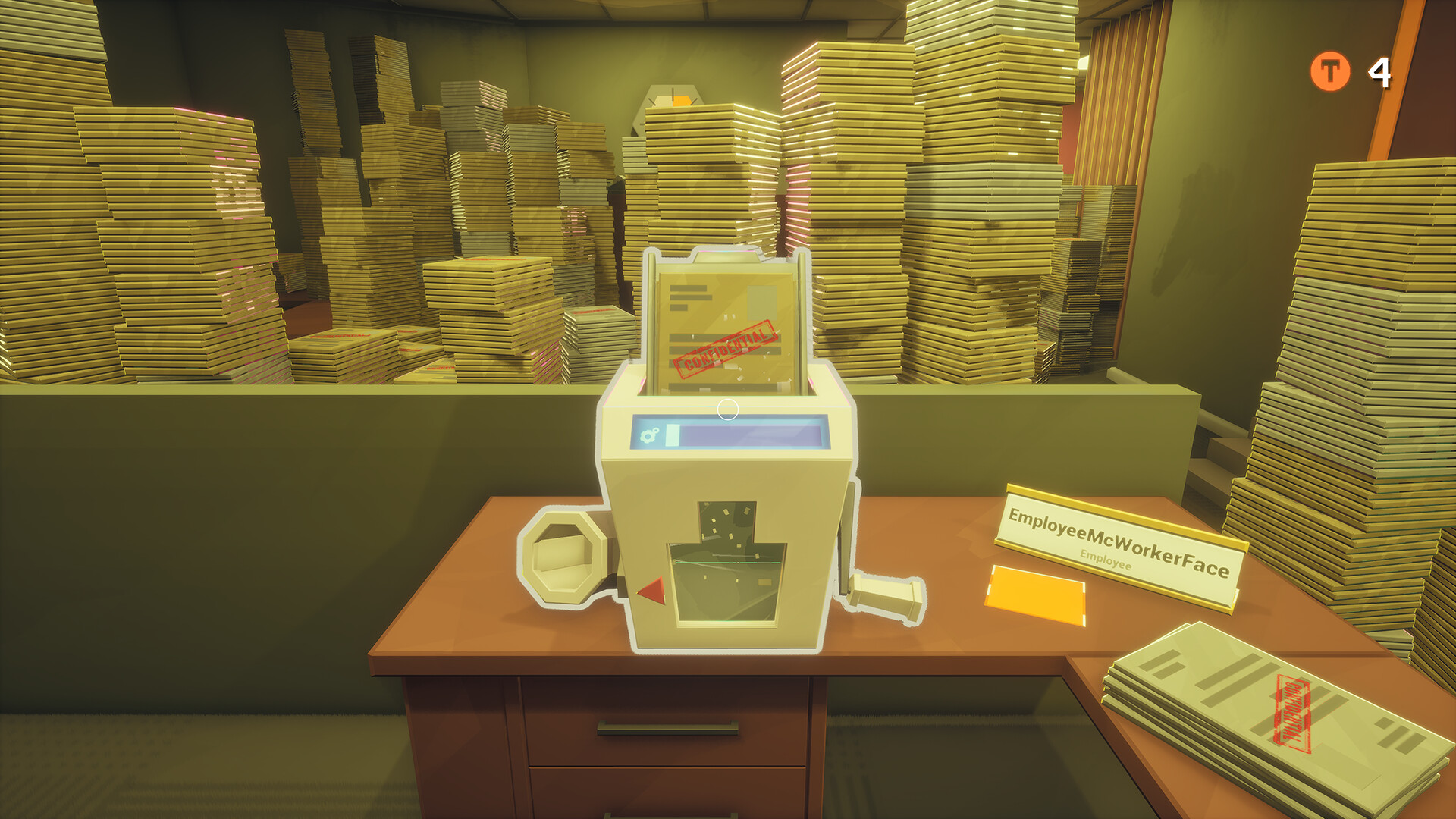
- Hand crank the shredder. The starting machine has no motor. You feed paper and crank. A few sheets in, you will already want automation. That impatience is the tutorial.
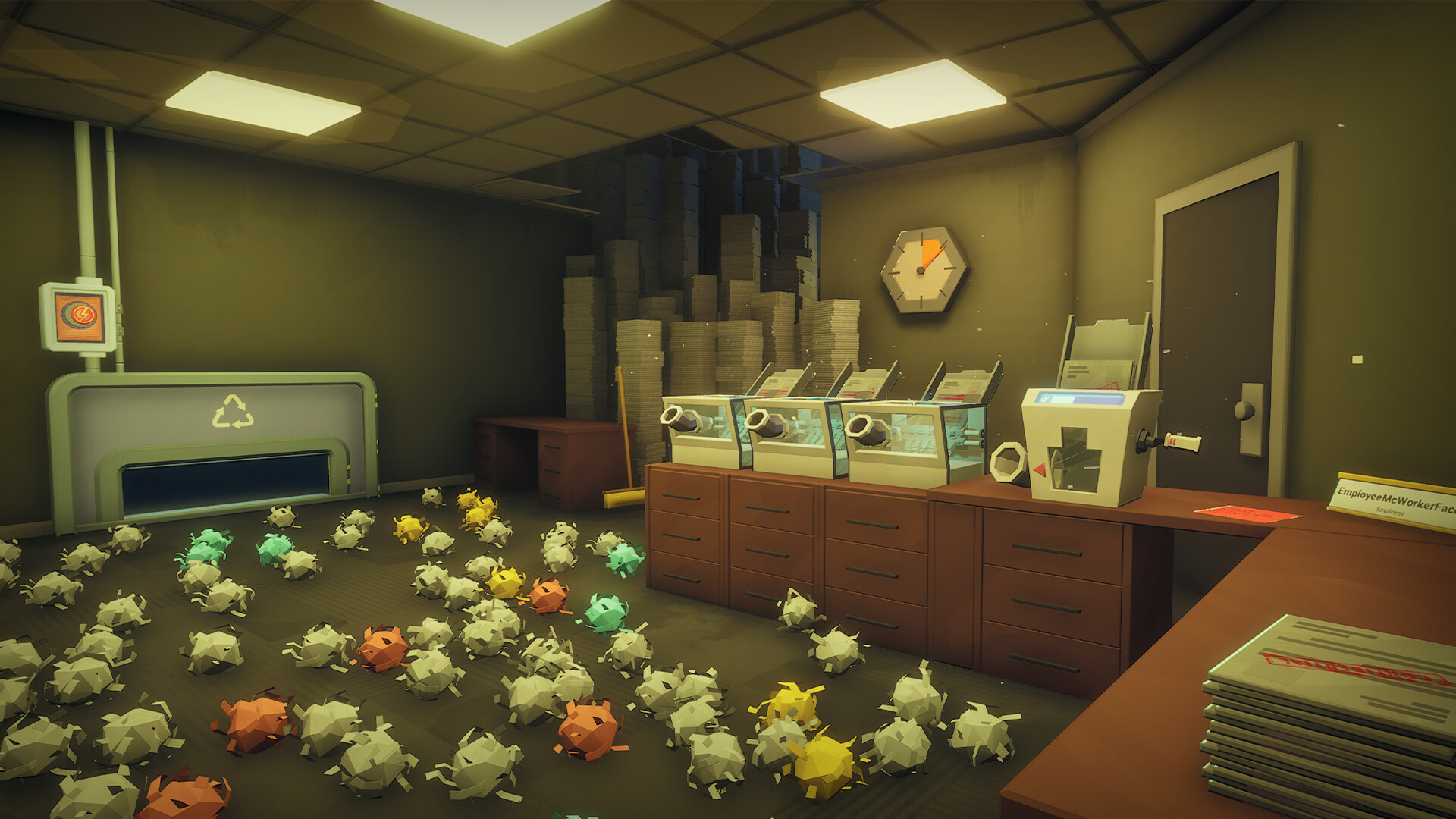
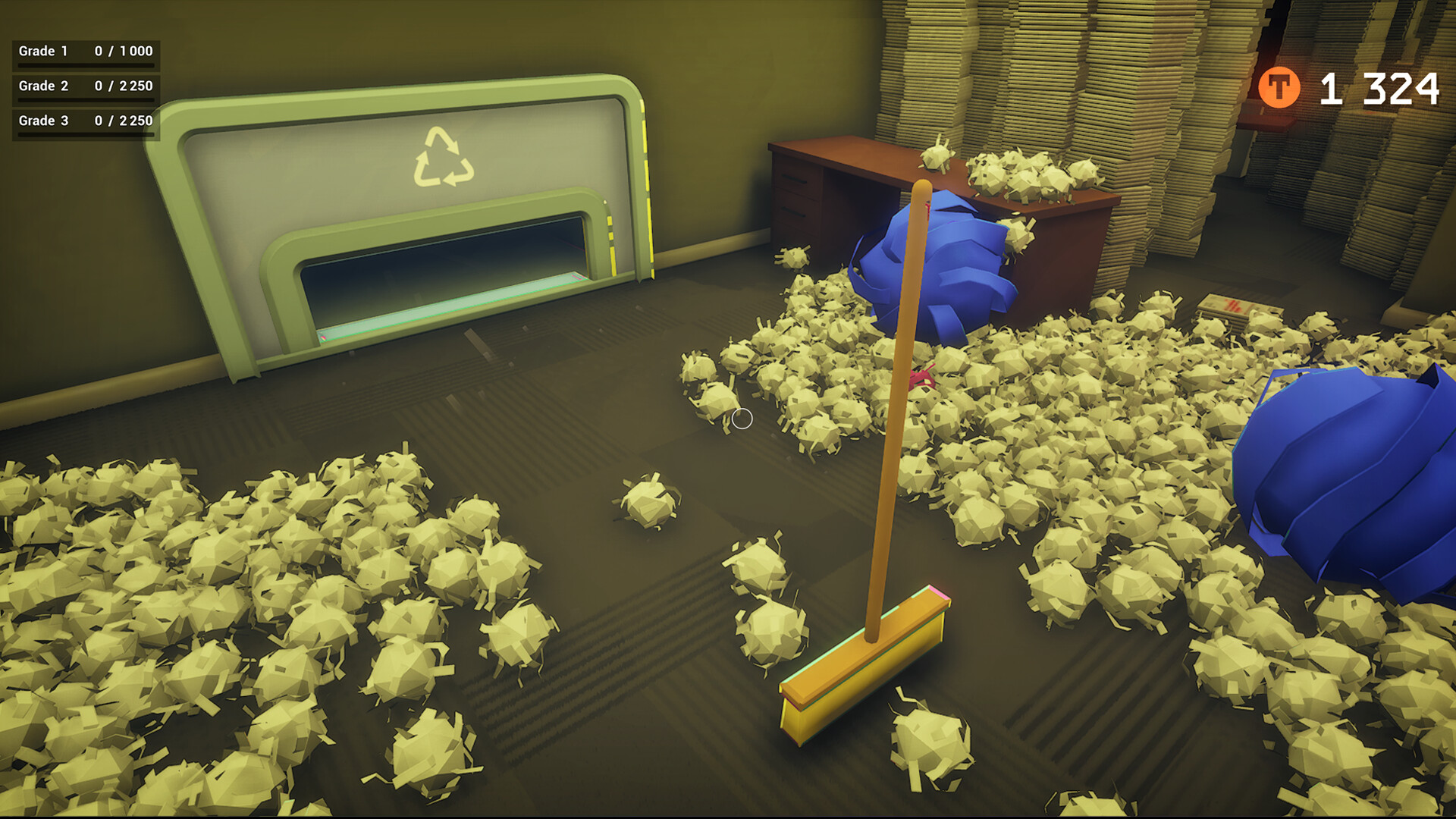
- Deal with the shreddies. Shredded paper comes out as confetti strips. They pile up on the floor. You can throw them or sweep them into the nearest recycling receptacle.
- Collect your pay. The company assesses everything in the receptacles and converts shreddies into company dollars. Dollars are the only currency that matters.
- Buy your first upgrade before you buy a second pile run. The early game tempts you to keep hauling manually. Resist. One capacity or crank-speed upgrade pays for itself within minutes.
Beginner mistakes to avoid:
- Ignoring the broom. New players treat sweeping as a chore between shredding sessions. Sweeping is a second income stream, not cleanup. Broom upgrades compound with shredder upgrades.
- Hauling stacks you can't finish. If your carry capacity upgrade slot is affordable, take it before anything flashy. Time spent walking is time the shredder sits idle.
- Reading every secret immediately at the expense of the loop. The buried documents matter for the story, but the payout clock does not pause while you reminisce about your predecessor.
- Assuming throw distance is useless. Tossing shreddies from the pile straight into a receptacle skips the sweep pass entirely once you learn the arc. Practice it early.
Core Mechanics Explained
The economy runs on one conversion chain, and every upgrade plugs into a specific link of it.
Paper pile → carry → shredder (crank/motor/auto) → shreddies (floor)
    → throw or sweep → recycling receptacle → company dollars → upgrades
Carry capacity governs the first link. Early on you carry one sheet. Upgrades raise how much paper you hold per trip, which multiplies the value of every second spent walking. In idle-game terms this is your gather rate and it stays relevant longer than most players expect.
Shredder throughput is the second link. The hand crank gives way to motorized upgrades, then to automatic shredders that process paper while you handle other tasks. Automatic units are the classic idle-game inflection point: the moment you own one, the game shifts from doing the work to supervising the machines.
Disposal is the third link and the one most players undersell. Shreddies on the floor earn nothing until they land in a receptacle. Two clearing methods exist. Throwing is skill-based, fast, and free. Sweeping is slower but collects everything in an arc and scales with broom upgrades. High-level play mixes both: sweep dense clusters, throw strays.
Company dollars sit at the top of the chain. Everything in the receptacles gets assessed and converted. There is no secondary currency confirmed for launch, which means there is no bad conversion path, only throughput bottlenecks.
The uncover layer runs parallel to the economy. Digging through the stacks surfaces documents from past employees: their notes, their complaints, their exits. Reading them advances the narrative and eventually forces a choice about what you do with the knowledge. The store page's closing question, "Will you sign?", is that decision staring back at you.
Progression Strategy: What to Buy and When
No full upgrade tree has shipped publicly, but the playtest plus the store description lock down the upgrade categories. Spend in this priority order:
| Priority | Upgrade type | Why it comes first |
|---|---|---|
| 1 | Carry capacity | Multiplies every trip before any machine upgrades exist |
| 2 | Crank/motor speed | Removes the manual bottleneck on the whole loop |
| 3 | Broom width or sweep speed | Second income stream scales cheaply early |
| 4 | Receptacle proximity or count | Cuts travel time on the disposal leg |
| 5 | First automatic shredder | The idle transition; income continues while you move |
| 6 | Additional automatic shredders | Stack them near different piles |
| 7 | Capacity multipliers | Late-game time value: bigger loads, fewer cycles |
A rough pacing target for your first session: by minute 20 you should own a motorized shredder and a broom upgrade. By the first hour you should be running at least one automatic unit and hauling loads of ten-plus sheets. If you are still hand cranking at minute 40, you over-invested in disposal too early.
One rule that holds across every incremental game and applies here: buy the upgrade that shortens your loop, not the one with the biggest number printed on it. A 20% crank speedup you exercise hundreds of times per session beats a 100% capacity boost you fill twice.
Builds: Three Setups for Three Play Styles
Since the economy has two manual inputs (carry, sweep) and one automated one, distinct play styles emerge.
The Foreman (automation-first). Rush your first automatic shredder, then pour everything into additional units. You personally handle only overflow. This build produces the best dollars-per-minute late game and the most AFK-friendly sessions. Weakness: early-game income is slow because automation is expensive before capacity upgrades. Buy capacity levels 1-3 first anyway, then pivot.
The Janitor (sweep-first). Max broom width and sweep speed, keep shredding modest, and let disposal be your income engine. This build feels great mid-game because the floor never clogs and receptacle trips are constant. Weakness: it caps out. Shredding throughput eventually outpaces any broom, so plan a pivot to automation once automatic shredders become affordable.
The Courier (carry-first). Everything into carry capacity and movement, personally feeding multiple shredders across the office. This is the most active play style and the strongest in the first 30 minutes, which matters if the full game structures progress in shifts or chapters. Weakness: it demands attention. If you walk away, income walks away with you.
For most players the honest answer is Courier into Foreman: carry upgrades early, buy the first automatic shredder the moment it appears, then stop hauling entirely.
Step-by-Step: Five Concrete Game Plans
1. The zero-to-motor speedrun (first 20 minutes). Carry five sheets and crank them all before buying anything. Purchase crank speed level 1. Carry 10 more sheets. Purchase carry capacity level 1. Alternate one shredder upgrade and one capacity upgrade until the motor unlock appears. Do not sweep more than the floor needs; every second sweeping before motorization is a second not hauling.
2. The receptacle circuit. Map the office before you optimize. Note the distance from each major pile to its nearest receptacle. Always upgrade, position, or plan around the shortest circuit. If two piles share one receptacle, that is your farming zone for the entire early game.
3. The throw calibration drill. Stand at the pile, face a receptacle, and throw 10 shreddies from the same spot and angle. Adjust until 8 of 10 land. Once calibrated, you can clear a pile's worth of output without moving, skipping the sweep leg of the loop entirely for that pile.
4. The automation transition. The moment you can afford your first automatic shredder, buy it and immediately park it at your densest pile. Keep manual shredding at a second pile so income never dips while the machine works. Reinvest machine output into machine count until every pile has coverage. This is where the session stops being a job and starts being supervision.
5. The secret excavation route. Set aside dedicated digging sessions. Work one pile all the way down rather than nibbling at several. Buried documents cluster with depth, and finishing a pile fully triggers whatever narrative payoff it holds. Sweep the area after each excavation wave; the game does not exempt you from disposal just because you were reading your predecessor's paperwork. Office safety first.
Advanced Tips
- Shreddies have physics. Piles that spawn near walls drop strips into corners sweeping arcs may miss. Walk the perimeter of every room once per session.
- Stack the two disposal methods. Sweep the dense center mass, then throw the perimeter strays. Neither method alone matches the combined clear rate.
- Your carry upgrade value changes over time. Early, capacity saves trips to the shredder. Late, with automatic shredders running, capacity mostly serves excavation hauls. Re-evaluate before dumping late-game dollars into it.
- The Happiness Manager is watching, and that is information. Characters who monitor you in games about workplace obedience usually gate upgrades or punish slacking. If a morale mechanic exists at launch, steady pacing will beat sprint-and-rest.
- Xbox players get the same loop with different physics feel. The game launches on Xbox Series alongside PC. Controller sweeping and throwing will feel different from mouse aim; if you play on both, recalibrate your throw arc before trusting it.
- Wishlist-tier patience pays. Additional playtests are planned before winter launch. Requesting access on the Steam page costs nothing and gets you into the next test, where an hour of practice makes launch day trivial.
The Story Layer: What "Will You Sign?" Is Really Asking
The incremental genre rarely ships a real ending, and Paper Shredder is advertising one. The predecessor documents scattered through the piles describe employees who couldn't bear the grind and shredded a path to freedom instead. The company offers you $1,000,000 for 100% disposal efficiency. The final choice, whether to sign, will almost certainly weigh the payout against what you learned about where the paperwork came from and where the previous staff went.
Practical advice for launch: play your first run blind and honest. The choice loses all weight if you metagamed it from a wiki. Your second run, if the game supports one, is where you pick the other option and compare.
FAQ: Common Questions and Gotchas
When does Paper Shredder release? Winter 2026. An exact date was still pending as of late October. Steam, Xbox Series, and Microsoft Store simultaneously.
How much will it cost? The developer's own estimate is $5-10 USD, subject to change with final content size.
Is there co-op or multiplayer? No co-op at launch. The team has said it might arrive post-launch if demand holds, but plan for single-player.
Is there a demo? Not yet. Closed playtests ran in October and more are planned. Request access on the store page and join the Discord to be considered. The playtest held about an hour of content, which is a fair sample of the core loop.
Do I really have to sweep? Your dollars say yes. Unreceptacled shreddies are unassessed work. You can throw instead, and skilled throwing is faster, but the floor does not clear itself and corners are where income goes to die.
Does it work on Steam Deck? No official Deck verification has been announced. The game is mouse-driven and light on hardware demands, so odds are good, but treat it as unconfirmed until launch.
How long is the game? Unknown. The playtest was an hour, but the $1,000,000 endpoint and story ending suggest a designed campaign arc rather than an endless idle. Expect somewhere between a long weekend and a working week for full completion, depending on how aggressively the grind scales.
Written November 3, 2026, ahead of the winter launch, based on official store details, developer updates, and closed playtest information. This deep dive will be updated with launch-verified upgrade trees and endgame data once the game ships.
Screenshots