Official game
Play Monk Took Book
This game is hosted by Steam. Continue to the official page to play or download it.
Wishlist on SteamOverview
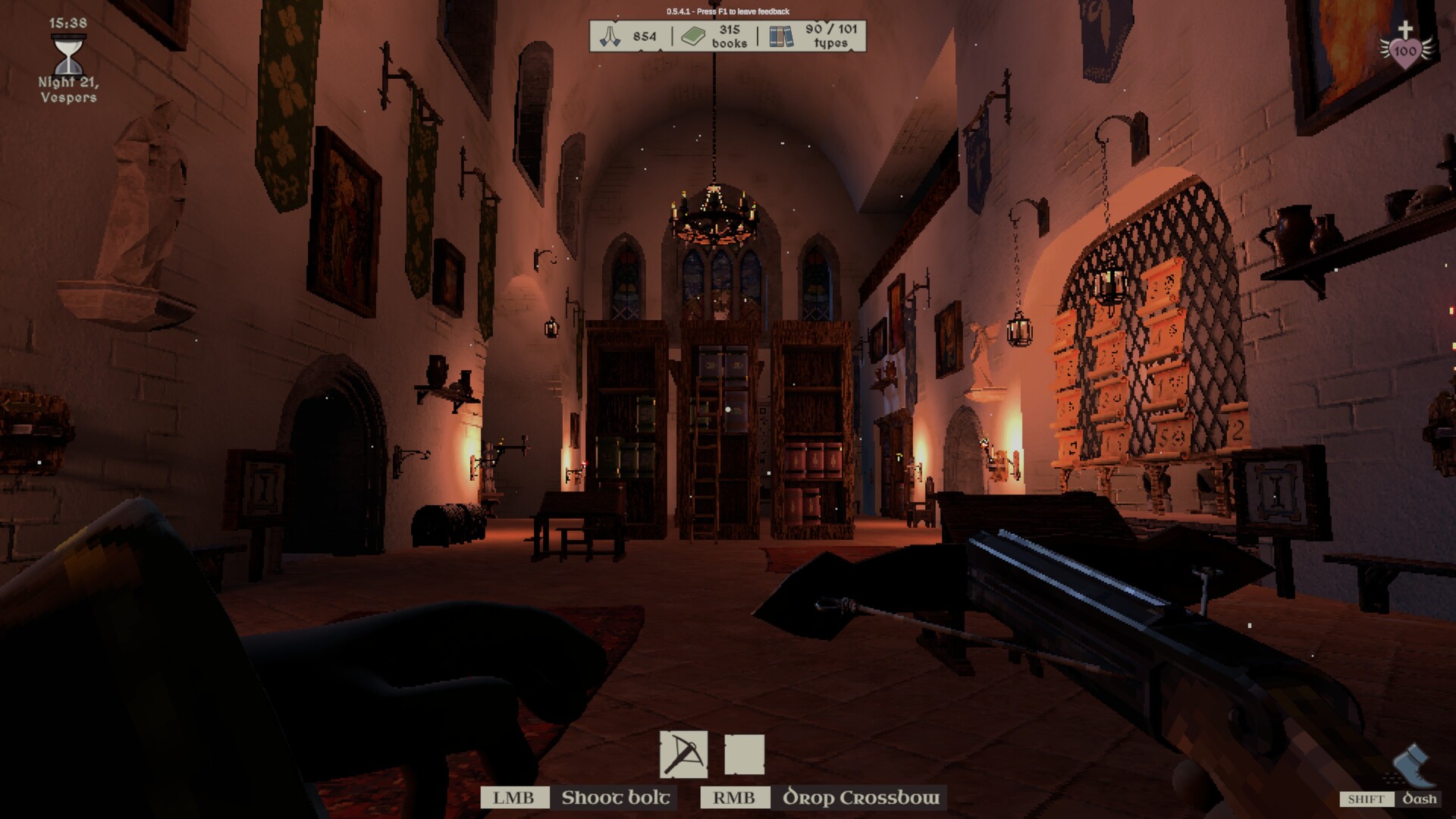
Monk Took Book is a cozy-creepy medieval library simulator from SquarePlay Games, the two-person team of Alastair and Sarah behind Space Trash Scavenger. It launches on Steam on Thursday, September 3, 2026. You are a novice monk on Holy Island, home to the greatest monastic library of the Dark Ages. Your job is to run the place, organize a growing collection, and eventually complete the Legendary Collection.
Strip away the theme and the game is a memory game bolted onto a management sim, all running on a physics sandbox. Every morning a new delivery of books arrives, each stamped with a distinct symbol on its cover. You remember the symbols and shelve the books wherever your design puts them. When night falls, the Scribes request specific tomes, and you must remember where you put each one and deliver it. Forget a shelf and the night becomes a hunt through your own library.
Then the dark twist: after nightfall the abbey is not safe. Vermin and rats gnaw at the collection, spiders web your shelves, Viking ghosts raid the isle, and a creepy little book thief stalks the stacks. You take up a dagger, a crossbow, or a holy cross to defend your labor, then use a quill to restore any books the night damaged. The whole thing runs on systems-based emergent gameplay: simulated fire with visible embers, water dousing by pail, the chaotic physics of tumbling and thrown tomes, a full day/night cycle, ballistic weapons, and melee combat.
Who it is for: Fans of cozy sims with real systems underneath — Unpacking's organization itch, Overcooked's co-op chaos, Book of Hours' library fantasy. It also suits anyone who wants a chill management game where the combat is a dial you can turn down or switch off.
Who it is not for: Players who want fast-paced action or a deep narrative. This is a slow, deliberate management sim. The real antagonist is your own memory, and the "threats" are optional.
| Fact | Detail |
|---|---|
| Developer | SquarePlay Games |
| Publisher | SquarePlay Games |
| Genre | Cozy-creepy library simulator |
| Platforms | Windows (runs well on Steam Deck) |
| Release | September 3, 2026 |
| Price | To be announced |
| Players | Solo or online co-op, up to 4 players |
| Camera | First or third person |
| Combat | Dagger, crossbow, holy cross, parry (all optional) |
| Accessibility | Arachnophobia mode, granular difficulty, disable enemies/fire |
| Multiplayer | Proximity voice chat, text chat, lobbies, Steam invites, join codes |
| Requirements | Win 10, i5, GTX 1050 4GB (min); Win 11, i9, RTX 2070 8GB (rec) |
Getting Started — The First 30 Minutes
Set Up Before You Launch
- Understand the day/night rhythm before you touch a book. Mornings are for receiving deliveries, shelving, and banking Blessings from the Abbot. Nights are for delivering tomes to Scribes and defending the Collection. Your shelf system has to survive both sides of that cycle or you lose everything.
- Set your difficulty honestly. The options are granular: reduce, increase, or disable some or all enemies; disable fires; and control the book rate for a chill experience. If you want pure cozy, kill the enemies and slow the deliveries. The game explicitly built these sliders for that. There is no shame in using them.
- Decide solo or co-op. Up to four monks can share the abbey. Co-op adds proximity voice chat, in-game text chat (press Y), and shared labor. Solo pauses the game in menus and dialog boxes, which is an underrated safety net.
- Learn what the Abbot wants. Your toils earn Blessings. Spend them on Perks that raise Strength, Speed, and Carpentry, or on expanding the Collection with new shelves and chambers. Blessings are the entire progression currency.
- Test the controls early. The game is fully playable in first or third person with complete key rebinding. It hotswaps between controller and keyboard/mouse live, updating HUD prompts as you switch. Full gamepad menu navigation means you can run it from the couch. There's also an Auto-Run toggle.
Your First Morning
- Receive the delivery and read the symbols. Each book carries a symbol that is your only memory hook. Say each one aloud or attach a mental location. Never shelve a book you cannot tie to a symbol.
- Shelve with a system, not vibes. The game lets you design any layout, but random shelving turns every night into a scavenger hunt through the whole abbey. Commit to fixed zones per symbol family from day one.
- Don't over-stack. You can carry books in tall stacks or throw them vast distances. Stacks are efficient but one unlucky tumble scatters the whole pile, and the physics is genuinely chaotic.
- Spend your first Blessings on Carpentry. More shelves and new chambers mean more books organized per day and less night-time chaos. Space is the direct cure for memory overload.
- Watch for the book thief. A creepy little guy lurks at night and steals from your collection. If books vanish, follow his footprints to track him down before he robs you blind.
Beginner Mistakes
| Mistake | Why It Hurts | Fix |
|---|---|---|
| Shelving randomly | Night deliveries become a blind hunt through the abbey | Use a symbol-to-zone system from day one |
| Over-stacking shelves | Tall stacks tumble, scattering books and breaking your layout | Balance stack height against reachability |
| Ignoring Blessings | Perks and new shelves compound; skipping them stalls the whole library | Spend Blessings on Carpentry and Speed early |
| Treating enemies as the main threat | The real loss is time spent fighting instead of shelving | Reduce or disable enemies if they cut into your routine |
| Not using the quill | Damaged books stay damaged and the Collection degrades | Repair books as soon as the night wave ends |
| Hoarding books in piles | Piles get stolen, knocked over, or knocked into the fire | Put every book on a shelf by nightfall |
| Leaving torches near shelves | Torches now spit embers that bounce and can ignite books | Keep ember-proof distance between torches and your best shelves |
Core Mechanics Explained
The Day and Night Cycle
Each morning begins with a delivery of new books, each stamped with a unique symbol. You shelve them, earn the Abbot's favor, and when night falls the Scribes request specific tomes by symbol. Your job is to recall where each symbol lives and deliver the right book to the right Scribe. That memory link between a request and a shelf location is the game's real difficulty, and the book cycle can be sped up or slowed to change the pressure.
The night brings the optional threat layer. Enemy pressure is a dial: granular options let you keep, raise, lower, or remove each threat. Out of the box you get vermin and rats that bite, spiders that web your shelves, several flavors of Viking ghost skeletons (some better at blocking than others), and the book thief. Combat is melee and ballistic: daggers for close work, crossbows at range, and the holy cross against spirits.
Blessings and Perks
The Abbot rewards your daily work with Blessings, the game's currency. You have two ways to spend them:
- Perks that raise Strength, Speed, and Carpentry. Strength governs carrying and combat, Speed governs movement and delivery pace, and Carpentry governs building and shelving.
- The Collection, where you raise new lofty shelves and unlock new chambers. More space directly reduces the memory load per night.
The priority order is deliberate: Carpentry first, Speed second, Strength third. A well-shelved library fights half its own battles.
Combat and Defense
All enemies are optional. The default game has them; granular difficulty lets you reduce, increase, or disable some or all. The roster:
- Vermin and rats — the baseline nuisance. They attack, bite, and after each bite are more likely to keep attacking than wander off.
- Spiders — shelf-climbing web-builders. Arachnophobia mode replaces their web-casting and jumping bodies with text overlays, so you keep the gameplay without the visuals.
- Viking ghosts — the abbey has been raided for years and the dead still raid it. Several flavors of skeletons, some stronger and better at blocking than others.
- The book thief — a creepy little guy who steals from the collection at night. Follow his footprints to catch him.
Your tools: the dagger, the crossbow, and the holy cross. Combat gained real depth in the Next Fest update. Beyond a basic parry there is now a Perfect Parry — block precisely at the moment of the enemy's strike and you daze them briefly, opening a clean window to counter. Hold a block and you absorb, time it and you punish. After a wave, use the quill to restore any damaged books.
The Physics and Systems Sandbox
The abbey is a systems playground. Books tumble with chaotic physics. Fire is simulated — flame spreads, consumes, and now torches spit visible embers that bounce around and can ignite your tomes. You douse fires with pails of water. You can carry great stacks, throw books vast distances, knock things over mid-throw, and watch a misplaced pile collapse. The ember mechanic is the biggest hidden threat: a torch set near unshelved books can quietly start a blaze that eats a whole wall of your organization.
Companions and Quality of Life
The abbey gained a new resident in the Next Fest update: Lord Fluffy, a cat who can help with pest control. He's a genuine answer to the vermin problem, worth tracking down if rats are chewing your collection.
The QoL list is long: full key rebinding; manual and autosave; FoV, headbob, gamma, and camera-shake sliders; windowed or fullscreen; widescreen support; an Auto-Run toggle; full controller and d-pad menu navigation (which carries through to Steam Deck, and the developers say it runs well there). If your hotbar is full, the game hotswaps to an empty slot when you pick something up.
Co-op and Lobbies
Up to four players share the library. The game ships proximity voice chat, public and private lobbies, Steam invites, copy/paste join codes, and in-game text chat. Session reconnects are handled robustly now: if you drop and rejoin, your held books, items, and unlocked shelves restore correctly. Input hotswapping between controller and keyboard/mouse is live with HUD updates.
Progression Strategy
The Blessing Priority Order
Every Blessing should follow the same hierarchy until your library is comfortably large:
| Priority | Spend On | Why |
|---|---|---|
| 1 | Carpentry | More shelves and chambers = more books off the floor = less night chaos |
| 2 | Speed | Faster deliveries and repairs once you have space to fill |
| 3 | Strength | Carrying and combat, but only after the library can hold itself |
| 4 | Shelf resale value | You can sell shelves (hold Z) for a full reimbursement, so rebuild guilt-free |
Always bank a few Blessings for emergency re-shelving. If a fire or a thief hits a key zone, you want enough to raise a fresh shelf immediately rather than wait out two day cycles.
What to Unlock First
- A second chamber as soon as it appears. Splitting zones across rooms reduces per-room clutter and gives you dedicated firebreak space.
- The Carpentry line of Perks before touching Strength. Space compounds; muscle does not.
- Lord Fluffy's pest control early. Vermin drain your repair time every night, and a cat that handles them frees you to shelve.
Sink or Pivot
The system rewards committing to a layout, but sells and rebuilds are cheap (hold Z to sell, full reimbursement). If your zone system is failing, don't suffer through it — tear it down and re-layout in a slower cycle. The cost of rebuilding is one quiet morning; the cost of a bad layout is every night thereafter.
Builds, Tier Lists, and Loadout Priorities
Tool Priorities (Best-in-Slot Thinking)
| Tool | Priority | Best Use |
|---|---|---|
| Quill | Always carried | Restores damaged books after every night wave — your repair lifeline |
| Pail of water | High | Douses fires and ember-sparked blazes before they spread |
| Crossbow | High | Ranged deal with the book thief and raiders before they reach your shelves |
| Holy cross | Medium | The correct answer to spirits; weak elsewhere |
| Dagger | Low | Last-resort melee; avoid extended fights that waste shelf time |
| Torch (positioned) | Situational | Provides light but spits embers — keep it away from stacked tomes |
The Co-op Roles Meta
In a two-to-four monk game, assign permanent roles and rotate your mental maps daily:
| Role | Job | When |
|---|---|---|
| The Shelver | Receives arrivals, maintains the zone system | All day |
| The Patrol Monk | Handles vermin, spiders, the thief, repairs | Nights and mid-day |
| The Fire Marshal | Watches embers, keeps pails stocked, douses blazes | Whenever torches are lit |
Swap who shelves and who patrols each in-game day so every player keeps their mental map of the collection fresh. The Shelver is the highest-skill role and should never also be the one who gets dragged into a melee.
Step-by-Step Strategy
Sequence 1 — The First Clean Night
- On day one, assign each symbol family a fixed zone and write it down on paper if you must.
- Shelve every incoming book into its zone as you receive it.
- Before nightfall, confirm every book is on a shelf — the floor is where the thief and flames work.
- When night comes, take the Scribe requests one at a time. Deliver, then immediately return the symbol to its zone rather than skimming the top of a random pile.
- After the wave, take out the quill and repair every damaged book before morning deliveries start.
Sequence 2 — Catching the Book Thief
- At night, notice when a symbol you shelved is suddenly missing.
- Stop delivering and scan the floors for footprints.
- Follow the trail rather than guessing which zone was robbed.
- Corner him before he leaves the abbey; a crossbow bolt from range beats chasing him through the stacks.
- Return the stolen tomes to their correct zones before you resume deliveries.
Sequence 3 — Surviving a Torch Fire
- The moment you see embers, drop what you're holding.
- Locate the source — usually a torch placed too close to shelved or stacked books.
- Grab a pail of water and douse the source first, before the spread line.
- Rescue the highest-value shelves (your Legendary Collection progress) before the less valuable ones.
- After the blaze, sell and rebuild the charred shelf, then reposition the offending torch at safe ember distance.
Sequence 4 — The Chip-Away Boss/Fight Strategy for a Strong Skeleton
- Pick the ranged weapon that matches the enemy — crossbow for distance.
- Study the skeleton's block timing. The stronger ones parry and block.
- Wait for your turn; bait an attack, then Perfect Parry to daze it.
- Counter during the daze window, then reset distance before it recovers.
- Lather, rinse, repeat. Never trade blows with a good blocker — you lose the shelf-time war.
Sequence 5 — Scaling Up to a Four-Monk Abbey
- Assign the four roles before the session even starts (Shelver, Patrol, Fire Marshal, a floater for deliveries).
- Agree on the zone map out loud so every monk knows the layout.
- Designate one PvP-free delivery corridor to avoid two monks grabbing the same book (the devs fixed the dual-grab bug, but routing still helps).
- On a reconnect or drop, re-establish roles immediately — the game restores held items and shelves.
- Rotate roles each in-game day so nobody's mental map goes stale.
Sequence 6 — Cozy Speedrun (Zero-Enemy Optimization)
- Disable all enemies and set a fast book rate for the pure management loop.
- Rush the Carpentry line and a second chamber first — no combat means Strength is pointless.
- Bank Blessings fast by completing deliveries with zero repairs needed.
- Use the quill only as insurance; with enemies off, most nights cost nothing.
- Race your own best delivery route and see how fast you can empty a full night's Scribe list.
Advanced Tips
- Perfect Parry is the economy. A dazed skeleton costs you nothing to kill, and the time you save not trading blows is delivery time earned. Timing the block is the single highest-skill, highest-reward habit in the game.
- Embers are the sleeper threat. Torches now visibly spit fire. The fire that kills your collection rarely starts from an enemy — it starts from a torch you left near a pile of unshelved books.
- The floor is the enemy's table. Every book left unshelved at night is a gift to the thief and a fuel source for embers. Shelve everything or stack it somewhere the fire can't reach.
- Sell and rebuild freely. Shelves sell for full value with a long press of Z. A bad layout is cheap to undo; a stubborn one is expensive to keep.
- Speed the book cycle when you're ahead. The game lets you cycle books faster. When your shelves are empty and your map is fresh, a faster cycle banks Blessings quicker than a slow, comfortable one.
- Steam Deck is viable. Full controller menu navigation and an Auto-Run toggle make it honestly playable on Deck, which is rare for a management sim this fiddly.
- Arachnophobia mode keeps the gameplay. It swaps the spider bodies for text overlays rather than removing the spider behavior, so both worlds get what they want — you keep the challenge, not the eight legs.
FAQ / Common Mistakes
When does Monk Took Book release? Thursday, September 3, 2026, on Steam.
How much does it cost? To be announced. It's wishlistable now.
Is there a demo? Yes. The co-op demo was updated for Steam Next Fest 2026 with new book sizes that fill shelves without gaps, the book thief, Viking ghosts, Perfect Parry, Lord Fluffy, arachnophobia mode, and deeper combat.
Is it single-player or multiplayer? Both. Solo pauses in menus and dialog; online co-op supports up to four players with proximity voice and text chat.
Does it have controller support? Yes. Full controller and d-pad menu navigation, live hotswapping with keyboard/mouse, and full key rebinding. It runs well on Steam Deck.
Can I disable enemies? Yes. Granular difficulty lets you reduce, increase, or disable some or all enemies, and you can control the book rate. Fires can be disabled in Game Options too.
Is there an arachnophobia mode? Yes. It replaces the spider visuals with text overlays while keeping the spider gameplay.
What are the system requirements? Minimum: Windows 10 or later, Intel Core i5 or equivalent, desktop Nvidia GTX 1050 4GB or equivalent. Recommended: Windows 11, desktop Intel Core i9, desktop Nvidia 2070 8GB. Integrated and low-spec mobile GPUs are not supported.
Does progress save? Yes, manual and autosave are both included.
Someone dropped from my co-op game. What happens? The game restores their held books, carried items, and unlocked shelves on reconnect, so nobody loses progress mid-session.
Why are my books catching fire? Check your torches. They now spit embers that can ignite unshelved books or stacks left too close. Douse with a pail and reposition.
Final Tips
Build your symbol-zone system on the first morning and never abandon it. The monks who thrive are not the ones with perfect combat — they are the ones who shelve with structure, spend Blessings on Carpentry early, keep a pail of water near the good shelves, and learn the Perfect Parry so fights stay short. Lord Fluffy handles the rats, the embers are the quiet killer, and a well-mapped abbey with three friends is the best chaos there is. Watch for the September 3 launch, try the Next Fest demo if you are on the fence, and remember: the floor is where books go to die.
Last reviewed by Game How To Editorial. We play each game, verify controls against official sources, and update guides when game mechanics change.
Screenshots