Official game
Play Memoirium
This game is hosted by Steam. Continue to the official page to play or download it.
Play on SteamOverview
Memoirium is a retro PS1-era Soulslike action RPG from solo developer GoldenGratus, published with Outersloth, the indie fund started by the team behind Among Us. It released August 13, 2026 on Steam for Windows at $14.99.
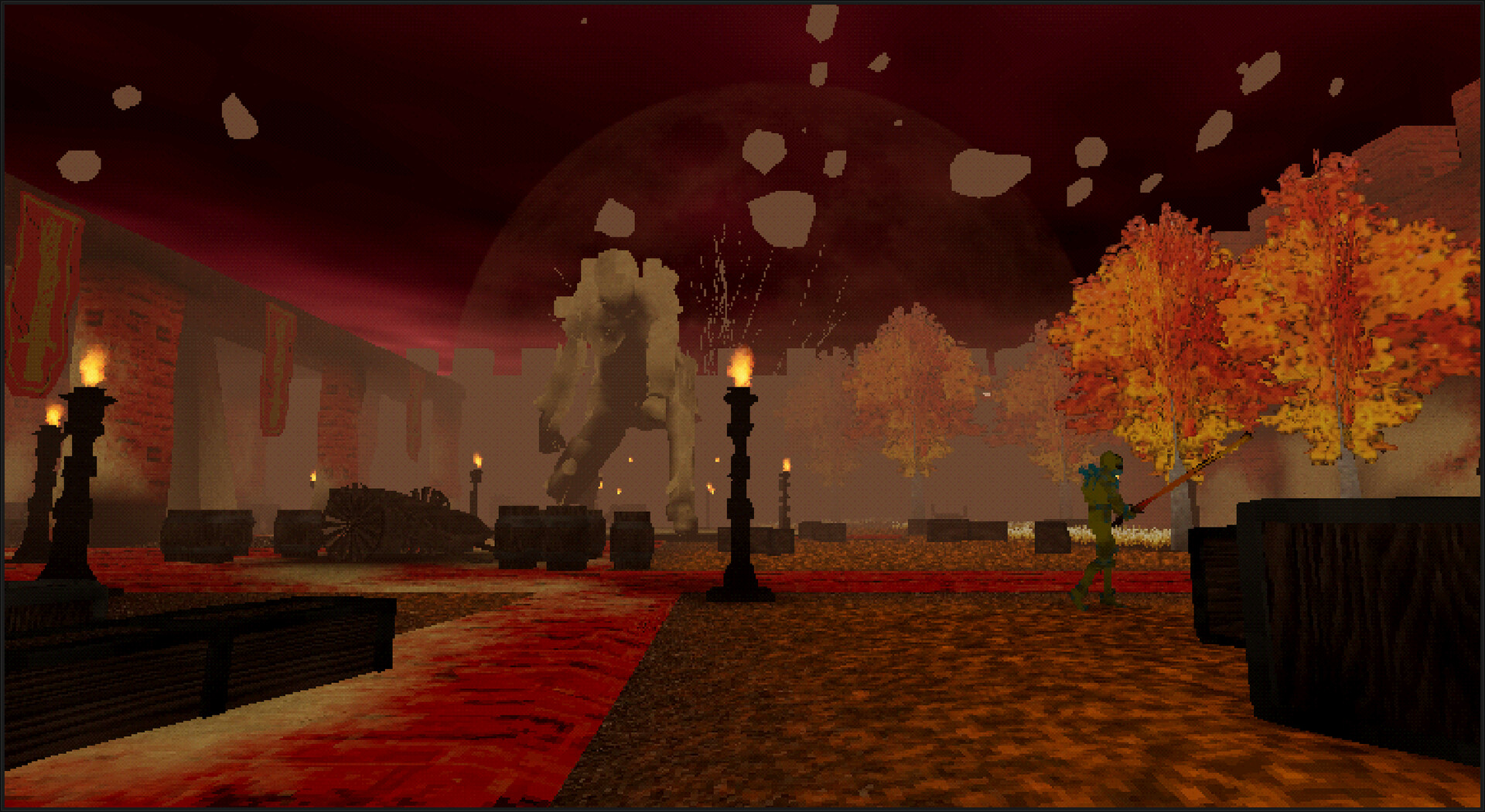
You play the Dreamer, trapped in a crumbling realm of dreams built from liminal spaces. One moment you walk a 21st-century school corridor. The next you cross a castle held together by wax. Three Dreamer-figure guardians hold the keys to the exit: one rules a fort of wax, one a giant house encased in ice, one the depths of the world itself. Kill all three to wake up. Or fail, and keep dreaming.
The core slogan is DREAM, DEFY, DECORATE. You explore dreamscapes, defy other Dreamers, and decorate the one safe room you control. The world design is closer to Dark Souls 1's interlocking shortcuts than Elden Ring's open fields, wrapped in Backrooms-adjacent horror. There is no map. The developer placed visual markers in almost every room precisely because players have to navigate by landmarks.
Who it is for: Soulslike veterans wanting a fresh setting, fans of liminal horror, players who loved the dreamy melancholy of Omori. It is also friendlier to newcomers than it looks, because consumables replenish and you can save anywhere.
Who it is not for: Players who want fast, flashy combat or explicit quest markers. Memoirium is opaque by design. The world explains itself through item descriptions and environmental storytelling, and the opening hours will frustrate anyone who refuses to read.
| Fact | Detail |
|---|---|
| Developer | GoldenGratus (solo) |
| Publisher | GoldenGratus, Outersloth |
| Genre | Soulslike action RPG |
| Platforms | Windows |
| Release | August 13, 2026 |
| Price | $14.99 base |
| Players | Single-player |
| Achievements | 34 |
| Weapons | 31 |
| Lullabies (spells) | 67 |
| Keepsakes (consumables) | 25 |
| Dungeons | 8 |
| Save system | Save anytime + checkpoint bedroom |
| Controller | Partial support, fights fine, menus iffy |
| Languages | English, Spanish, Japanese, Korean, Brazilian Portuguese, Simplified Chinese |
| Requirements | Windows 10, dual-core, 8 GB RAM, GTX 970, 1 GB storage |
Getting Started: The First 30 Minutes
Before You Launch
- Set combat expectations. This is a deliberate, stamina-driven game, not a hack-and-slash. The developer has said he designed combat as "a turn-based game": your resources are the number of actions in your turn, and enemies end their turn only when their attack patterns pause. Greed costs you the exchange.
- Read every item description. Memoirium hides its rules in text. Equipment descriptions explain dream logic, hint at secrets, and tell you which statuses matter in each area.
- Know that items replenish. Consumables restock at checkpoints instead of vanishing forever. Use them aggressively.
- Tune the camera first. Camera Comfort and Color Alternatives options exist, plus volume sliders and subtitle toggles. Adjust camera speed before your first fight, not after ten deaths.
Your First 30 Minutes
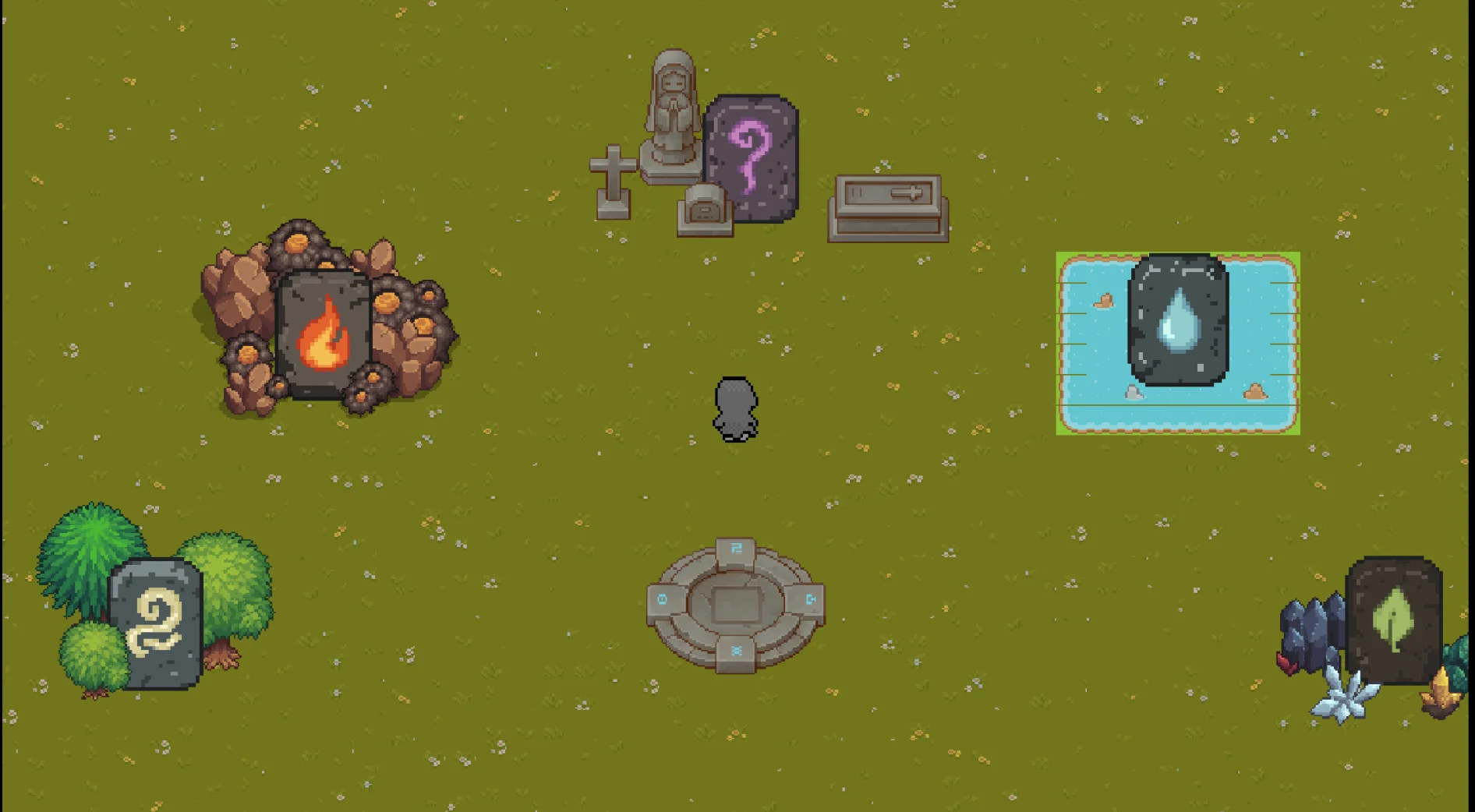
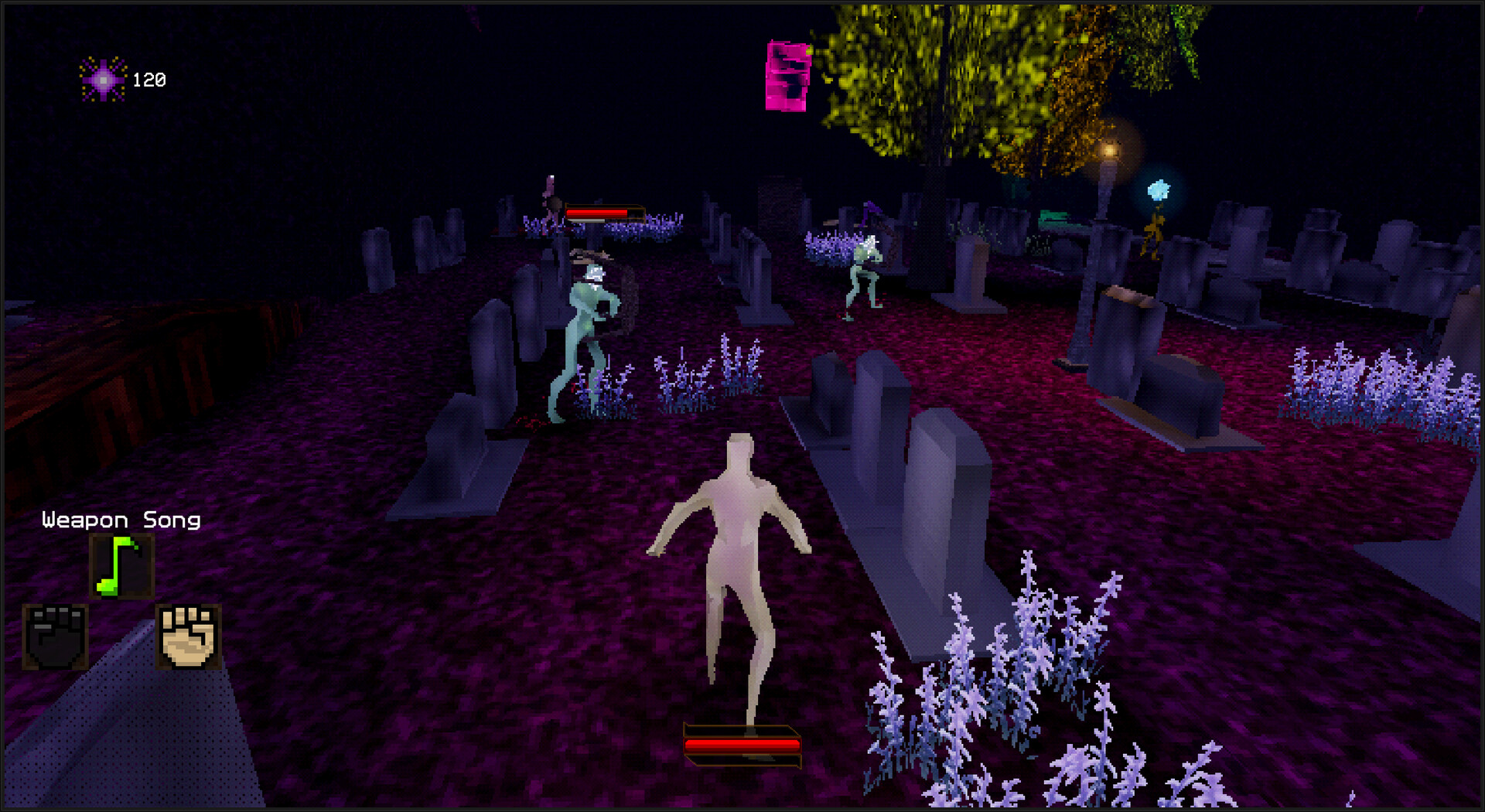
- Wake in the cemetery. The game opens in a void-ravaged graveyard. Follow the path across a crumbling statue into a cultish school. This double opening teaches the pattern: hostile dream area first, then a familiar-looking liminal space with its own rules.
- Take the first fight slow. Lock on, dodge, punish one attack at a time. The first enemies telegraph heavily.
- Grab your first weapon and armor. Early equipment is simple, but the descriptions set up the core rule: everything in the dream realm has limits.
- Find the bedroom. This is Memoirium's bonfire. You rest here, level stats, save progress, and decorate. It is the one safe space in the game.
- Test your first Lullaby. Lullabies are your spells. Cast one on a weak enemy to learn its cost and watch the Connection bar fill. More on that below, because the Connection bar will bite you later if you ignore it.
- Pick a direction and commit. The world is interconnected with multiple paths. No first direction is wrong, but commit long enough to reach a checkpoint or unlock a shortcut before backtracking.
Beginner Mistakes
| Mistake | Why It Hurts | Fix |
|---|---|---|
| Hoarding Keepsakes | They replenish at checkpoints anyway | Use them constantly; passives stack with your build |
| Ignoring item descriptions | The dream world's rules live in text | Read everything, especially armor and masks |
| Button mashing | Attacking past your resources invites extra damage | Fight in turns: act, recover, reset |
| Spamming Lullabies | A full Connection bar turns your next spell against you | Track the Connection bar like a second health bar |
| Selling or discarding duplicates | Duplicates upgrade items | Collect the same item repeatedly to level it |
| Decorating the room last | The bedroom is your progress anchor and stat hub | Furnish early; it makes rest stops meaningful |
| Expecting a linear path | The world loops back on itself constantly | Explore; shortcuts are the game's real reward |
Core Mechanics Explained
Memoirium runs on three resources, and understanding how they interact is the difference between fighting and flailing.
Health and Stress: The Two-Bar System
Early versions of the game stacked health, stamina, and stress into a single bar. The developer scrapped it because it was too punishing, then split it into two bars that each do double duty.
Health is your life. Nothing fancy.
Stress is the interesting one. It fills as you take hits and perform risky actions. A full Stress bar does not lock you out of anything. You keep fighting, but under worse conditions:
- You take extra damage while Stressed.
- Your dodge changes from a roll into a short dash.
- You cannot sprint.
That dash detail matters more than it sounds. A roll carries you further and gives i-frames through attacks; a dash is shorter and can leave you inside an enemy's hitbox. Stressed fighting means shorter dodges, no sprint escapes, and a health bar that melts faster. Stress is the game charging you interest.
The attack menu is three actions: attack, dodge, and reflect (parry). Dodge is the low-risk option. Reflect is the high-risk, high-reward option: it needs precise timing, and failure means eating the hit. The reward for a successful reflect is that it fills the enemy's Stress bar instead of yours.
That is the core trick. Enemies suffer the same rule you do. A Stressed enemy takes extra damage and fights worse. So the optimal loop is not "dodge everything safely." It is "build the enemy's Stress with reflects and counters, then cash it in with aggression while they are Stressed."
The Turn-Based Mindset
The developer's own framing: stamina in a Souls game is the number of actions before you "end your turn," and good play means placing yourself in a safe position when your actions run out. Memoirium makes this literal with Stress. Treat every engagement as a turn. Spend your actions, then disengage and let Stress settle before the next exchange. Enemies "end their turn" during the pauses in their combos, and those pauses are your window.
Connection: Mana That Fights Back
Connection is the third bar, and it is the weirdest system in the game. It does two jobs at once:
- It is the mana cost pool for Lullabies (spells).
- It is a status gauge that eventually turns your own magic against you.
The rules:
- Casting a Lullaby fills the Connection bar with that spell's element.
- Getting hit by an elementally infused enemy attack fills it too.
- When the bar is full, the next Lullaby you cast inflicts that element's status ailment on YOU.
- While you are ailed, casting further Lullabies costs a huge chunk of health.
There is no hard lockout. You can cast as many Lullabies as you want, ever. Health is the true limiter. That is the developer's stated design philosophy, risk and reward, applied to magic: every spell is a small bet against your own body.
| Connection state | What happens |
|---|---|
| Empty to partial | Lullabies cost Connection, fill it with their element |
| Full | Next Lullaby afflicts you with its element's status |
| Ailed + casting | Each further Lullaby drains a big chunk of health |
| Hit by elemental attacks | Connection fills even if you never cast |
Practical consequence: in a fire-themed dungeon, enemy fire attacks push your Connection toward full even if you never cast anything. Then your next fire Lullaby burns you. Watch the bar, not just your health.
Equipment That Changes Behavior
Equipment is not cosmetic. Every category alters how the game plays:
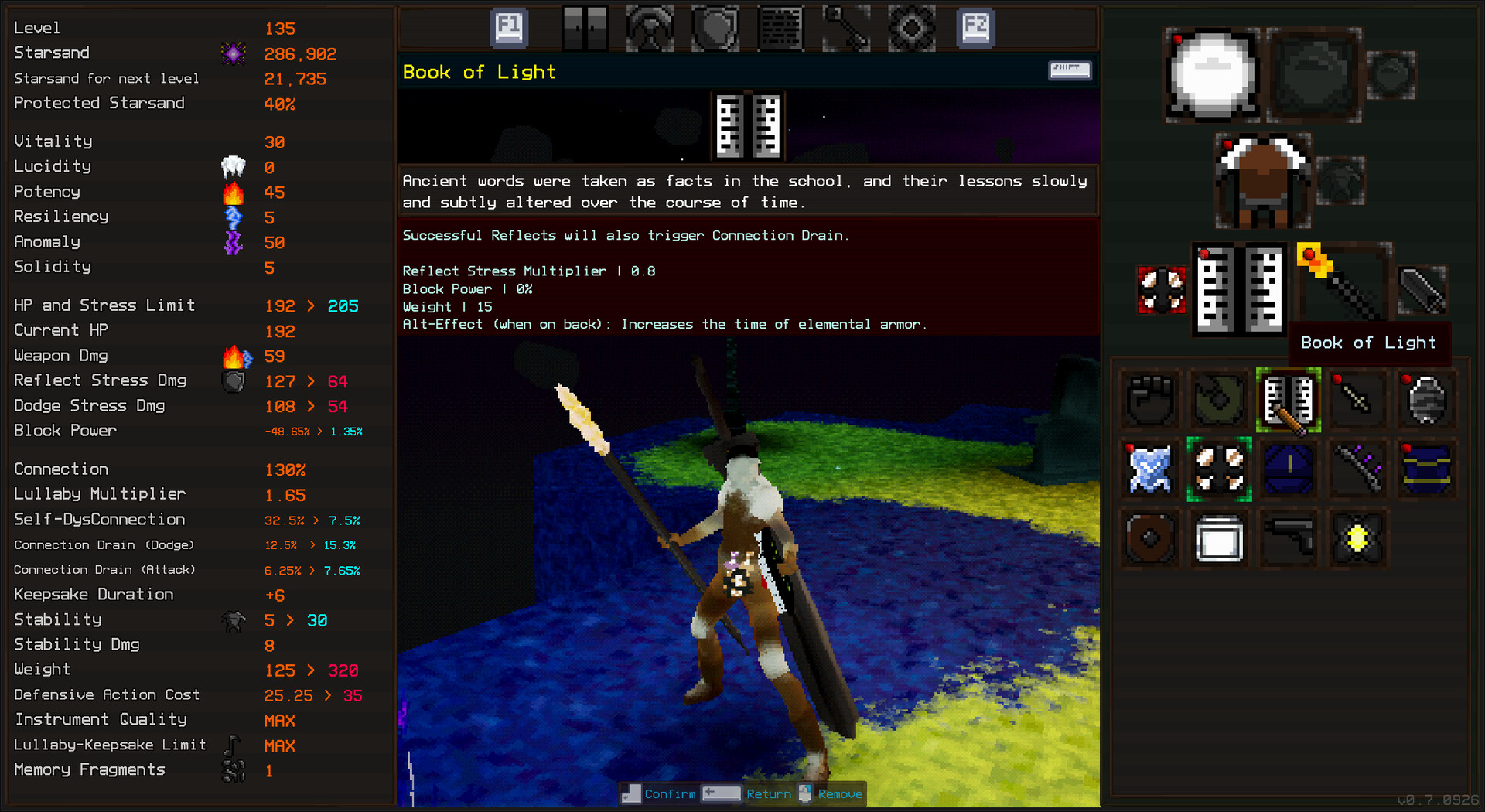
- Armor sets change how long negative statuses last on you. With the Connection system in play, status-duration armor indirectly reduces your spell self-damage window.
- Masks change how enemies approach you in combat. Some masks make aggressive enemies hesitate, others lure them into bad positions.
- Off-hand items modify your combat style, from parry timing to Stress recovery.
- Weapons span 31 entries, from mundane blades to the bizarre. You can and will fight enemies attacking with chairs, and you can find weapons just as absurd.
Every item has a purpose. Items replenish at certain points instead of disappearing when consumed. Collect the same item multiple times to upgrade it, but dream equipment has limits. Plan upgrades around one build, not six.
Keepsakes and Lullabies
Two consumable systems run in parallel:
- 25 Keepsakes are replenishing consumables with passive effects. They are your bread and butter. Swap them between sections and let checkpoints refill them.
- 67 Lullabies are the spell list. Each has its own cost and effect, from projectiles to buffs to area denial. Every cast feeds your Connection bar, so a caster build is a resource-management build.
Dungeons and Bosses
The game has 8 unique dungeons, each with its own mobs, mini-bosses, and final boss. The cemetery and school act as the tutorial. Later dungeons escalate the dream logic: hostile geometry, floating platforms, ledges that turn out to be giant swords. One infamous early death comes from rolling off a hundred-foot ledge that was actually a blade.
Named bosses include the Grave Warden (fought in his own garden), the Matron Defenders, the Deacon of Dreams, the Duke of Dreams, and The Librarian. Achievement names map to bosses and collection milestones, so the full list doubles as a progress checklist.
The Bedroom
The bedroom is Memoirium's unusual bonfire. A modern, mundane room inside a fantastical nightmare. You rest here to level stats and save. You can furnish it with mementos found across the journey and write in it. The contrast between the modern room and the sword-and-sorcery combat outside reinforces the sense that this world is not quite right. Decorating is partly a gimmick, but it lands as a genuinely safe space.
Progression Strategy
What to Prioritize First
- Survivability stats first. Early game, survival beats damage. A bigger health pool buys more mistakes, and more health directly funds the Lullaby-casting-while-ailed lifestyle if you go caster.
- Weapon upgrades over new weapons. Duplicates upgrade your current weapon. Find one moveset you like and feed it duplicates. A leveled basic weapon beats an unleveled exotic one.
- One Lullaby, mastered. Do not spread casting thin. Learn one reliable ranged or buff Lullaby and one panic button. Every cast stacks Connection, so a small, disciplined spellbook is safer than a big one.
- Status armor for the area. Before each dungeon, identify its status effects and swap armor. Shorter status duration means fewer turns Stressed and smaller Connection penalties.
- Unlock shortcuts before bosses. The interconnected world is built so you can loop back to the boss door. Always spend the extra minutes hunting the loop.
Area Order Logic
You can reach dungeons in multiple orders, but a sensible path follows difficulty and status themes:
- Cemetery and school (tutorial pair, learn the Stress and reflect system)
- The first full dungeon you can reach with your starting weapon level
- Dungeons that drop armor for the statuses used by later areas
- The hardest, most vertical dungeon last, after you have a mobility or survivability Lullaby
There is no wrong order. There is only an order that wastes fewer Keepsakes.
Builds and Tier Lists
Caster Discipline: The Lullaby Budget
A magic build in Memoirium is really an exercise in Connection accounting. Budget your casts per checkpoint cycle:
Connection-safe casting pattern:
  Cast 1-2: free, Connection building
  Cast 3:   check the bar; if near full, STOP
  Full:     next cast afflicts you, switch to melee
  Ailed:    zero casts until it clears, or pay health
Pair a damage Lullaby with a status-cleanse or duration-reduction armor set. Casters who ignore Connection die to their own spellbook.
Weapon Families
| Family | Strength | Weakness | Best for |
|---|---|---|---|
| Straight swords and blades | Balanced speed and damage | Low stagger | Beginners learning the reflect loop |
| Heavy weapons | Massive stagger, high damage | Slow, punishing whiffs | Players who can time reflects consistently |
| Pike/spear (e.g. the flaming pike) | Range, safe pokes, elemental fill on enemies | Weak in tight corridors, feeds elemental Connection | Poking bosses from outside their swing arc |
| Off-hand focus builds | Reflect and counter synergy | Demands perfect timing | Players who mastered the Stress-transfer loop |
A flaming pike style is a legitimate full-offense strategy even in the early game. Range does not save you from dream geometry though. Elemental weapons and spells fill your Connection bar with their element, so the aggressive elemental build still needs discipline.
Mask Loadouts
Masks are the hidden build layer. If a boss is aggressive, equip a mask that makes enemies hesitate. If a dungeon's mobs swarm, equip a mask that lures them into favorable positions. You can change a boss fight's entire rhythm without changing your weapon.
Armor Sets by Situation
| Threat you face | Armor priority |
|---|---|
| Poison or decay | Status-duration reduction |
| Stress buildup from big hits | Defense and recovery |
| Fire and elemental dungeons | Element resistance, which also blunts Connection fill from enemy hits |
| Generic physical | Defense and weight balance |
Keepsake Priority
| Keepsake type | When to use |
|---|---|
| Passive damage buff | Between checkpoints, on the approach to a boss |
| Survival passive | Boss fights and unfamiliar areas |
| Status immunity | Dungeons built around one status |
Cycle Keepsakes at every checkpoint. The replenishment system is designed for aggressive, varied use.
Step-by-Step Strategy
Sequence 1: The Cemetery to School Opening
- Wake in the cemetery. Do not fight everything. The path forward matters more than clearing the graveyard.
- Cross the crumbling statue. Watch your footing; dream geometry is hostile from minute one.
- Enter the school. Expect a tall humanoid enemy that chases through corridors. It is fast, so use doorways to reset its approach.
- Find the first checkpoint and the bedroom. Rest, then level stats.
- Practice the reflect on the school's slowest enemy. Watch the enemy's Stress bar fill with each successful reflect.
- Fight the school mini-boss. Keep Stress below full at all times; the extra damage while Stressed turns a survivable hit into a death sentence.
Sequence 2: The Stress Transfer Loop
- Enter a fight with Stress at zero. Disengage and recover if you are anywhere near full.
- Learn one attack pattern. Dodge the safe attacks.
- Reflect the telegraphed, parryable attacks. Each success fills the enemy's Stress.
- Once the enemy's Stress is full, switch to aggression: they take extra damage, so cash in.
- Back off before your own Stress fills. Ending the exchange healthy beats ending it dead.
- Repeat. The whole game is this loop at increasing speed.
Sequence 3: Dungeon Clearing
- Enter with the right armor for the dungeon's status theme.
- Clear the first room to learn the local enemy movesets and which attacks are elemental.
- Hunt for the shortcut before the boss. Explore every locked door and one-way drop.
- Return to the bedroom with collected items. Upgrade your weapon if you found duplicates.
- Equip a survival Keepsake for the boss.
- Fight the boss with the Stress transfer loop from Sequence 2.
Sequence 4: Boss Preparation
- Spend the first attempt purely on defense. Classify every attack: dodgeable, blockable, or reflectable. Note which ones are elemental, because those fill your Connection.
- Equip a mask that changes the boss's approach behavior.
- Swap to status armor if the boss applies statuses.
- Fill Keepsakes at the checkpoint, then take the shortcut to the boss door.
- On the second attempt, reflect only the attacks you classified as reflectable and build boss Stress.
- Punish the Stressed window with a heavy attack or one careful Lullaby, then reset.
Sequence 5: The Collection Run
- After the credits, review the achievement list. It names every boss and collection milestone.
- Use the interconnected world to reach missed areas through shortcuts.
- Collect weapon, armor, mask, and off-hand duplicates to finish the upgrade achievements.
- Decorate the bedroom with every memento. The room tracks your completion.
- Revisit boss gardens for missed items. The Grave Warden's garden is easy to under-explore.
Advanced Tips
Reflect Early, Reflect Often
The single highest-value skill in Memoirium is the reflect. It is risky, but a success shifts Stress onto the enemy, which is effectively free damage and free breathing room. Train on slow school enemies until the timing is muscle memory. Bosses use the same rules, just faster.
Watch Your Own Stress Like a Second Health Bar
Stressed fighters take extra damage, dash instead of roll, and cannot sprint. When your Stress bar climbs, disengage even if the enemy looks weak. Most deaths in this game are Stressed players taking one hit too many.
Connection Is a Dungeon Property, Not Just a Spell Resource
Elemental enemies fill your Connection when they hit you. In an element-themed dungeon your Connection climbs passively, which means your next spell may afflict you even if you cast sparingly. Check the bar before every cast in elemental areas.
Armor Swap Between Areas
Never keep one armor set forever. Status-duration armor is wasted in a dungeon with no poison and essential in one that floods the floor with it. Swap at the bedroom before each new area.
Keepsake Cycling
Rotate Keepsakes every checkpoint. Use the passive that helps the current section, swap to a different one for the boss, and let the checkpoint refill both.
Lullaby Synergy
The 67 Lullabies are not all equal. Pair a Lullaby that applies a status with one that punishes enemies carrying that status, but count the Connection cost of the combo before you commit. Test combinations in safer areas before taking them to bosses.
Shortcut Hunting
When you find a locked door or a one-way drop, note it. Returning from the other side usually reveals a shortcut that cuts a full dungeon loop in half. With no map, drop a mental landmark on every shortcut you open.
Save Anywhere, But Rest Deliberately
You can save anywhere, but the bedroom is the only place to level and restock. Resting respawns enemies, so plan your route around the bedroom loop rather than saving reflexively.
Controller vs Mouse and Keyboard
Combat plays fine on a controller. Menu interactions, especially inventory sorting and decoration placement, work better with a mouse. Use the controller for fights and the mouse for menus, and test your setup early because controller support in menus is hit-or-miss.
Known Issues and Troubleshooting
| Issue | Status / Workaround |
|---|---|
| Character stuck, unable to act | Fixed in patch v1.0.81426; if it recurs, restart and load the save |
| Inventory screen stutter | Patched performance pass; keep the inventory closed during fights |
| Invisible attacks | Fixed in v1.0.81426 |
| Enemies jumping off ledges | Mostly fixed; treat it as a feature when it happens |
| Main menu pausing the game | Fixed in hotfix v1.0.81226 |
| No pause during gameplay | Known complaint; save anytime instead |
FAQ and Common Mistakes
Is Memoirium hard?
It is a fair Soulslike. The first hours are the hardest because you are still learning the Stress and reflect systems. Once you understand that Stress is a shared resource you can push onto enemies, fights get dramatically smoother.
How long is the game?
With 8 dungeons, 31 weapons, 67 Lullabies, and 34 achievements, a full playthrough with collection runs lands around 15 to 25 hours.
Do consumables run out forever?
No. Keepsakes and items replenish at checkpoints. Use them freely.
Can I upgrade equipment?
Yes. Collect the same item multiple times to upgrade it. Dream equipment has upgrade limits, so invest in one build.
Why do my spells hurt me?
That is Connection. When the bar is full, your next Lullaby inflicts its element's status on you, and casting while ailed drains health. Stop casting when the bar fills, or accept the tax.
Does it have multiplayer?
No. Strictly single-player.
Is there a pause button?
Not in the standard sense. The game supports save anywhere, so use that instead.
Does it run on Steam Deck?
The Steam page lists Windows only. Steam Deck users should check Proton compatibility before buying.
Common Mistake: Fighting everything
Not every enemy is worth the exchange. Run past packs to reach checkpoints and shortcuts, then fight the ones that block your path.
Common Mistake: Ignoring the bedroom
The bedroom is your stat hub, restock point, and save anchor. Skipping rest loops to save time costs you upgrades and Keepsakes.
Common Mistake: One build forever
The game rewards adapting armor, masks, and Keepsakes to each area. A static build works, but a reactive one wins.
Final Verdict
Memoirium earns its spot with its setting and its mechanics. The dream world of liminal spaces, the PS1-era graphics, and the deliberate dream logic combine into something genuinely fresh. The Stress-transfer system gives combat an identity beyond "Dark Souls but weird": you are not just dodging, you are managing a mood that belongs to both fighters. Connection turns magic casting into a resource gamble that no other Soulslike attempts. The bedroom adds a quiet, personal rhythm between the horror.
Buy it if you love liminal horror and want a Soulslike built around that mood. Skip it if you need fast combat, a clear story, or hand-holding. At $14.99, a solo-dev game with this much personality is an easy recommendation.
Last reviewed by Game How To Editorial. We play each game, verify mechanics against official sources, and update guides when patches change them.
Screenshots