Official game
Play Forsworn
This game is hosted by Steam. Continue to the official page to play or download it.
Wishlist on SteamOverview
Forsworn is a turn-based tactics roguelite about stacking combinations broken enough to kill gods. You lead a party of heroes through a realm torn apart by divine war, and every run ends one of two ways: a dead god or a dead party. Death is not the failure state. Death is the economy. When a run ends, it pays out Soul Shards, and those shards buy the permanent upgrades that make the next run smarter, faster, and meaner.
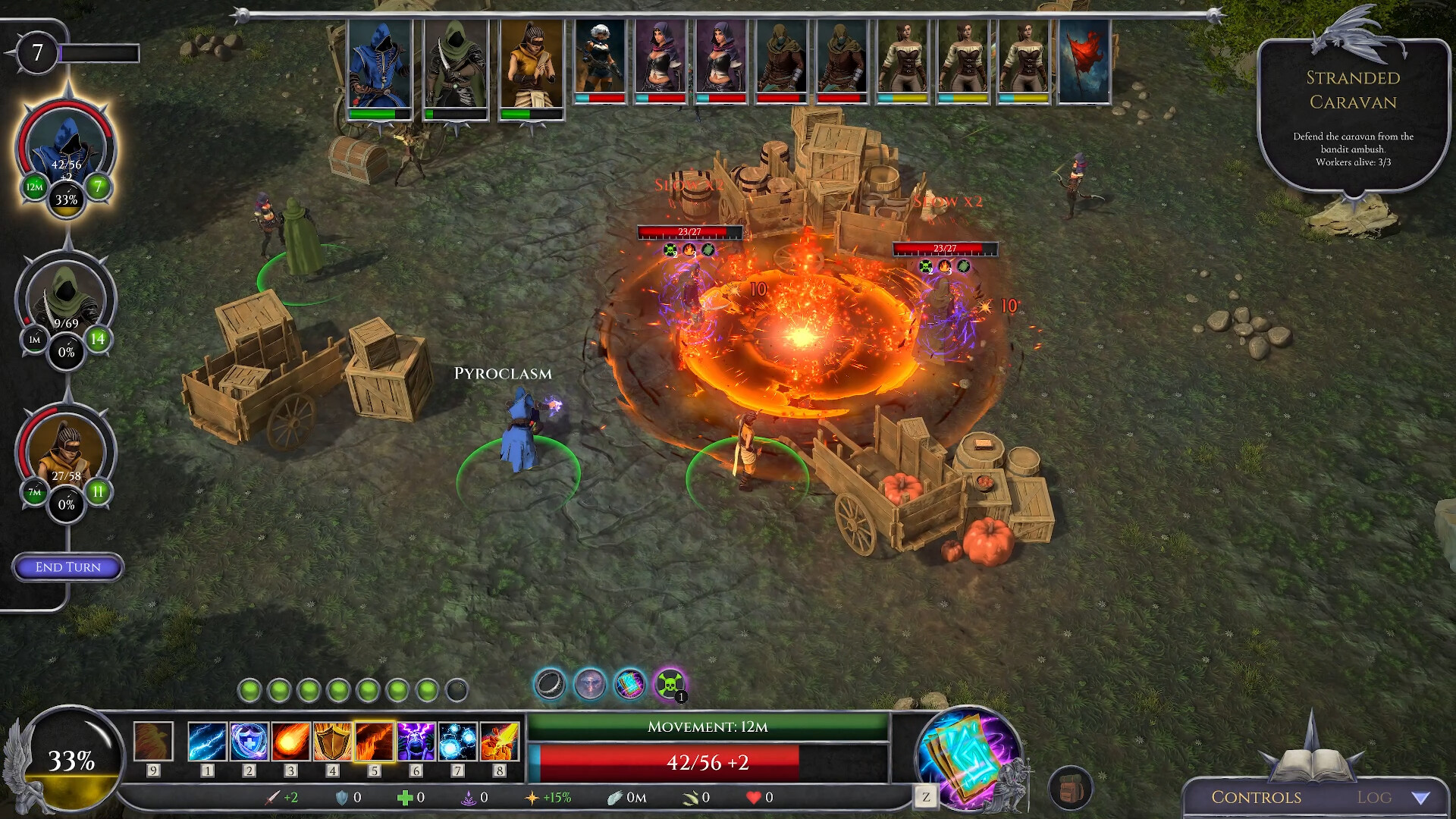
Combat runs on simultaneous turns. Everyone commits their commands, then everything resolves together. You never get to react to an enemy move because it happens in the same tick as yours. That single design choice changes everything about how you plan. Bluffing, prediction, and round-by-round scripting replace the you-go-I-go chess of classic tactics games, and the developer leans into it openly, citing Baldur's Gate 3 and Divinity: Original Sin 2 as the inspiration for the action economy and elemental interactions.
The numbers behind the build space are the selling point: six hero classes, three branching subclasses each, 150+ items to build around, and 200+ abilities with individual upgrade paths. The launch build also added an Endless Arena mode with escalating curses and global leaderboards, plus scaling difficulty tiers that stack enemy modifiers and map-wide trials onto every encounter. One player made all of this. Resummon Studios is a solo developer, and the launch announcement credits years of solo work plus a very active playtest community.
Launch facts that matter for your wallet and your wishlist: the game released September 10, 2026 at $15.99 USD with a 20% launch discount through September 24, bringing it to $12.79. The free demo contains the full first Act, its boss, and progress carries over to the full release, which makes the demo the correct starting point for anyone on the fence.
Target audience: players who want Slay the Spire's build-crafting, Into the Breach's tight tactical puzzles, and a co-op structure that actually works. If you enjoyed Stolen Realm or Inkbound but bounced off their long-term support, this is the same genre with a fresher start. Solo players get the full game; co-op groups of two to four get the same campaign with shared chaos.
Difficulty: Normal and Hard, plus escalating difficulty tiers after that add enemy modifiers and map-wide trials. Expect your first run to end somewhere in Act 1 or 2. That is normal. The meta-progression is tuned so losses always pay.
| Fact | Detail |
|---|---|
| Developer / Publisher | Resummon Studios LLC (solo dev) |
| Genre | Turn-based tactics roguelite, party RPG |
| Release | September 10, 2026 |
| Price | $15.99 USD, 20% off to $12.79 until Sept 24 |
| Platforms | Windows, native Linux, Steam Deck |
| Players | Single-player, 1-4 online co-op |
| Heroes | 6 classes (Knight, Paladin, Wizard, Monk, Assassin, Ranger), 3 subclasses each |
| Items / Abilities | 150+ items, 200+ abilities with upgrade tiers |
| Modes | Adventure (3 Acts), Endless Arena, leaderboards |
| Meta-currency | Soul Shards, Soul Shard Bonuses, blessings |
| Deck verification | Developer-confirmed support: native Linux build, controller-first, enlarged text, 60fps (80fps on lower presets) |
| Demo | Free, full Act 1, progress carries to release |
Getting Started: Your First 30 Minutes and Beyond
The tutorial teaches three layers at once: the party in front of you, the run you are drafting, and the meta economy between runs. Learn them in that order.
- Play the tutorial fights slowly. The simultaneous-turn system is the whole game. Watch how enemy commands resolve at the same time as yours. Your first instinct will be to wait and react; you cannot. Plan the round, commit, and read what happened.
- Draft a boring party first. One damage dealer, one tank, one support. Eighteen base playstyles exist across the roster before items. The broken synergies come later, after you have seen what a standard round looks like.
- Never spend a tick without generating Ultimate Charge. Attacking, casting, and defending all charge your Ultimate. A hero who ends a round having done nothing is a hero who delayed the party's win condition by a full rotation.
- Lose on purpose if you must. Death pays Soul Shards. The worst opening move in this game is restarting a doomed run, because a completed failed run still buys permanent power.
- Spend shards on mechanics, not numbers. Soul Shard Bonuses that add triggers, charge sources, or new ability behavior outscale bonuses that raise stats, because enemy scaling erodes flat numbers every tier and never erodes mechanics.
- Treat Rest Sites as build editors. They recharge the party and let you reshape an ability. Healing is the boring option; editing a carry ability to fit your item pool is the strong one.
- Re-roll merchants ruthlessly. Since the demo update, re-rolling shop stock is a core tool. A shop with nothing that fits your build is not a shop; it is a prompt to pay for a better one.
- Set the game speed up. A faster speed option ships in the settings. Tactics veterans should enable it early; fights are designed to be readable at speed, and Hard mode assumes you can process a round quickly.
- Claim the free wins. Early achievements double as a progression checklist: first death (Through Death, We Endure, 42.9% of players), 500 gold banked in one run (Deep Pockets), and casting 8+ abilities in a single turn with one hero (Perfect Calculation). That last one sounds absurd until you build a charge engine around the Monk.
Beginner Mistakes That Cost Runs
| Mistake | Why it hurts | Do this instead |
|---|---|---|
| Restarting failed runs | You forfeit Soul Shards | Let the run die, take the payout |
| Hoarding Ultimates for the boss | Charge from unused rounds is wasted tempo | Rotate Ultimates on a rhythm |
| Buying stat-block items | +stats dilute an identity build | Buy items that trigger your engine |
| Skipping elites out of fear | Elites pay the best reward mix in the game | Path through them with a plan |
| Playing Hard before clearing Normal | Hard assumes fluent charge management | Clear Normal, learn the scaling, then Hard |
| Ignoring the tank's guard action | Guard builds charge like anything else | Guard as a charge generator, not a white flag |
Core Mechanics Explained
Simultaneous Turns Change Every Rule
Every combatant commits actions for the round, then everything resolves together. There is no initiative duel, no reaction window. Three consequences follow, and they define high-level play:
- Prediction beats reaction. You are forecasting the enemy round, not answering it. Learn enemy intent tells early; the Bandit King's clone threshold is the first hard lesson (more below).
- Free tempo is the strongest resource. Anything that grants extra actions, delays enemy turns, or re-positions without spending an action is worth more here than in any you-go-I-go game.
- Co-op plays at solo speed. Four players commit commands at once, so a full lobby runs as fast as a solo run. Coordination happens in the planning phase, which makes callouts before confirmation the real co-op skill.
Heroes, Subclasses, and the Ranger
Six hero classes ship in the launch build, each with three subclasses that alter playstyle rather than just numbers. Upgrades evolve abilities and unlock new mechanics. The visible roster and subclass unlocks, per the achievement list and the pre-launch dev posts:
| Hero | Known subclasses | Unlocked at | Kit identity |
|---|---|---|---|
| Knight | (base Worthy Blade path) | Level 6 | Frontline durability, shield generation |
| Paladin | Lights Herald | Level 6 | Support-damage hybrid, empowerment |
| Wizard | Time Warden | Level 6 | Damage + shielding, turn manipulation |
| Monk | (perfect-equilibrium build) | Level 6 | Charge generation, ability spam |
| Assassin | (burst/execute path) | Level 6 | Single-target deletion, multi-kill turns |
| Ranger | Hunter (permanent pet), archery, tracking | Level 6 | Pet companion, ranged control |
The Hunter subclass is the one the developer described in detail before launch: a permanent pet companion, with the Ranger's other two subclasses focused on archery and on tracking magic and tools. If you like pet classes, the Ranger is the hero to unlock first.
The Synergy Economy
The game is a drafting engine wearing tactics clothes. 150+ items and 200+ abilities exist to be combined, and the store page's language is a design contract: theorycraft your way to broken, game-breaking combos. In practice the economy has a shape, learned from the release build and its players:
- Act 1 is scarce by design. Items are sparse and niche. Most of them are build-defining if you commit. This is where you find your run's identity.
- Act 2 is the crunch. Items flow more freely, but you only start with four item slots, so you start cutting. Abilities can be maxed here, and depending on the ability, maxing is a genuine power spike.
- Act 3 is the payout. By this point a healthy run is swimming in items and gold. Duplicate epics pile up; sell them, dump gold into tomes, and max your core skills. The run either became a god-slaying machine or it did not, and Act 3 mostly measures the drafting you did earlier.
Ultimate Charge
Every action builds charge: attacks, spells, defense. When the gauge fills, the hero's unique Ultimate fires, and Ultimates break enemy ranks, empower allies, or deal overwhelming force. Because everything charges, the correct question is never "should I save?" It is "what is my rotation?" A party that fires a support Ultimate into a carry Ultimate every third round is playing a different, better game than one holding both for a perfect moment that never comes.
Two achievements define the ceiling of this system: Limitless asks for +75% Ultimate Generation in combat with a Monk in the party, and it sits at 0.4% of players. The entire Monk charge-engine build exists to reach that number.
Status Effects Are a Win Condition
The status layer is deep enough to build around, and the achievements prove it: No Escape wants 8 different negative status effects on one enemy, Blood Spiller wants 20 Bleed stacks, Powerless Before Me wants 10 stacks of Weakened. Stacking one debuff family to absurdity is a legitimate Act 1-2 strategy, and Bleed in particular scales into a primary damage source with the right items.
Rest Sites, Smiths, Merchants, and the Map
Each node type pays a different currency, and understanding the exchange rates is the difference between a strong run and a dead one:
| Node | Pays | Best used for |
|---|---|---|
| Fight | XP + gold + ability/upgrade + items | Everything; the best all-around node |
| Elite fight | Bigger version of the above | Priority pathing once the party can handle it |
| Rest Site | Heal, max HP, ability swap, ability re-roll | Build edits, emergency recovery |
| Smith | Targeted upgrade for tokens | Focused power, but costs multiple visits |
| Merchant | Items, abilities, re-rolls for gold | Filling identity gaps late |
| Event | Variable, usually one reward type | Gambling for tempo |
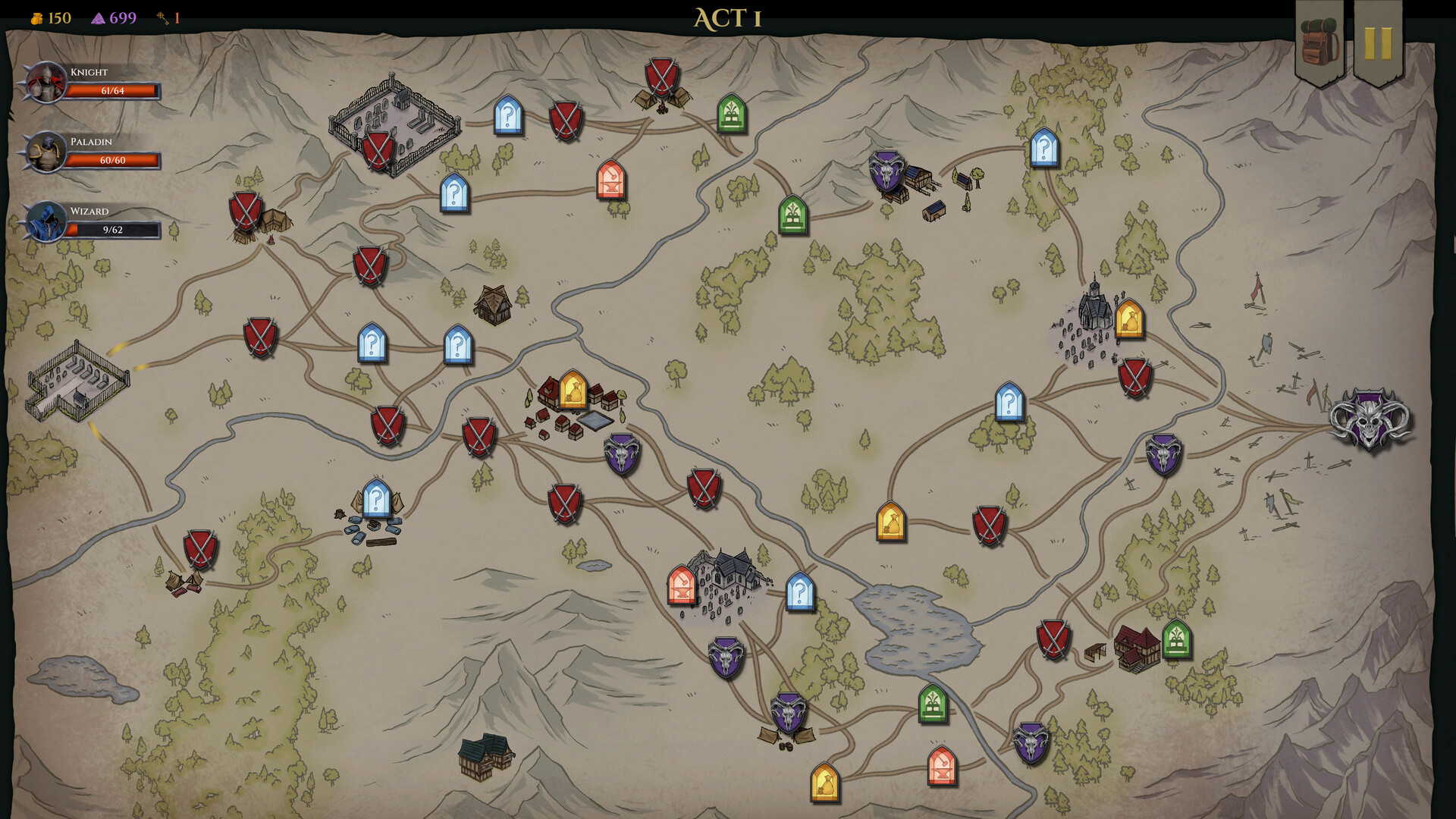
Pathing is the hidden skill. One release-week run mixing fights, elites, rests, smiths, and events evenly got crushed by the Act 1 boss; the next run that took nearly every fight and elite trivialized it. Fights pay a bit of everything for free, so when in doubt, path toward combat and treat smiths as a targeted bonus rather than a destination.
Hidden Locations and Events
The run map hides special nodes that the achievement list confirms: a tower from the lands beyond whose ancient keeper is a real boss fight (The Flame Now Watches), a forgotten Blacksmith in the castle depths (By Hammer and Flame), a Mysterious Vendor who gives gifts (A Mysterious Gift, 4.6%), a Transmutation Genie who grants three wishes (The Final Wish, 1.5%), and a Lord of Greed who will take your whole soul if you offer it (Nothing Left to Give, 1.7%). The lesson: check map edges, take the weird node. These events are where runs bend.
Death, Soul Shards, and the Meta
Defeat pays Soul Shards. Shards buy Soul Shard Bonuses (permanent hero modifiers), blessings, and ability unlocks. Two meta notes from launch week: demo progress carries into the full release, and achievements earned in the demo were briefly blocking Steam achievements for some players, which the developer is aware of; if your achievement list looks wrong after buying, that is a known sync issue, not you. Heroes also level mid-run, and party level 13 in a single run is a real achievement (The Long Game, 1.7%), so XP pathing matters inside the run too.
Progression Strategy: Spend Like You Mean It
Meta Spending Order
- Soul Shard Bonuses that add mechanics. New triggers, charge sources, on-kill effects. These change every future draft and never get diluted by enemy scaling.
- Hero ability unlocks for heroes you actually play. Widening the synergy pool of your two or three mains beats spreading unlocks across all six.
- Level-6 subclass unlocks. Six of them, one per hero, each a new playstyle. The Paladin's Lights Herald and Wizard's Time Warden are early favorites for how much they change their hero.
- Blessings. Last, because they are per-run. Once your meta base is solid, blessings become the way you force a run identity instead of hoping for one.
In-Run Progression
| Priority | Action | Reasoning |
|---|---|---|
| 1 | Path through fights and elites | Best reward mix per node, feeds XP and gold together |
| 2 | Upgrade your two carry abilities to max | Maxed abilities are spikes, not increments |
| 3 | Hold gold for tomes in Act 3 | Selling duplicate items into skill maxes is the late-run power curve |
| 4 | Smith visits only with a specific target | Tokens are expensive; random smithing is not |
| 5 | Rest Site edits over healing once sturdy | A reshaped ability outvalues 20 HP for the rest of the run |
The Four Item Slots
You start with four item slots, and they are the run's constitution. Every item you equip should either feed your damage engine, feed your charge engine, or cover a gap the party cannot afford. Two identity items and two enabler items is a workable default. Five fights into Act 1, write down what your run is trying to do; if the next item does not serve that sentence, sell it later for tome money.
Builds and Tier Lists
The meta is two weeks old, so treat tiers as directional. What follows reasons from the achievement data, the subclass design, and what launch players have reported winning with.
Hero Tier List (Launch Meta)
| Tier | Hero | Why |
|---|---|---|
| S | Monk | Charge economy is the game's strongest axis; Limitless (+75% Ultimate Gen) builds run through this hero |
| S | Assassin | The only hero with a multi-kill achievement (6 kills in one turn, 0.4%); burst scales best into simultaneous turns |
| A | Wizard | Time Warden subclass manipulates turns; damage + shielding covers two jobs at once |
| A | Ranger | Hunter's permanent pet is a full extra body; the pet tanks, you shoot |
| B+ | Paladin | Lights Herald support-damage hybrid; strong in co-op where empowerment multiplies |
| B | Knight | Solid, honest, shield-heavy; No Blade Shall Pass (75 shield end-of-turn) is a Knight flex, but the hero needs item help to carry |
Subclass Pairing Rules
- Pair a debuff applier with a debuff punisher. Bleed-stacking items with an execute-happy Assassin. Weakened-stacking with any AoE carry. The status families are the connectors.
- Pair charge generators with charge spenders. Monk generates; Assassin spends. In co-op, put these two players adjacent in the Ultimate rotation.
- Draft the blessing first, the subclass second. A blessing that amplifies a status family or charge rate tells you which subclasses are live this run.
Three Worked Builds
The Bleed Engine (Assassin carry). Take every Bleed-inflicting ability and item you see. Stack Blood Spiller (20 stacks on one enemy) as your mid-run checkpoint. Add on-hit items that apply Bleed with basic attacks, and a support who extends duration. The Assassin's single-target damage stops mattering; the bleed does the killing while you survive on repositioning. Watch for Act 3 enemies that cleanse; that is the build's ceiling.
The Charge Battery (Monk engine). Rush Ultimate Generation stats. The Monk's abilities mostly exist to generate charge for everyone. Items that grant charge on kill, on guard, and on cast turn the whole party into an Ultimate rotation that fires every two rounds. In co-op this is the party's engine room; solo, pair with Wizard so the Time Warden's turn manipulation gives the rotation more cycles.
The Immovable Wall (Knight + Paladin). Shield generation on the Knight, empowerment and sustain on the Paladin. No Blade Shall Pass (75 shield at end of turn) is the checkpoint. The Wall wins by refusing to lose HP while Bleed and chip damage do the work. Slower, safer, and the correct first co-op composition for new groups. Its Hard-mode achievement, Immovable (elite cleared without any party member losing health, 1.7%), lives here.
Step-by-Step Strategies
Strategy 1: The Act 1 Boss (Bandit King) — No Clones Allowed
The achievement A Coward Laid Bare (11.6% of players) requires killing the Bandit King before he summons his Shadow Clones, and the developer confirmed the exact threshold: he casts Shadow Clones when he drops below 70% HP.
- Enter the boss fight with the party healthy; this is a burst check, not an attrition fight.
- Build his HP down to 75-80% and stop. Do not cross the line by accident with an AoE tick or a Bleed stack; DoT damage counts when the round resolves, so watch your own dots.
- Set up the burst window: support Ultimate on the carry, charge items fired, everything lined up in one round's plan.
- Commit the full party damage into a single simultaneous round and kill him from above 70% to zero. If the math says you are short, take one more round of setup while keeping him above the threshold.
- Purple ghosts on the field mean you missed; finish the run and take the normal kill, then retry the achievement on the next run. The clones split the fight into a war of attrition you do not want.
This fight teaches the game's core skill: managing your own damage so the enemy's phase threshold is crossed only when you choose.
Strategy 2: The Fight-Heavy Route
- In Act 1, path through nearly every fight and elite node. Skip events unless the node is literally between two fights.
- Spend nothing at smiths unless you have a specific ability targeted.
- Bank gold instead of buying Act 1 shop items unless the item is an identity piece.
- By the Act 1 boss, you should be one level and four items ahead of a mixed route. Feel the difference.
- Repeat in Act 2 with one Rest Site edit per Act to reshape a carry ability.
This route converts the reward asymmetry into power. The boss that crushed your mixed-route run becomes trivial.
Strategy 3: The Ultimate Rotation
- Assign the rotation before the fight: support Ultimate, then carry Ultimate, then tank/control Ultimate.
- Fire on rhythm, every two to three rounds, regardless of the situation. Rhythm beats perfection.
- Use guard rounds to top off charge when a hero has nothing safe to do. Guard charges.
- In co-op, call the target and the status stack before the round commits. Mid-round changes are impossible.
- If a hero's Ultimate is not ready on their window, hand the window to the tank. Empty windows are wasted rounds.
A party in rotation never loses the action economy, and simultaneous turns reward the party that acts more per round.
Strategy 4: The Act 3 Tome Pivot
- Enter Act 3 with a full inventory and a full pouch. Sell every duplicate and off-identity item immediately.
- Dump the gold into tomes and max your core abilities. Two maxed abilities beat five half-upgraded ones.
- Keep exactly one flexible item slot for an Act 3 answer (a cleanse, a revive, a defensive panic button).
- Re-roll one merchant if your identity gap is a single item; otherwise save the gold.
- Spend the last Rest Site before the Act boss on an ability edit, not healing.
By the time the Act 3 boss loads, your party should feel over-tuned. If it does not, the drafting in Acts 1-2 was the problem, not Act 3.
Strategy 5: The Four-Player God Kill
- Lock roles at party creation: engine (Monk), burst (Assassin or Wizard), wall (Knight or Paladin), flex (Ranger or Paladin).
- Agree on the Ultimate rotation before the first fight and keep it for the whole run.
- Use the planning phase for all coordination. Nobody reacts mid-resolution; everybody predicts.
- When a boss phase threshold approaches (70% clone lines, summon lines), call "hold" one round early. Burst together or not at all.
- Debrief after every boss in one sentence: what worked. The rotation that survives three bosses becomes the group's standard.
Strategy 6: The Hard Mode Scout Run
- Accept that your first Hard run is reconnaissance. It will probably die in Act 2.
- Draft for charge rate and status stacking; Hard's enemy modifiers punish slow attrition builds.
- Note every modifier that killed you. Map-wide trials tell you which Hard modifiers your roster answers badly.
- Convert the notes into a draft plan: more charge items, earlier elite pathing, one cleanse minimum.
- Run it again with the plan. Hard opens up once your meta bonuses cover the modifier variance, exactly like the Diablo-style difficulty tiers it is imitating.
Advanced Tips
- DoT damage resolves with the round. Bleed you applied last round ticks when you did not press anything. Track it before you "hold" damage under a boss threshold, or you will summon clones with a papercut.
- AP caps your ability bar, not your library. Past the early game, new abilities stop mattering if you cannot cast them. More of the same type is dead weight; depth in two or three abilities wins.
- Sell early, sell often. Duplicate epics are tome money. Inventory pressure is real from Act 2, and hoarding "maybe" items is how runs quietly die.
- The Endless Arena is the build laboratory. Curses escalate and enemies scale, so it is where you test how far an engine goes. The leaderboards are a bonus; the information is the prize.
- Steam Cloud Saves split your play. Deck on the couch, desktop for theorycraft sessions, one progression bar. The 60fps target holds on Deck; drop graphics a notch for 80fps and battery life.
- Escalating difficulty tiers are post-game. They add enemy modifiers and map-wide trials on top of Hard. Finish the Normal campaign with two or three builds before touching them; the modifiers assume fluency.
- Co-op language quirk: some floating combat text follows the host's language, not yours. If your friend's screen says a different ability name than yours, you are both seeing the same effect.
FAQ and Common Mistakes
What is the price and is there a discount? $15.99 USD at launch, regionally adjusted, 20% off to $12.79 through September 24, 2026.
Does demo progress carry over? Yes. The developer pinned the PSA: demo progression carries into the full release. Play the free Act 1 demo first; it is the correct tutorial.
My Steam achievements look wrong after buying the full game. Demo progress could briefly block achievement unlocks for some players; the developer knows. If yours is stuck, re-check after a patch rather than restarting.
How many heroes and subclasses? Six hero classes at launch, three subclasses each: Knight, Paladin, Wizard, Monk, Assassin, Ranger. The Ranger's Hunter subclass keeps a permanent pet companion.
How does the Bandit King achievement work? Kill him before he summons Shadow Clones. He casts them below 70% HP, so hold your burst until you can take him from above the threshold to zero in one round.
Is there an Endless mode? Yes. Endless Arena with escalating enemies and curses, plus global leaderboards.
Does it run on Steam Deck? The developer confirms full support: native Linux build, controller-first play, enlarged text, Steam Cloud Saves, 60fps with lower presets at 80fps. Official verification may lag the support.
Can four players play locally on one screen? No. Co-op is online, 1-4 players. Local couch co-op is a frequent forum request, not a feature.
Is there a language setting? In-game language switching is limited at launch and some text follows the host's language. Translations launched rough in some languages; expect patches.
How long is a run? Roughly one to two hours for a full three-Act Adventure run at normal speed, faster with the speed option raised. Endless Arena runs are open-ended.
Common Mistakes
- Crossing boss thresholds by accident. AoE splash and DoT ticks count. The 70% clone line punishes imprecise planning more than weak parties.
- Drafting all six heroes shallow instead of three deep. Meta Soul Shard Bonuses on your mains beat a little progress everywhere.
- Treating smiths as mandatory stops. Tokens are scarce, fights pay more, and a random upgrade is not a plan.
- Hoarding Ultimates. Charge is tempo. Spend it on rhythm, save it never.
- Skipping the speed setting. Hard mode at default speed is self-inflicted difficulty.
- Reading Act 3 item floods as wealth. Duplicates are inventory pressure; convert them to tomes immediately.
Quick Reference Card
| Goal | Answer |
|---|---|
| Best first party | Monk + Assassin + Wizard (or Knight in co-op) |
| Best node to path | Fights and elites, always |
| Bandit King clone threshold | 70% HP, hold burst above it |
| Best meta spend | Mechanical Soul Shard Bonuses first |
| Best Act 3 gold sink | Tomes to max core abilities |
| Achievement rarity peaks | Limitless 0.4%, No Gods No Masters 0.2%, Swift Judgement 0.4% |
| Deck preset | 60fps default, lower graphics for 80fps |
| Launch discount | 20% off until September 24, 2026 |
Final Tips
Pick a blessing, draft two carries around it, and let every item either feed the engine or get sold for tome money. Path through fights because fights pay in everything. Hold your burst above phase thresholds and cross them on purpose. Fire Ultimates on rhythm, not on inspiration. And when the run dies anyway, bank the shards, buy the mechanic that fixes the draft, and start again. The gods are not going to kill themselves.
Last reviewed by Game How To Editorial. We play each game, verify facts against official sources, and update guides when game mechanics change.
Screenshots