Official game
Play Flipdee Flopdee
This game is hosted by itch.io. Continue to the official page to play or download it.
Play on itch.ioOverview / Game Introduction
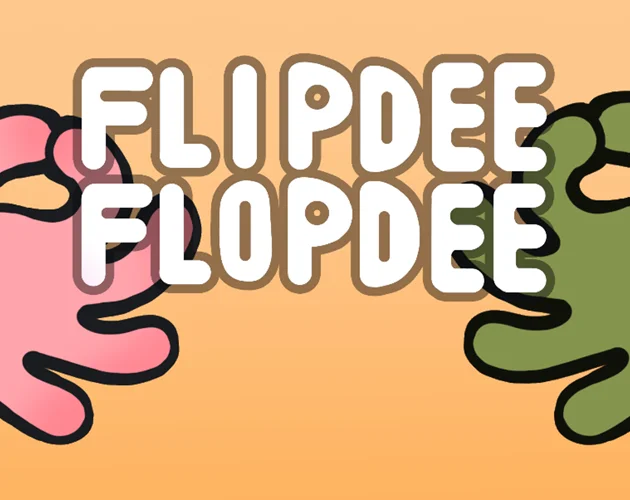
Flipdee Flopdee is a free browser-based coin-flipping battle game that mashes the positional thinking of Othello/Reversi with the glorious uncertainty of a coin toss. Developed by Gumboot Studio (Brieyh'leai and Nic) for the Summer Slow Jams 2026: Luck game jam, it's a game that asks a simple question: what if every move you made in a board game was settled by a coin flip?
The result is a delightfully chaotic local multiplayer duel where two players take turns dragging coloured coins onto a wooden board. Each time a coin lands, every adjacent coin flips in the air — and when they come back down, they randomly land on either your side or your opponent's. The tension comes from the fact that you can set up a brilliant positional play, only to have the flip gods hand the advantage to your opponent... or you can take a reckless gamble and watch the coins rain down in your favour.
Games are fast — typically 3–5 minutes per round — making Flipdee Flopdee an ideal party game, a quick warm-up between longer sessions, or a salty grudge-match engine between friends. With its warm, hand-drawn art style, cosy colour palette, and charming character designs, it's the kind of game that looks cute on the surface but can get fiercely competitive after a few rounds.
| Detail | Info |
|---|---|
| Genre | Strategy / Party / Board Game |
| Developer | Gumboot Studio (Brieyh'leai & Nic) |
| Engine | HTML5 (Play in browser) |
| Platform | Browser (itch.io) + Windows Download |
| Price | Free (name your own price) |
| Players | 2 players (local multiplayer, same screen) |
| Release | 23 June 2026 (updated 30 June 2026) |
| Game Jam | Summer Slow Jams 2026: Luck |
| Rating | 4.5 / 5 (itch.io) |
| Session Length | 3–5 minutes per round |
| Download Size | 63 MB (Windows ZIP) |
Target audience: Anyone who enjoys quick, luck-driven strategy games with a social edge. Fans of Othello, Reversi, or Connect Four will appreciate the positional layer. Fans of dice games, Mario Party mini-games, or anything with a "one more round" energy will love the pace. It's equally at home on a couch with a friend or played remotely via screenshare with a buddy on voice chat.
Getting Started — First 30 Minutes
Opening the Game
Flipdee Flopdee runs directly in your browser on itch.io — no account or download required unless you want the offline Windows build. Just hit the Run game button on the game page and you're in.
First Impressions
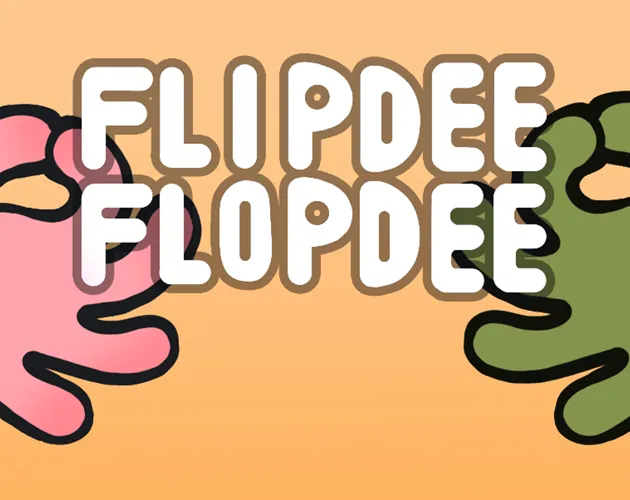
You're greeted with a warm, illustrated title screen. The art style is unmistakably Gumboot — soft colours, cute characters with big eyes, and a hand-drawn feel reminiscent of storybook illustrations. A wooden game board sits in the centre of the screen, flanked by two player areas.
Your First Match
- Two players share the same keyboard and mouse. Player 1 (typically pink/red tokens) sits on the left; Player 2 (blue tokens) sits on the right.
- Pick up a coin. Move your mouse cursor over your coin stack, click and hold (LMB), then drag onto an empty square on the board.
- Release to drop the coin. The coin lands, and immediately every adjacent coin (up, down, left, right — and possibly diagonals) flips into the air.
- Watch the flip. The flipped coins spin and land — each one has a ~50% chance of landing on your colour or your opponent's. This is the core luck mechanic.
- Pass the turn. The game alternates between players automatically. Take turns placing coins one at a time.
- The board fills up. Once every space is occupied, the game ends. The player whose colour appears on more coins wins.
What You'll Notice Right Away
- The first few moves feel random. You're just throwing coins onto an empty board. That's fine — the strategy emerges as the board fills.
- Adjacent flips cascade. Placing a coin in a cluster can flip multiple neighbouring coins, which themselves might land in your favour or against you. The chain reaction is where the chaos lives.
- Scores update in real time. A tally at the top (or side) of the screen shows whose colour is currently winning. Watch it swing back and forth!
- The "one more game" pull is strong. With rounds this short, you'll rematch before you know it.
Controls Reference
| Action | Input |
|---|---|
| Pick up a coin | Click and hold LMB on your coin stack |
| Place a coin | Drag to an empty board square and release |
| Confirm ready / next round | SPACE key |
| Navigate menus | Mouse |
| Select opponent / options | Mouse click |
Advanced Tips
| Mistake | Why It Hurts | How to Fix It |
|---|---|---|
| Placing in the centre first | The centre has 4+ adjacent neighbours, meaning your first move flips the most coins — but they all land randomly. You give the opponent just as much chance to benefit. | Start near the edges or corners where fewer neighbours means less chaos until you have a positional advantage set up. |
| Ignoring adjacency before placing | Every coin you place flips all adjacent coins. If three of your coins surround an empty space and you place there, they all flip — potentially handing them to your opponent. | Before dropping a coin, look at which of your own coins are adjacent. Ask: "Am I about to sabotage my own position?" |
| Playing purely defensively | Clustering all your tokens in one corner seems safe, but the opponent can force flips that break your cluster apart. | Spread your placements to create multiple zones. If one zone flips against you, you still have others. |
| Not watching opponent's colour | You're so focused on your own coins that you miss where the opponent is strong. | Before your turn, scan the board for clusters of opponent-colour coins. Targeted placements near them can flip several at once. |
| Rushing the drag-and-drop | Dropping a coin on a neighbour you didn't intend to hit because you rushed the placement. | Take your time. Hover over the square, confirm it's the one you want, then release. |
| Thinking it's pure luck | Beginners write off every outcome as "random" and stop thinking strategically. | Yes, individual flips are luck. But where you place determines how many coins flip and which ones. Positional skill matters enormously over a full game. |
| Forgetting the board is finite | Placing recklessly early on leaves you without good options in the endgame. | The early game sets up the mid-game, which sets up the endgame. Think two or three moves ahead. |
Core Mechanics
1. The Coin-Flip Resolution System
Every coin in Flipdee Flopdee has two states: your colour and your opponent's colour. When a new coin is placed on the board, every orthogonally adjacent coin (up, down, left, right) flips into the air and lands in a random orientation.
Critical detail: The flip outcome is independent for each adjacent coin. This means:
- If you place next to 2 coins, both flip independently. You might get 2 favourable results, 2 unfavourable, or one of each.
- The probability is approximately 50/50 per coin, but the game does not use a "balanced" system — streaks happen. Embrace the chaos.
Skill application: You can't control which way a coin lands, but you can control:
- How many coins flip (target dense clusters)
- Which coins flip (target opponent-dominated areas, avoid flipping your own strong zones)
- What the board looks like after (set up traps where any outcome benefits you)
2. Board Geometry and Positional Advantage
The game board appears to be a rectangular grid (exact dimensions vary by build — typically around 6×6 to 8×8). Board positions have very different strategic values:
| Position Type | Adjacent Neighbours | Strategic Value |
|---|---|---|
| Corner | 2–3 neighbours | Low risk, good for securing a stable zone |
| Edge | 3–5 neighbours | Moderate risk, good for building walls |
| Centre | 4–8 neighbours | High risk, maximum flip potential |
Corner strategy: Corners are the safest places on the board. When you own a corner, it's hard for the opponent to flip it because fewer coins surround it. However, corner placements also flip fewer opponent coins — so they're defensive, not offensive.
Centre strategy: Placing in the centre is explosive. You'll flip many coins at once, but the outcome is highly random. Centre plays are best reserved for:
- Comeback attempts when you're behind
- Mid-game power moves when the centre is dense with opponent coins
- Desperation scrambles in the final turns
3. Turn Economy and Board Capacity
Flipdee Flopdee has a fixed number of turns — one for each empty square on the board. Since both players alternate, each gets roughly half the total moves (depending on whether the board has an odd or even number of squares).
Key implications:
- Early game (first 25% of moves): Establish zones. Don't over-extend. Place coins in positions that give you options.
- Mid game (25%–75% of moves): Fight for contested zones. This is where most flips happen. Target opponent clusters.
- Endgame (last 25% of moves): The remaining empty squares are precious. Every placement flips existing coins — often deciding the match. Count potential outcomes before you drop.
Turn parity: If you're playing on an even-sized board, both players get the same number of turns. On an odd-sized board, the first player gets one extra turn. The first player has a slight advantage because they set the pace — but the luck factor can easily erase it.
4. The "Neutral Flip" Strategy Layer
Here's the most important strategic insight in Flipdee Flopdee: not all flips are created equal. When you place a coin and adjacent coins flip, the outcome can be categorised into three types:
- Positive flip: A coin that was your opponent's colour lands on your colour. Net gain: +1 for you, −1 for opponent (swing of 2).
- Negative flip: A coin that was your colour lands on your opponent's colour. Net loss: −1 for you, +1 for opponent (swing of −2).
- Neutral flip: A coin flips but lands on its original colour. No net change.
The skill lies in engineering situations where most possible outcomes are neutral or positive for you. For example:
- Placing next to two opponent coins in a corner: if both flip, best case is both become yours; worst case is both stay opponent's (neutral for you). Either way, you didn't lose anything you owned.
- Placing next to two of your own coins: if both flip away from you, you lose two coins. This is high-risk with no upside — avoid it unless you're desperate.
Golden rule of Flipdee: Never place next to more of your own coins than your opponent's coins.
5. The "Readiness" System
After the board is full, the game calculates the winner. But before the next round, players press SPACE to ready up. This small ritual serves a purpose:
- It gives both players a moment to process the result
- It prevents accidental skipping of the outcome screen
- It creates a clean transition into the rematch
Use this moment to mentally review the game: what worked, what didn't, and what you'd do differently next round.
Advanced Strategies
1. Baiting the Opponent Into Over-Flipping
Advanced players create apparent weak points — clusters of their own coins that invite the opponent to place an adjacent coin. If the opponent takes the bait, they'll flip those coins, but because you've set it up near the edge with few neighbours, the potential damage is limited. Meanwhile, you've baited them into using a turn on a low-impact move.
How to bait: Leave one or two of your coins slightly isolated near the edge. The opponent sees an opportunity to flip them. But because they're isolated, the flip affects at most 1–2 coins — a small price for controlling where the opponent places.
2. The Flip Cascade Trap
When the board is dense (late mid-game), you can engineer a situation where placing a single coin triggers a cascade — flips that chain into each other (though each coin only flips once per placement). The key is to target a "keystone" square adjacent to 4+ opponent coins. Even if each flip is 50/50, the expected value of 4 flips is +2 coins in your favour. Over multiple games, playing the expected value wins more than playing scared.
3. Zone Denial
In the late game, focus on denying the opponent high-value placements. If you notice a square that would let the opponent flip 3 of your coins, place there first — even if it's suboptimal for you otherwise. A mediocre move that denies a great opponent move is often the winning play.
Zone denial checklist:
- Are there any empty squares adjacent to 3+ of my coins? Place there to protect them.
- Are there any empty squares adjacent to 3+ opponent coins? Place there to steal them.
- Are there any empty squares that split the remaining board into two disconnected zones? Place there to control the flow.
4. Reading the RNG
While individual coin flips are random, the aggregate over a full game tends toward balance. If you've lost three straight flips in a row, the odds of losing a fourth are still 50% — the coins have no memory. But human psychology does. Use this:
- After a bad beat: Don't tilt. Your position is probably worse than the score suggests because luck swung against you. Play conservatively and wait for the pendulum to swing back.
- After a hot streak: The opponent is likely tilted. Exploit their aggression. They'll take risks to catch up — place defensively and let them over-extend.
- In a tied game late: Play for expected value. Calculate which empty square gives you the best probability-weighted outcome, regardless of how you "feel" about the luck.
5. Board Splitting
In the final 5–6 moves, the remaining empty squares often form distinct clusters. If you can place a coin that "splits" the board — creating two isolated pockets of empty squares — you effectively decide which zone belongs to which player for the remaining turns. Place in the split square that gives you the better zone for the endgame grind.
FAQ
Q: Is Flipdee Flopdee free to play? A: Yes! It's free to play in your browser on itch.io. You can also download the Windows version with a "name your own price" donation — even $0 works.
Q: What platforms is it available on? A: It runs in any modern web browser (Chrome, Firefox, Edge, Safari) via itch.io. A downloadable Windows version (63 MB ZIP) is also available.
Q: Is this a single-player or multiplayer game? A: It's local multiplayer for 2 players, sharing the same screen and mouse. There is no AI opponent or online matchmaking — you need a human opponent.
Q: Can I play online with a friend? A: Not directly via the game itself. However, you can use screensharing tools (Discord, Zoom, Steam Remote Play Together) to share your screen with a friend and take turns controlling the mouse.
Q: How long does a game take? A: Typically 3–5 minutes per round. The exact length depends on board size and how quickly players place their coins.
Q: Does it require an internet connection? A: Only to load the game from itch.io initially. Once loaded in your browser, it runs locally — but for the downloadable Windows version, no internet is needed after download.
Q: Can I change the board size or rules? A: The current version (as of June 2026) uses a fixed board size and rule set. Gumboot may add options in future updates.
Q: Is the game purely luck-based? A: No. While individual coin flips are random (~50/50), the strategic layer of where you place your coins creates meaningful skill differentiation. A skilled player will consistently beat a beginner over multiple rounds, even though any single round can swing on luck.
Q: Who developed Flipdee Flopdee? A: Gumboot Studio — Brieyh'leai (@comfyfish) and Nic (@niclupfer). They've created many charming games including Moon Boot Boogie, Chess Bonk, Maypole Royale, and Slumber Squad.
Q: Will the game get updates or new features? A: Gumboot has been updating the game (latest update: 30 June 2026), so further improvements are possible. Follow @gumbootstudio on Twitter for announcements.
Final Tip & Verdict
Final tip: Place where you'd least want your opponent to place. Before dropping any coin, ask yourself: "If it were my opponent's turn, where would they most want to put a coin?" If it's the same square you're considering, you're probably making the right move. Flipdee Flopdee is as much about denial as it is about accumulation — the player who controls the board's valuable spaces, even at the cost of immediate flip luck, will win more games in the long run.
Verdict: Flipdee Flopdee is a perfectly formed little party game that nails its core concept. The Othello-meets-coin-flip mechanic is simple enough to explain in 30 seconds but deep enough to reward repeated play with the same opponent. The presentation is charming — Gumboot's signature warm art style makes even a crushing defeat feel cosy. It's free, it runs in a browser, and a single round takes less time than making a cup of tea.
Is it a game you'll sink 100 hours into? Probably not. But it's a game you'll pull out for 20 minutes of laughter, tension, and friendly trash talk — and for that purpose, it's nearly perfect. If you have a friend nearby and five minutes to spare, give it a flip.
Guide last updated: July 2026. Game version: 1.0 (Summer Slow Jams 2026 entry). Guide by Game How To Editorial.
Screenshots