Official game
Play Battle Bot Tactics
This game is hosted by Steam. Continue to the official page to play or download it.
Play on SteamWhat Is Battle Bot Tactics?
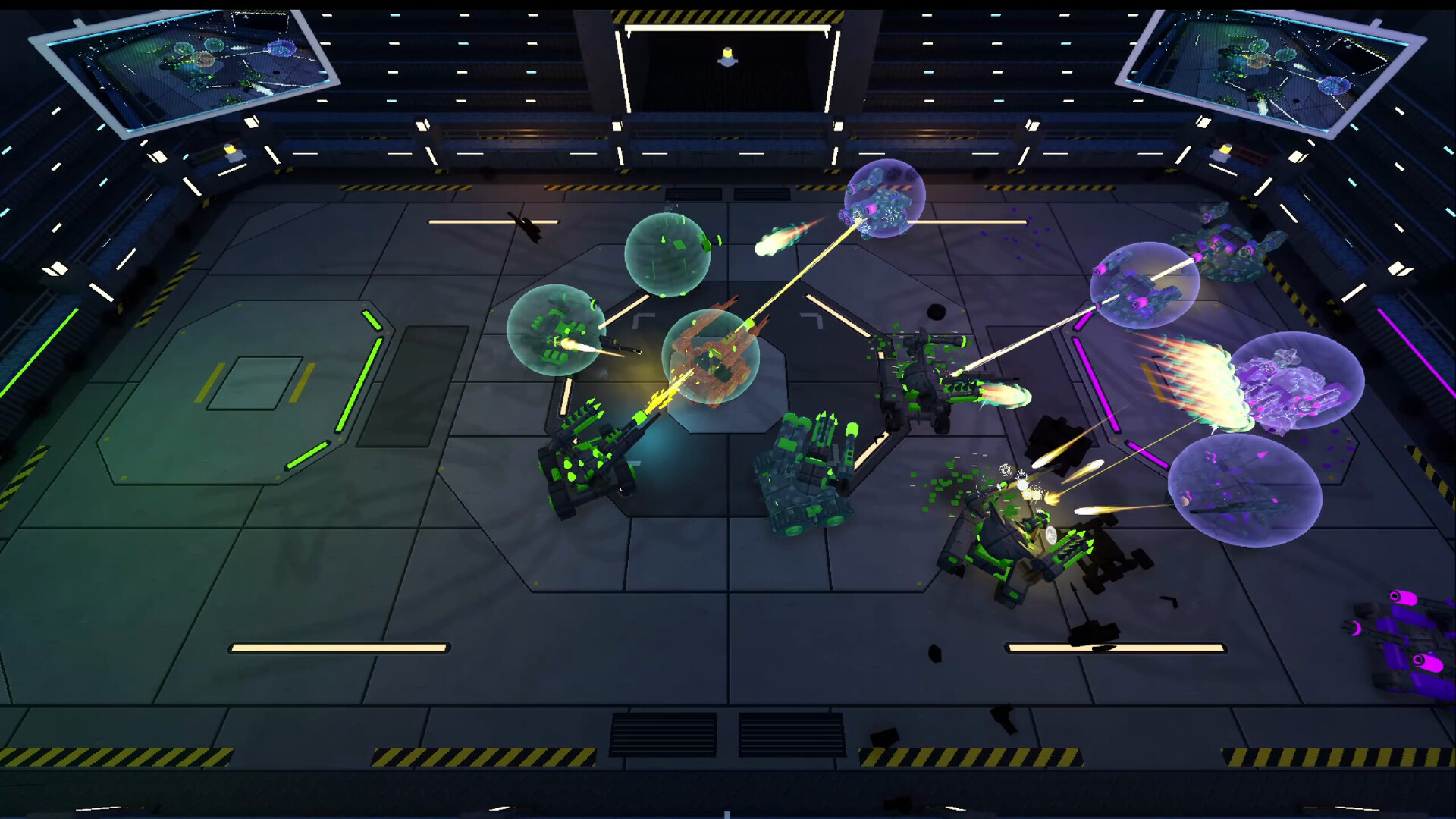
Battle Bot Tactics is a bot-building auto-battler from solo developer OddEngine, launching into Steam Early Access on October 30, 2026 for Windows and Mac. You engineer combat robots from loose parts, snap them onto a chassis grid, assign an AI module that decides how the bot behaves, then send a squad into the arena and watch the fight resolve on its own. The PvP is asynchronous, meaning your bots fight snapshots of other players' designs rather than live opponents, so battles happen on your schedule.
The loop comes straight from the inventory-management school of strategy games. Every part you scavenge or earn is a puzzle piece: weapons, movement systems, utility modules, and armor all compete for the same grid squares. The store page puts it plainly. There is no single correct way to build a bot. Win or lose, you end up back in the garage with new ideas and better parts.
The full game, per the store description, comes down to a seven-item list: building and customizing robots, experimenting with different parts and builds, watching automatic arena battles, improving your machines between fights, finding powerful combinations, climbing the ranks, and occasionally watching a terrible idea somehow work. That last item is a design promise, not a joke — the developer explicitly frames failed experiments as part of the fun.
Battle Bot Tactics Details
| Detail | Info |
|---|---|
| Genre | Auto-battler, bot builder, inventory management |
| Developer | OddEngine (solo developer) |
| Publisher | OddEngine |
| Platforms | Windows, macOS (Steam) |
| Price | to be announced, Early Access |
| Players | Single-player, asynchronous online PvP, online co-op |
| Release | October 30, 2026 (Early Access) |
| Languages | 10 at launch: English, French, German, Spanish, Portuguese-Brazil, Polish, Russian, Simplified Chinese, Japanese, Korean |
| Store ID | Steam app 4967580 |
A free demo (app 5145640) is already live, and the developer confirmed in an October announcement that the demo covers the full loop, including menus, tutorial, parts, and combat, in all 10 languages.
How to Play Battle Bot Tactics
The Build Pipeline
Every bot goes through three decisions, and each one changes how the machine fights:
1. Chassis and movement. The chassis is your grid, and the movement system decides where the bot ends up on the battlefield. Heavy tracked builds sit back and absorb damage. Fast platforms close distance or kite. The developers call out heavily armored machines, long-range attackers that keep their distance, aggressive damage-focused bots, and rapid-fire builds as distinct archetypes, and mixing movement systems with weapons is how you find in-between builds.
2. Weapons and parts placement. Position matters because the grid controls what fits where. Shotgun weapons want to be on a bot that survives the walk into melee range. Sniper chips want range and a platform that holds a firing line. Part combinations, not individual parts, produce results, so plan around what a full loadout does together.
3. The AI module. This is the part that separates Battle Bot Tactics from plain stat-check builders. The AI module determines behavior: when to advance, when to shoot, what to prioritize. The store page jokes about running a sniper chip on a bot with no utility parts and only short-range shotguns, then admits it might actually work sometimes. That is the experiment loop in a nutshell.
Once your squad is set, you press Play and the battle runs automatically. Positioning, stats, weapons, and your AI choices decide everything. Some fights go exactly to plan. Some expensive masterpieces evaporate in seconds. Both outcomes feed the next garage session.
The Four Archetypes, Explained
The store description names four build families, and each one wins a different way:
Heavily armored machines trade speed for survivability. They want to hold a position or grind forward while the enemy exhausts their damage into armor. Pair them with short-to-mid-range weapons that keep firing while under fire, and let them be the wall the rest of your squad hides behind.
Long-range attackers keep their distance and win by out-ranging the answer. Their weakness is anything that closes fast, so their AI module should hold position or retreat while shooting. If your long-range bot ends up in melee, the build lost in the movement decision, not the damage one.
Aggressive damage-focused bots are the burst play: close the gap, spike the damage, delete one enemy before the fight stabilizes. They need enough chassis to survive the approach. A glass cannon with no armor only works if the rest of your squad gives it a distraction to sprint behind.
Rapid-fire builds stack small hits. They shine against armor values that threshold out big single shots and struggle against enemies that burst them down before the chips accumulate. They are also the archetype where grid placement matters most, because rapid-fire loadouts tend to sprawl across many small parts.
Most strong squads mix two or three archetypes rather than running four copies of one plan. A wall, a kiter, and a diver cover each other's failure modes in a way a mono-archetype squad never can.
Building Around the AI Module
Treat the AI module as the bot's contract with reality. If your module makes a bot push forward, give it armor and short-range weapons to match. If it holds position, range and utility pay off. The fastest way to lose matches is to write one behavior in the AI and equip the bot for a completely different plan.
The store page's own joke is the best teaching example: a sniper chip on a bot with no utility parts and only a few low-range shotguns. The sniper chip wants maximum engagement distance; the shotguns want point-blank. Whatever distance the bot ends up at, half its kit is dead weight. The developer's admission that it might work anyway is the honest part — the auto-battle resolution and matchmaking variance mean incoherent builds occasionally steal wins, and the only way to find out which bad ideas scale is to run them.
The Range Coherence Check
The single most transferable rule from the store description: every weapon on a bot should agree on the distance where the fight happens. Walk the bot's full loadout before pressing Play and ask one question — at what range does this machine do damage? If the answer is "two ranges, badly," split the concept into two bots. Coherence beats raw part quality at every skill level.
Asynchronous PvP, Explained
Because battles are asynchronous, your squad fights saved versions of other players' bots. That has two practical effects. First, queue times are short and battles start whenever you want. Second, the meta shifts as thousands of players iterate on designs. A build that dominated yesterday can meet a hard counter today, which keeps the garage relevant even between play sessions.
It also changes what a loss means. You are not losing to a person outplaying you in real time; you are losing to a design. That makes every defeat a data point about the current meta: what archetypes are common, what range plans you keep failing against, which of your bots died first and to what. Read replays like design reviews, not like blame.
Climbing the Ranks
Wins move you through the arena and raise your rank. The progression is the classic auto-battler rhythm: fight, learn from the replay, adjust the grid, fight again. Since the game ships with Steam Achievements and saves you can trigger anytime, ranked pushes work in short sessions. The store description frames the ceiling as open-ended — keep improving your bots, experiment with new builds, and see how far your machines can climb — which in Early Access terms means the rank ladder is where long-term goals live while the parts catalog grows.
Advanced Tips
Change one variable per iteration. After a loss, adjust exactly one thing — a weapon, a movement part, or the AI module — before the next fight. Multi-change iterations produce results you cannot attribute, and attribution is the entire skill of this genre.
Build for the squad, then the bot. Before optimizing any single machine, check what the squad lacks. Three ranged bots and no frontline is a squad problem, and no amount of perfect grid placement fixes a composition gap.
Let cheap bots carry experiments. Put the untested idea on your lowest-investment chassis. If the concept is bad, you learn it for less; if it is good, you now know exactly which expensive parts to scale it up with.
Counter-read the meta between sessions. Because PvP is asynchronous, the bots you meet reflect what everyone is building right now. Losing repeatedly to one archetype is the meta telling you what your next garage hour is for.
Watch what dies first, not what wins. The first casualty in your replays identifies the real pressure point of your squad. Fixing the first death usually fixes the fight; fixing the last survivor fixes nothing.
Co-op as a design lab. Online co-op lets two players field squads against the same opposition, which isolates build differences cleanly. Use a friend's stronger squad as a free consulting session.
Tips and Tricks
Rebuild one bot at a time. After a loss, change a single variable (weapon, movement, or AI module) before the next fight. If you overhaul three bots at once, you learn nothing from the result.
Copy the archetype before you improvise. The listed builds (armored frontline, ranged kiter, burst damage, rapid fire) are proven starting points. Get one working, then bend it.
Watch for the shotgun-sniper trap. Mismatched range plans lose to almost anything coherent. Check that every weapon on a bot agrees with its AI module's preferred distance.
Use the demo as a sandbox. The localized demo includes the whole tutorial and combat system. Testing wild ideas there costs nothing.
Co-op is there for iteration. Online co-op lets you and a friend compare builds on the same battlefield, which is the fastest way to see why a design fails.
Expect Early Access churn. The developer has already patched tutorial flow and part balance in the demo period. Balance numbers will move; build principles will not.
Who Is This Game For?
If you liked the garage phases of robot combat games or the packing puzzles of inventory battlers, this sits right in that overlap. The asynchronous structure also makes it a coffee-break game: design a bot, run one fight, get back to your day. And because battles need zero reflexes, the ceiling is pure design skill. Players who enjoy the theorycrafting more than the execution — spreadsheet people, build-experimenters, "what if I did something stupid on purpose" engineers — are the target audience, and the developer's own tone on the store page is written directly for them.
System Requirements
| Tier | Specs |
|---|---|
| Minimum | Windows 10, Intel Core i5-4460 or AMD Ryzen 3 1200, 8 GB RAM, NVIDIA GTX 1050 or AMD Radeon RX 560, DirectX 12, broadband internet, 300 MB storage |
A 300 MB footprint with a GTX 1050 floor means almost anything from the last decade runs it. The broadband requirement is the PvP talking; the game itself is light. Mac users get the same launch-day build, which is worth noting in a genre where Mac support is routinely skipped.
Accessibility and Quality of Life
The Steam feature list includes Camera Comfort, Custom Volume Controls, Playable at Your Own Pace, Playable without Timed Input, and Save Anytime. Combined with automatic battles, this is one of the least input-pressured PvP games on Steam. Full localization in ten languages at Early Access launch is unusual for a solo project and removes the language barrier for most of the world.
FAQ
Is Battle Bot Tactics free? The price is listed as to be announced on the store page. A free demo is available now, so you can try the full loop before the price lands.
When does Battle Bot Tactics release? October 30, 2026 into Early Access on Steam for Windows and Mac.
Is there a demo? Yes, app 5145640 on Steam. It includes the tutorial, parts, and combat, localized in ten languages.
Do battles need any input? No. Fights resolve automatically after you press Play. The game is flagged as playable without timed input.
Can I play with friends? Online co-op is listed alongside asynchronous PvP, so you can test squads together and fight other players' saved bots.
Is PvP live or asynchronous? Asynchronous — you fight saved versions of other players' bots, not live opponents. No queue anxiety, no connection quality issues, and battles start on your schedule.
What decides a battle, exactly? Positioning, stats, weapons, and the AI modules you assigned. The battle is a resolution of your design decisions, not a test of reflexes.
How many languages does it support? Ten at Early Access launch: English, French, German, Spanish, Portuguese-Brazil, Polish, Russian, Simplified Chinese, Japanese, and Korean.
What is the AI module? A part that determines your bot's behavior in combat — when to advance, when to shoot, what to prioritize. Matching the module's behavior to the weapons on the chassis is the core build skill.
Does it have achievements and cloud saves? Yes. Steam Achievements, Steam Cloud, and Save Anytime are all on the store feature list, so you can run ranked pushes in short sessions without losing progress.
Is Early Access content going to change? Yes — that is what Early Access means. The solo developer was already patching tutorial flow and part balance during the demo period, so expect balance numbers to move. Build principles like range coherence stay valid across balance passes.
Can a deliberately bad build win? Sometimes. The store page itself jokes that a sniper chip on a shotgun-only bot might work — matchmaking variance means incoherent builds occasionally steal fights. Just do not expect the joke build to climb ranks.
Last reviewed by Game How To Editorial. We play each game, verify controls against official sources, and update guides when game mechanics change.
Screenshots