Official game
Play Very Safe Dino Park 🦖
This game is hosted by steam. Continue to the official page to play or download it.
Play on SteamOverview / Game Introduction
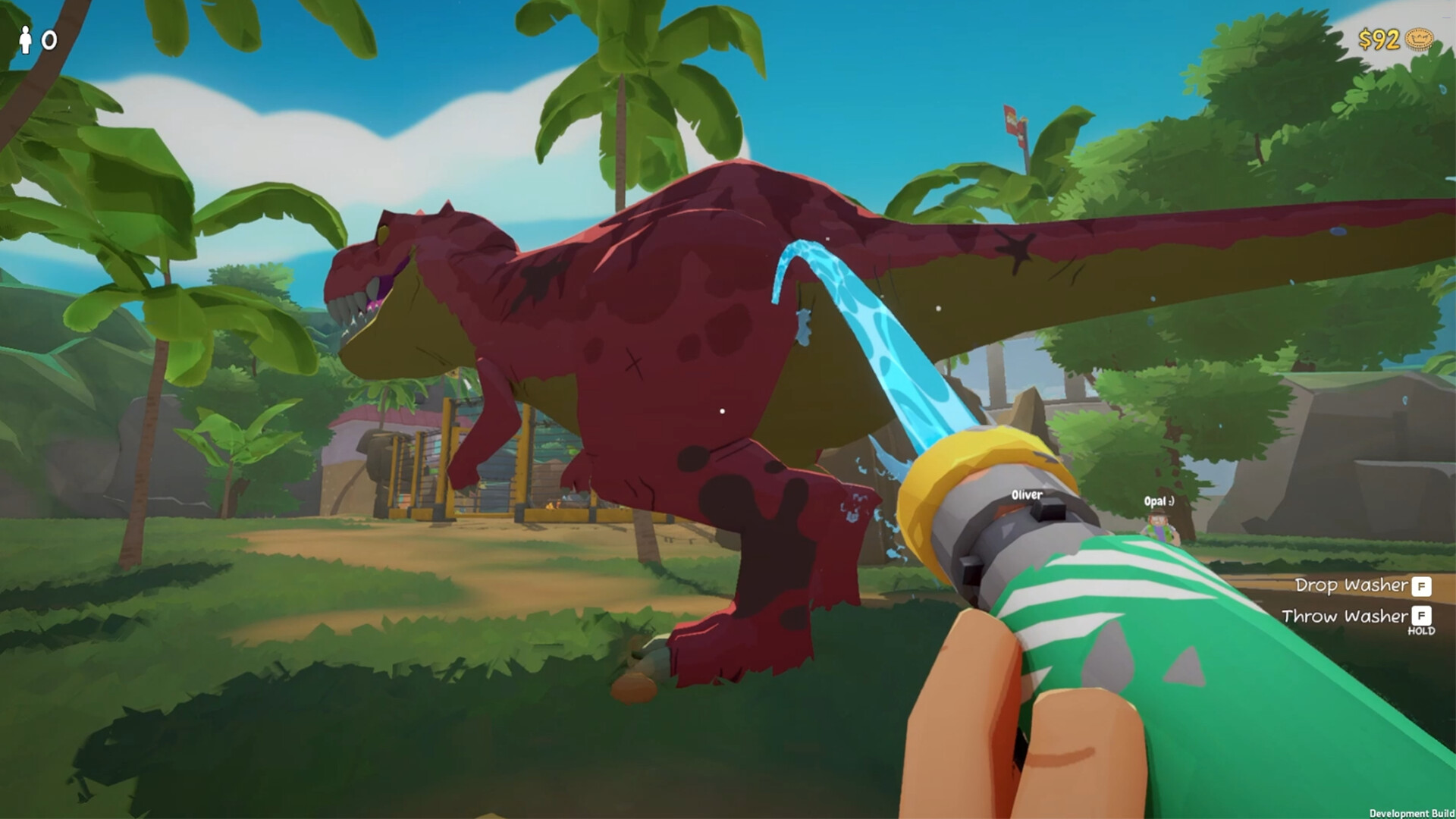
Very Safe Dino Park is a chaotic 1-to-4-player cooperative dinosaur park simulator from indie studio Panic Stations. Despite its reassuring name, this park is anything but safe. You're simultaneously the park manager, janitor, zookeeper, and emergency response team — and the dinosaurs have a distressing lack of respect for safety protocols.
The game takes classic park management (Jurassic World Evolution, Parkitect) and inverts it into a frantic, first-person cooperative survival experience. Instead of clicking menus from a bird's-eye view, you're on the ground running between enclosures, shovelling dinosaur droppings, wrestling with broken power systems, and desperately trying to keep paying customers from becoming dinosaur snacks.
Your job is deceptively simple: build enclosures, feed the dinosaurs, clean up after them, manage the guests, and keep the park profitable. The reality is a cascading disaster simulator where a single hungry T-Rex, a clogged vending machine, or a power outage can set off a chain reaction that ends with your entire park in flames.
Key themes: chaotic co-op (up to 4 players online), first-person park management, emergent disaster loops, dark humour, and constant resource pressure. The game is headed to Steam. Sessions range from 30 minutes to several hours, depending on how quickly your park spirals out of control.
Game Details
| Detail | Info |
|---|---|
| Genre | Action / Simulation / Strategy / Co-op |
| Developer | Panic Stations |
| Publisher | Panic Stations |
| Platform | Windows (Steam) |
| Price | TBA (wishlist on Steam) |
| Players | 1–4 (Online Co-op) |
| Release Date | To be announced |
| Engine | Unity |
| File Size | ~2 GB |
| Categories | Multi-player, Co-op, Online Co-op, Family Sharing |
| Minimum Specs | Core i5-8400 / Ryzen 3 1300, 8 GB RAM, GTX 1060 / RX 580, DirectX 12 |
| Difficulty | Medium–High — forgiving in the first 15 minutes, punishing once multiple systems demand your attention |
Target Audience
-
Co-op chaos fans — If you've enjoyed Lethal Company, Content Warning, Schedule I, REPO, or Waterpark Simulator, this game hits the same "friends helping and betraying each other while systems collapse" energy. The developer calls this "friendslop" — games where hilarious failure is the real goal.
-
Park management enthusiasts — Players who love Jurassic World Evolution or Planet Coaster but wish they could get their hands dirty instead of watching from a camera angle. The management mechanics (guest satisfaction, park rating, resource loops) are familiar, but the first-person execution makes every task visceral.
-
Chaos-first gamers — This game rewards improvisation and laughing at disaster. If you enjoy games where the fun comes from things going wrong, this is for you.
-
Small friend groups — Designed for 1–4 players. Solo is possible but harder. The sweet spot is 2–3 players.
-
Short-to-medium session players — Natural break points between catastrophes let you play 30–45 minutes and feel like you accomplished something (or survived something).
Getting Started — First 30 Minutes
Step 1: The Tutorial Handshake
You spawn in a small, functional park with a single herbivore enclosure, guest amenities, and a modest bank balance. The game teaches you: WASD to move, mouse to look/interact, right-click for the radial menu (your primary tool for building and task assignment), and Q for the handheld scanner (shows dino health, happiness, hunger, and status effects).
Step 2: Tour Your Park
Walk the perimeter. Your early park has 1 herbivore enclosure with basic fencing, a few dinosaurs (gentle herbivores like brachiosaurs or triceratops), a guest area with ticket booth/vending machines/benches, a utility shed with cleaning and repair supplies, and a power generator (keep an eye on it — it will break).
Step 3: Feed the Dinosaurs
Each dino species has specific dietary needs: herbivores need certain plants, carnivores need meat, omnivores accept both. Grab food from the supply depot, carry it to the enclosure, and toss it in through the feeding hatch. The scanner confirms when they're satisfied.
Step 4: Clean Up
Grab a shovel or bio-vacuum and clean the enclosure. Waste causes disease, lowers dino happiness, and attracts pests if left to fester. Bonus: process dino poop into biofuel to power your generators.
Step 5: Manage Your First Guest Wave
Open the gates. Guests buy tickets, purchase snacks, and expect a clean, safe experience. Restock vending machines, clean litter/spills, escort troublemakers (or "speed up the food chain"), and handle complaint icons floating above guests' heads.
Step 6: Survive Your First Crisis
Around the 20-minute mark, something goes wrong — a fence takes damage, a dinosaur gets hungry, the power flickers. This is the core loop: react, fix, stabilize, expand. Perfect stability is a myth. The game is teaching you to triage.
Advanced Tips
| Mistake | Why It Hurts | How to Fix It |
|---|---|---|
| Building the cheapest fences | Basic fences won't stop stressed or large dinosaurs. One breakout causes cascading failure. | Build one tier above what you think you need. Upgrade high-traffic enclosures first. |
| Ignoring dino happiness | Unhappy dinosaurs escape. The scanner shows happiness colour-coded — red means imminent breakout. | Feed on schedule, keep exhibits clean, add enrichment items (scratching posts, pools). |
| Neglecting the power system | Power outages disable electric fences = escaped dinosaurs = dead guests = lost revenue. | Process waste into biofuel. Keep a backup generator. Assign someone to monitor power. |
| Expanding too fast | More dinosaurs, guests, waste, and breakables than you can handle. | Stabilise each enclosure before building the next. Maintain a cash reserve. |
| No role assignment in co-op | Everyone assumes someone else is handling feeding/cleaning/repairs. Everything falls through cracks. | Agree on roles: (1) Feeder/Cleaner, (2) Maintenance/Power, (3) Guest Services, (4) Emergency Response. |
| Forgetting to restock | Empty vending machines, medical bays, or tool racks cause cascading failures. | Set a timer for supply runs every 10–15 minutes. Make restocking someone's dedicated job. |
| Letting waste accumulate | Causes disease, lowers happiness, attracts vermin. | Process waste into biofuel proactively. Turn a problem into a resource. |
| Going solo without automation | Solo is much harder. Players who skip auto-feeders and robotic cleaners burn out fast. | Prioritize automation unlocks. Set up conveyor systems. Use cameras for remote monitoring. |
Core Mechanics
1. The Dinosaur Management Loop
Each dinosaur tracks five stats: Hunger (depletes over time; hungry dinos become aggressive), Happiness (affected by enclosure size, cleanliness, enrichment, social needs; low happiness → escape attempts), Health (damaged by disease, fighting, or neglect), Waste (produced constantly; rate varies by species), and Temperament (a hidden individual stat — some are naturally calm, others are ticking time bombs).
Progression path: Start with herbivores (low risk, low reward) → graduate to small carnivores (higher ticket value) → eventually manage apex predators (highest revenue, highest risk of catastrophic failure).
2. The Guest Economy
Guests are your revenue source and a second management layer. They track cleanliness, food/drink availability, safety (escaped dinos = negative), entertainment (can they see dinosaurs?), and value (are tickets worth it?). Happy guests spend more; unhappy guests leave bad reviews and reduce future attendance.
Guest types include families (slow, spend on food), enthusiasts (fast, spend on merch), and troublemakers (need escorting). Complaint icons float above guests — a soda cup means "restock nearby vending machine," a stink cloud means "clean this area."
Key insight: Guests forgive minor messes if the dinosaurs are impressive. But nothing recovers from an escaped carnivore eating a child.
3. Infrastructure & Power Management
Your park runs on systems that will break at the worst possible moments:
- Fences: Multiple tiers (basic, reinforced, electric, composite). Electric fences need power. All fences take wear from dinosaur attacks.
- Power grid: Generators consume fuel. Power outages disable electric fences, lights, and automated systems — catastrophic.
- Biofuel loop: Dinosaur waste → processor → biofuel → generator fuel. This is the game's signature sustainability mechanic. A well-managed waste-to-fuel loop significantly reduces operating costs.
- Automation: Late-game unlocks include auto-feeders, robotic cleaners, and remote cameras. These reduce manual workload but require investment and maintenance.
Strategic note: Build redundancy into your power grid. Segment electrical circuits so critical systems (carnivore enclosures, medical bay) have backup power.
4. The Crisis Spiral
Problems compound. A generator coughs → power dips to Raptor fence → Raptors batter the fence → you repair the fence → forget to feed the T-Rex → T-Rex breaks out → loose T-Rex in guest area → no revenue → out of tranquilizer darts → park closure.
The art of crisis management is triage. You cannot fix everything at once. Identify which problem, if left unchecked, causes the most damage, and address that first. Then the next.
5. Co-op Role Dynamics
Common team structures:
| Players | Recommended Roles |
|---|---|
| Solo | Generalist — prioritize automation and biofuel loop |
| 2 | (1) Dino Keeper, (2) Park Manager (guests, power, repairs) |
| 3 | (1) Dino Keeper, (2) Facilities & Power, (3) Guest Services & Emergency |
| 4 | (1) Dino Keeper, (2) Cleaner/Waste, (3) Maintenance & Power, (4) Guest Services |
The sabotage factor: You can throw poop at friends, lock them in enclosures, or tranquilize them for no reason. In serious runs, establish a no-sabotage rule. In casual runs, expect betrayal.
Advanced Strategies
1. The Biofuel-First Economy
Rush the waste-to-biofuel processor. Purchased fuel is expensive; dino waste is free and unlimited. Excess biofuel can be sold for revenue. Never let fuel tanks run below 25%.
2. Zoning Your Park
Design in concentric zones: Perimeter (heavy fencing, emergency supplies) → Carnivore enclosures (farthest from guests, closest to emergency gear) → Guest areas (food courts, merch, viewing platforms — keep spotless) → Herbivore enclosures (safer, closer to guests) → Utility core (generators, fuel, waste processing). A carnivore breakout should never have direct access to guest areas.
3. Emergency Response Cache
Maintain in each zone: 2 fence repair kits, 3 tranquilizer darts, 1 medical kit, 1 guest evacuation flare, 1 portable generator. Check and restock at the start of each session and after any major incident.
4. Dinosaur Selection Strategy
- Starter: Triceratops and Brachiosaurus — forgiving, simple diets, moderate waste
- Mid-game: Dilophosaurus and Velociraptor — higher ticket value, need reinforced fencing, never house raptors next to each other (they coordinate escapes)
- Late-game: T-Rex and Spinosaurus — enormous revenue, require best fencing, constant monitoring, dedicated emergency plan
Always check individual temperament before acquiring. A "calm" T-Rex is far more valuable than an "aggressive" one.
5. Solo Play Tactics
- Prioritize automation above all else — auto-feeders and robotic cleaners are necessities, not luxuries
- Use cameras to monitor remote enclosures from a central command room
- Keep your park small — 3–4 well-managed enclosures outperform 8 neglected ones
- Accept controlled losses — contain damage rather than preventing it entirely
FAQ
Q: When does Very Safe Dino Park release? A: To be announced. Wishlist on Steam for updates.
Q: Can I play solo? A: Yes. Solo is harder but viable with automation unlocks.
Q: How many dinosaur species? A: Full roster TBA. Expect classics (T-Rex, Triceratops, Brachiosaurus, Velociraptor, Stegosaurus) plus surprises.
Q: What platforms? A: Windows via Steam only at this time.
Q: How much will it cost? A: Not yet announced. Wishlist on Steam to be notified.
Q: Is there PvP? A: No dedicated PvP mode. The "friendslop" mechanics (throwing poop, tranquilizing friends) provide sabotage options in co-op.
Q: Is there matchmaking? A: Uncertain at launch. The primary audience is friend groups.
Q: How long is a typical session? A: 45–90 minutes average. Can be 20 minutes (chaotic first attempt) or 2–3 hours (experienced team). Sandbox survival loop — no campaign.
Q: Does the game have progression? A: Yes — unlock new species, buildings, automation, and cosmetics as your park earns revenue. Roguelite-lite progression carries some unlocks between games.
Final Tip & Verdict
Final tip: Embrace the chaos. Very Safe Dino Park is not a game you "beat" — it's a game you experience. The most memorable moments come not from perfectly optimized parks but from the desperate scramble when everything falls apart. Your first T-Rex breakout will be stressful. Your tenth will be a story you tell your friends. Lean into the disaster.
Verdict: If you love co-op chaos games (Lethal Company, Content Warning, REPO) and have any interest in dinosaur park management, Very Safe Dino Park is shaping up to be a must-play. The biofuel loop is clever, the crisis spiral mechanic creates emergent storytelling, and the "friendslop" energy ensures every session is unique. It's not a serious park management sim — it's a hilarious, stressful, wonderful mess. And that's exactly the point.
Wishlist it on Steam — and start preparing your friends for the chaos to come.