Official game
Play Peekablock
This game is hosted by Steam. Continue to the official page to play or download it.
Wishlist on SteamOverview
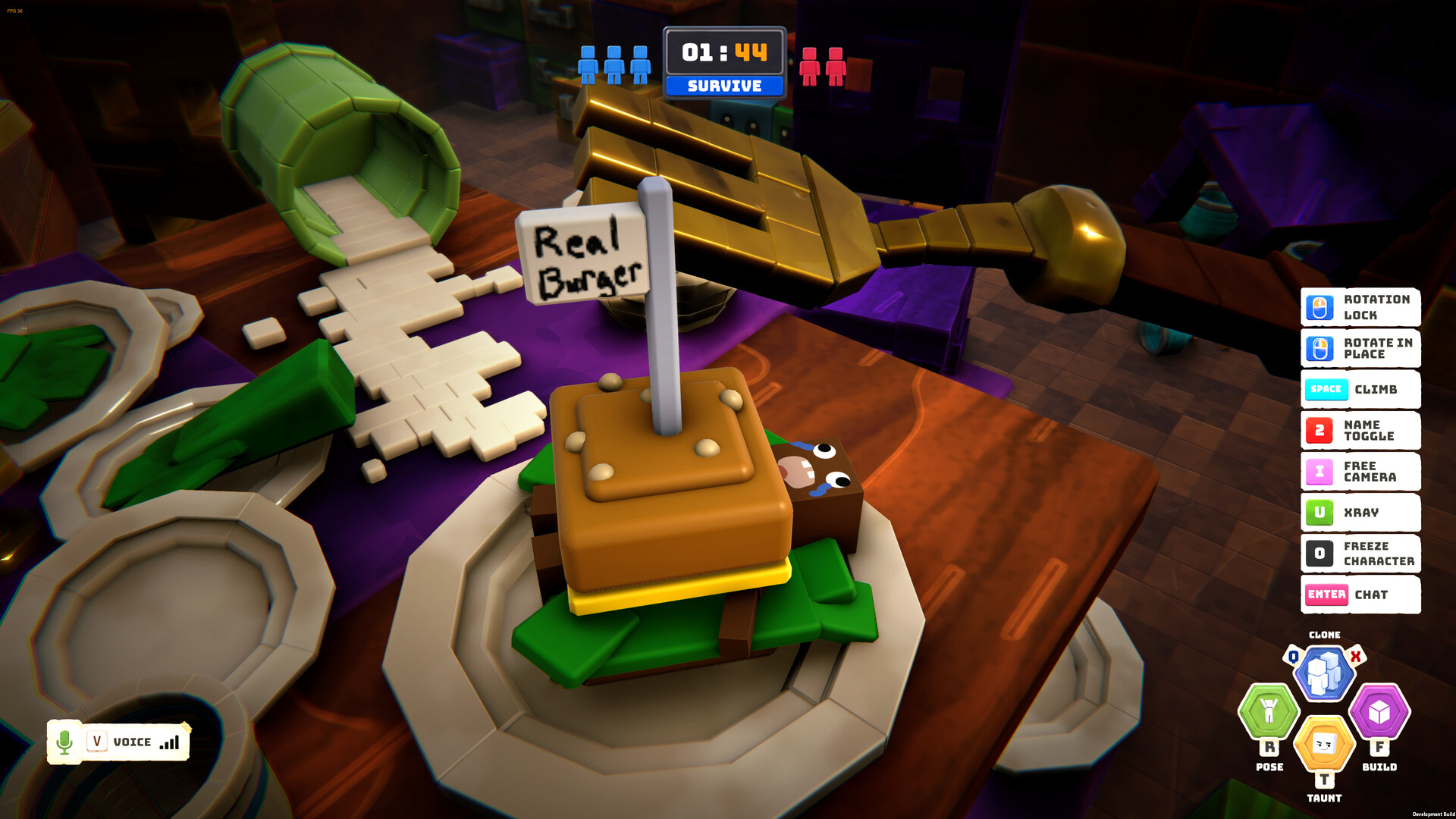
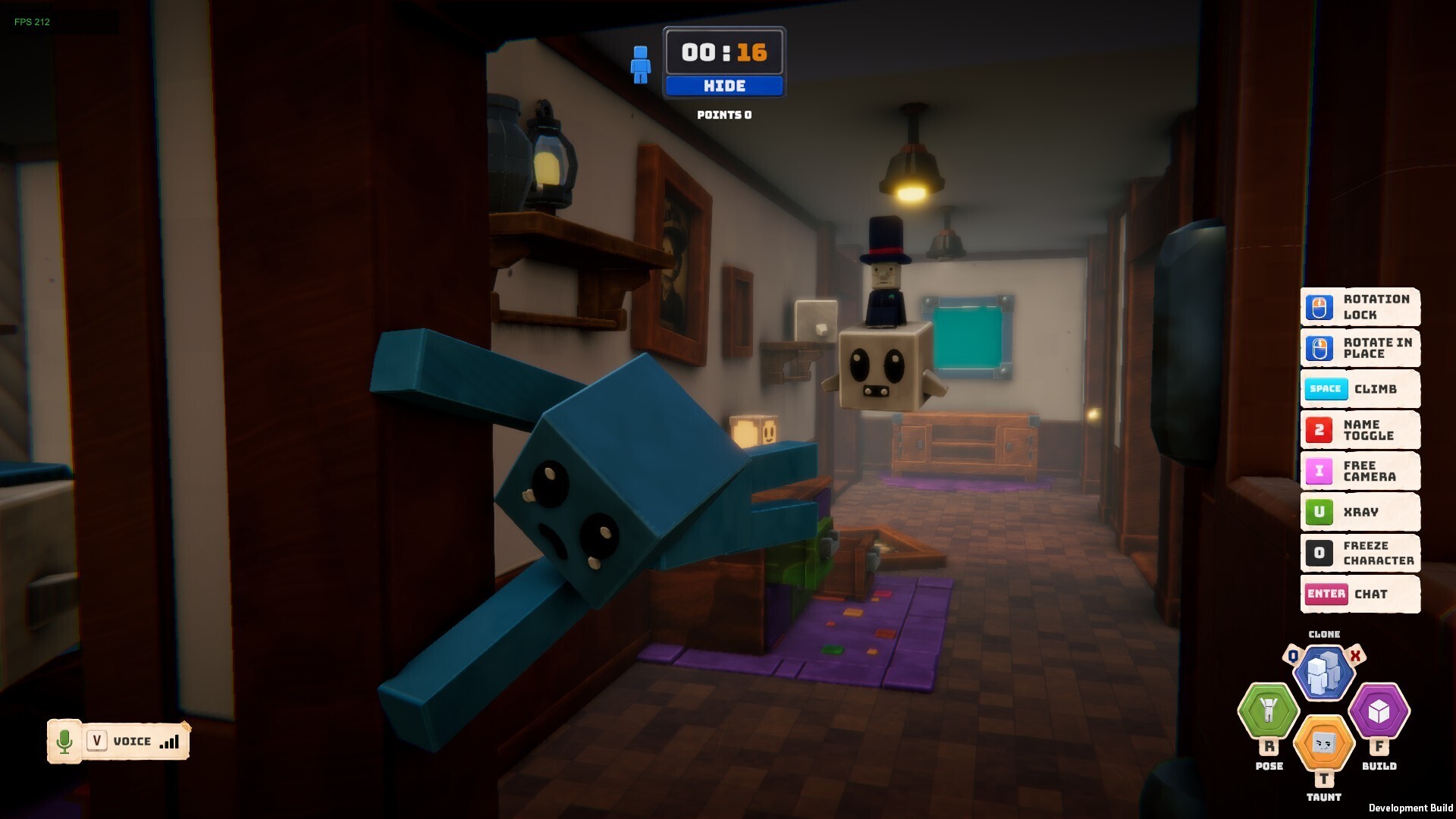
Peekablock is a multiplayer hide-and-seek party game from Goose Gang Games, the studio that describes itself as making silly ideas into serious hits. The pitch: Hiders build and paint their own disguises out of blocks, then melt into the map while Hunters try to spot the fakes. The tagline is "Hide. Blend. Survive!" and the rallying cry is "Don't just hide. Become the map."
Every round breaks into three beats: build your disguise, hide and hunt, then survive the end-of-match showcase where everyone votes. Combine simple shapes, change their size, rotate them, paint every piece. Mimic an object from the map or invent something nobody has seen before. If it works, it works, no questions asked.
Peekablock is in Early Access development (build V0.1.0), wishlistable on Steam. The studio is also building Life Origins, a ragdoll extraction survival game. A free browser Training Camp on the official site already teaches the builder, poses, and weapon forge.
Target audience: Jackbox and Among Us groups, couch party crowds, and anyone who spent hours in Roblox hide-and-seek maps and wished the disguises were player-made.
Why it stands out: most hide-and-seek games give you a fixed prop list. Peekablock gives you a block-by-block builder and a paint tool, which means the disguise economy is player-driven. A disguise that worked last round gets remembered, and the meta shifts every session.
| Fact | Detail |
|---|---|
| Developer | Goose Gang Games |
| Publisher | Goose Gang Games |
| Genre | Multiplayer hide-and-seek party game |
| Platform | Windows (Steam) |
| Modes | Hide & Seek, Infected (Tickets, Chicken Race, Double, Chameleon planned) |
| Builder | 3D shapes, resize, rotate, paint, materials |
| Features | Wall-climbing, voice chat, taunts, end-of-match voting |
| Weapons | Hunter-crafted range weapon; melee planned |
| Status | Early Access V0.1.0, wishlist on Steam |
| Release | Not yet announced (Steam wishlist live) |
Getting Started
A Peekablock round has four phases: build, hide, hunt, and the showcase vote.
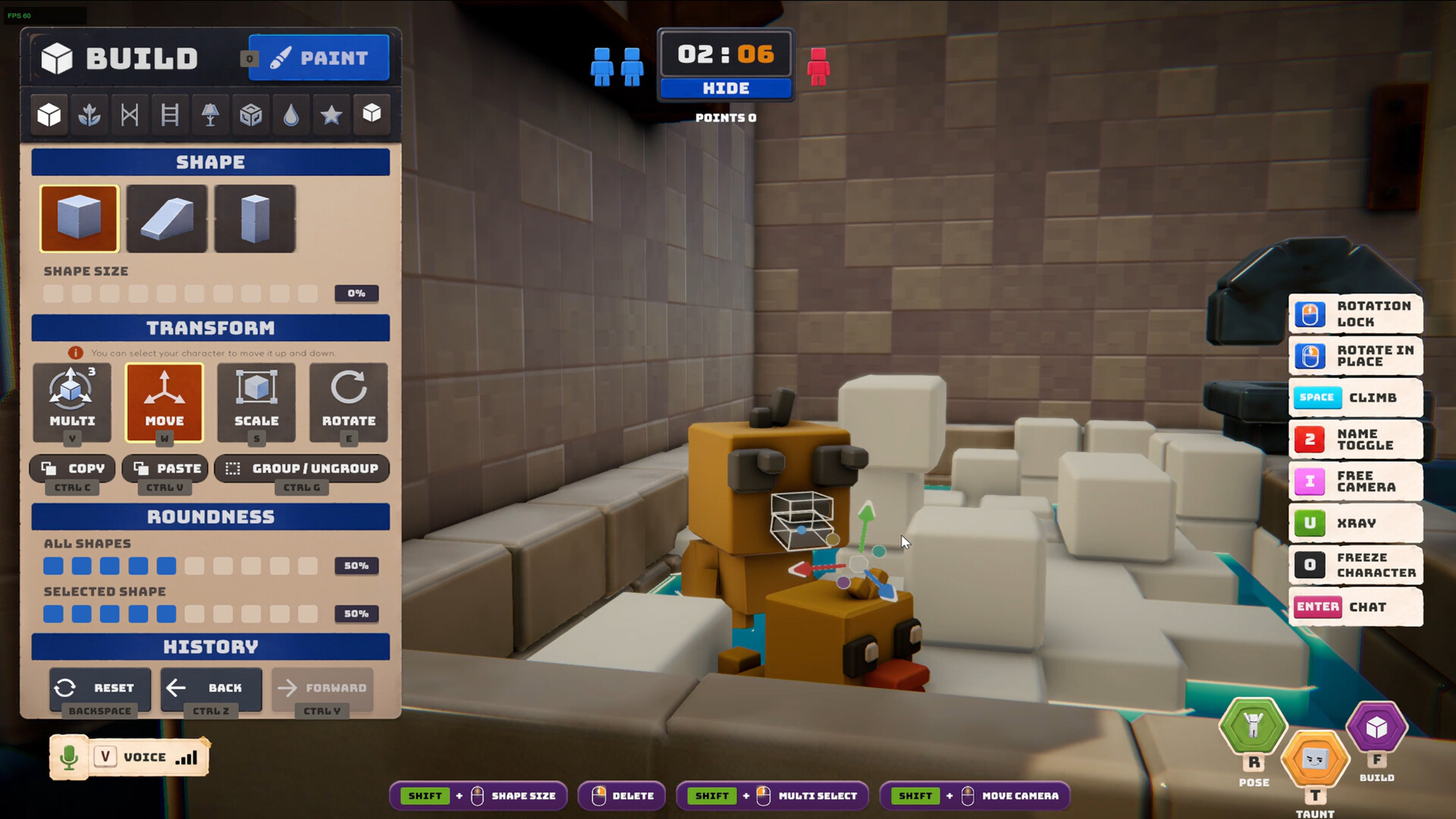
- Build phase. Hiders get time in the builder. Stack and merge shapes, scale them, rotate them, and paint every piece with the color, material, or pattern tools. The goal is a disguise that matches the environment, not a masterpiece. Speed matters more than polish.
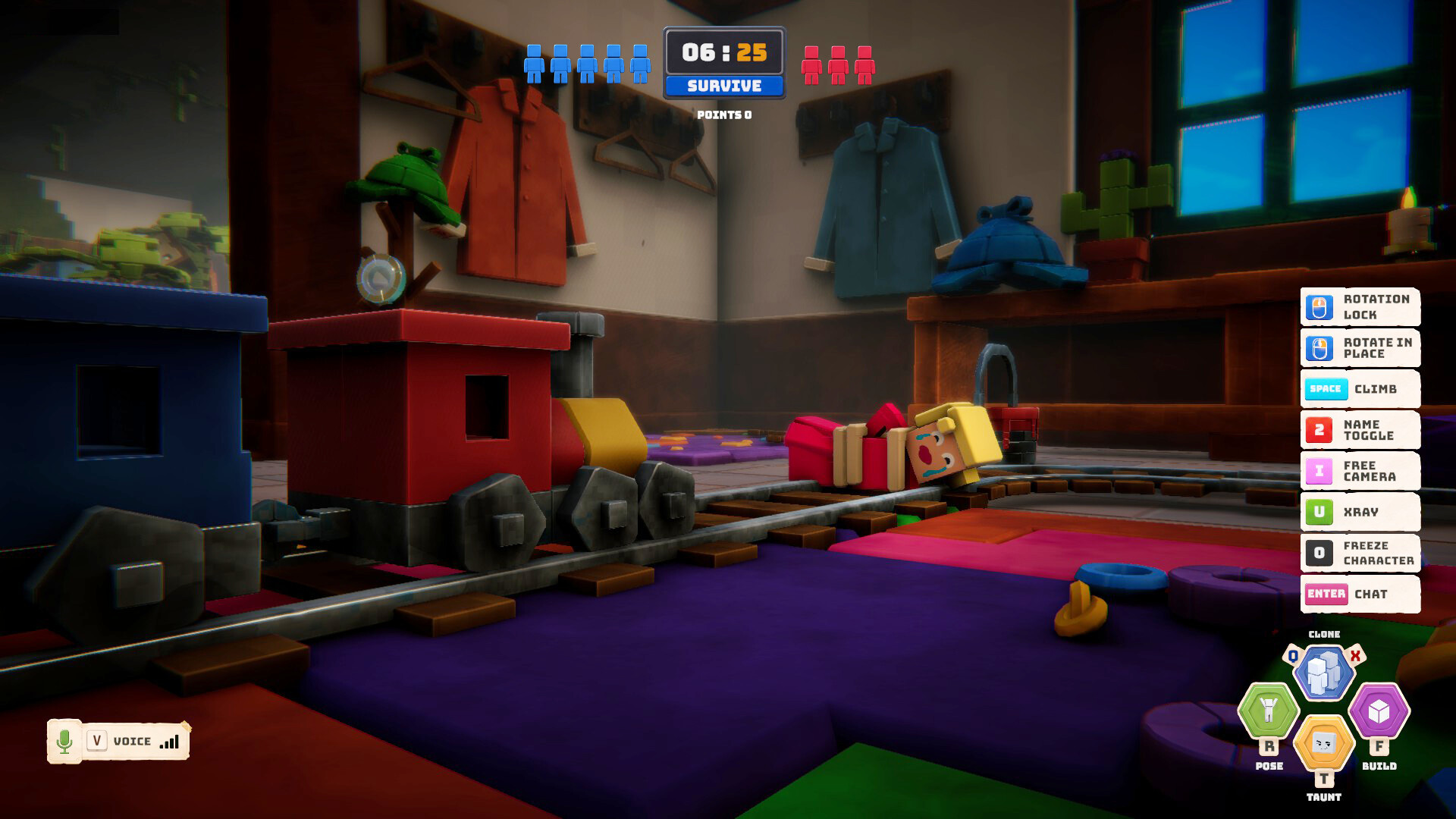
- Hide phase. Blend into the map, strike the perfect pose, and climb into unexpected hiding spots. Wall-climbing opens vertical options: ceilings, ledges, and the tops of tall props are all legal.
- Hunt phase. The Hunter studies the scene and finds what does not belong. Hiders who get spotted are out, and the round ends when the Hunter clears the map or the clock runs out.
- Showcase and vote. At the end of each match there is a showcase of the best hiding spots, and players vote. Winning the vote is a separate goal from surviving, and good voters remember great disguises.
Try It Before You Wishlist: The Training Camp
The official site hosts a free browser Training Camp (needs WebGL and JavaScript). It walks you through two core loops: build your hider and forge your weapon. The browser lab is not a full match, but it teaches the builder controls, the pose system, and the weapon forge without waiting for Early Access keys. Run through it once before your first real round to learn the voxel snapping and the paint tools.
Choosing Your Side
Every match starts with a role pick: Hunter or Hider.
Hunter. You hunt for a living. Forge your own weapon block by block before the round starts, then eliminate every hider before the clock hits zero. The Hunter kit is built around detection: an X-ray scan, binoculars, and a flashlight are on the gadget list, though not all are in the V0.1.0 build. Win condition: wipe the map or run out the clock with no hiders left.
Hider. Build a disguise, become the scenery, and survive the round. Paint every block to match the wall, pose to sell the illusion, and use taunts to bait mistakes. Surviving is only half the job: style decides the podium at the end.
Beginner Mistakes to Avoid
| Mistake | Why It Hurts | Fix |
|---|---|---|
| Building art instead of camouflage | A clever prop nobody recognizes still gets shot; a rough copy of the map's own prop scans as empty | Read the room's palette and silhouette first, then build |
| Overbuilding in the timer | Polish eats pose time; a perfect statue sitting in the open dies | Get 70% match, get posed, get hidden |
| Fidgeting when the Hunter is near | Movement is the loudest tell in the game | Hold the pose; do not react, even when stared at |
| Hiding on the floor | Hunters scan eye-level first, and floor props get counted instantly | Use wall-climbing ledges and ceilings |
| Taunting at the wrong moment | Opening whistles are fun but low-value; points multiply with Hunter proximity | Save big taunts for close calls and escapes |
| Ignoring the vote layer | The podium is scored by memory; a flashy fail and a boring survive both lose | Build something the room will talk about |
| Forgetting mode stakes | Infected turns victims into Hunters; Tickets costs the whole team | Adjust disguise risk to the mode |
Core Mechanics Explained
The Disguise Builder
The builder is the whole game. You combine simple shapes, change their size, rotate them, and paint every piece. The practical loop: look at the map you are about to hide in, build a prop that matches its color palette and silhouette, then place yourself in a crowded area where the Hunter has too much to scan.
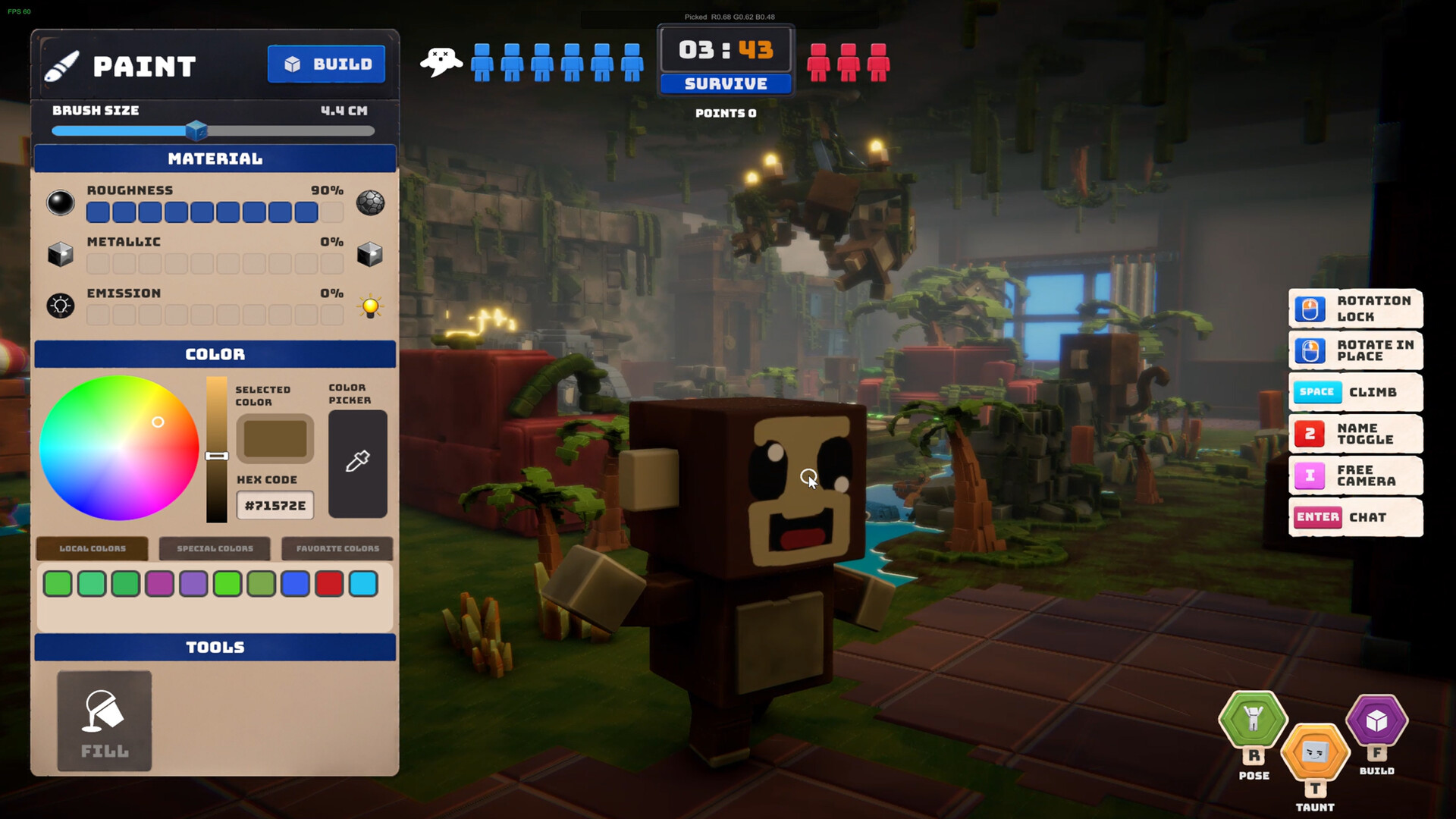
The builder works on a voxel grid with snap sizes of 0.25, 0.5, and a full 1 (a 4×4×4 voxel block). Transform controls cover move, scale, and rotate, with a history panel that keeps five undo steps plus reset, back, and forward buttons. Material sliders adjust roughness, metallic, and emission, and a separate color tool handles local colors, special colors, and favorites. A brush-size control and a fill tool speed up painting large surfaces.
Builder controls (browser camp): drag to rotate the camera, drag with a second axis to pan, hold to stretch a shape, right-click to erase, hold ALT for eyedropper, and scroll to change brush size. Ctrl opens the panel, and your build can be saved with the "Save my build" button.
The key skill is reading the map before you build. A cardboard-brown crate disguise is useless on a neon arcade map. Match the dominant material, the most common shape, and the lighting of the specific room you plan to hide in. The builder shares the same toolset used to make maps and weapons, so everything in a match is player-shaped.
Hider Tactics
Blending is only half of hiding. The other half is positioning. The best spots are visible-but-common: props that the Hunter scans past because there are ten identical ones. Wall-climbing lets you take spots on ledges and ceilings, which most Hunters check last.
Pose matters. The game ships ten poses, including a "NoPose" option in V0.1.0, and a disguise that looks identical to the prop next to it fails the moment the Hunter sees you move or emote. Strike the pose early, hold it, and resist the urge to react when the Hunter gets close.
Hunter Tactics
The Hunter wins by clearing the map efficiently, not by staring at one suspicious spot. Scan systematically: count the obvious props first, then check differences. A painted block that does not match the neighboring props is the fastest tell. Movement is the second tell, so Hunters should linger at doorways and corners where Hiders have to cross open space.
The Hunter also controls the pace. Wait out the clock in high-traffic zones. Hiders panic when the Hunter holds position, and panic produces the tell you need.
Ghosts After Elimination
Caught hiders do not leave the lobby, they become Ghosts for the rest of the round. Ghosts can still interact with remaining hiders and even with the Hunter, which keeps eliminated players in the social loop and lets them coach survivors or bait the Hunter. Expect Ghost interference in every serious match. In Infected, each caught Hider instead returns as a Hunter, growing the hunting team as the round goes on.
Taunts, Points, and the Social Layer
Peekablock is a social game first. The feature list includes in-game voice chat, taunts, and end-of-match voting. The taunt menu is real, scored, and loud: the Whistle is a polite opening bid worth 25 points, the Chicken ("Bwok. Bwok-bwok.") pays 40, and the Fart taunt, the classic, undefeated, pays 50. Land a taunt while Hunters are close and the points multiply. Taunts posted in the round feed label events like "FIRST TAUNT!", "threw a tomato at", and "TRIPLE BAIT (revenge)", and surviving a triple bait is its own trophy.
The meta layer: Hiders who taunt get remembered by the Hunter. Hunters who spare a friend get remembered by the room. The vote means even eliminated players stay engaged until the final showcase, and there is an in-game currency angle, the official site promises "fart at a hunter, get rich."
Weapons and the Forge
Hunters craft a weapon in the forge before the match starts, block by block. The V0.1.0 build ships the Range weapon; a Melee type is planned but not yet in the game. The weapon choice stands for the whole match, so pick for the map: range rewards long sightlines and open maps, while a melee kit wants corners and props to break line of sight.
Game Modes
Two modes are available in V0.1.0, with more planned through Early Access:
- Hide & Seek — the signature round: build, paint, and blend in before the Hunters find you.
- Infected — every hider caught returns as a Hunter, so the hunter count grows as the round goes on.
Planned modes (may change during Early Access, per the developers):
- Tickets — shared lives; every hider death spends one ticket from the team's shared pool.
- Chicken Race — watch each disguise, deduce its owner, then race to find them first.
- Double — everyone hides, everyone hunts: hide first, then race everyone else to find every hidden player.
- Chameleon — pick a spot, build a disguise, then press one button to match it to the world.
The Hunting Grounds: Map List
Every Peekablock map is a pile of ambushes, and the official site lists eight so far:
- PeekaHouse (featured) — a chaotic family house packed with toys, paint, props, and wonderfully bad hiding decisions.
- Pirate Cove — a shark-filled pirate stronghold where every barrel, cannon, and treasure chest is suspicious.
- Zoo — a block-built zoo of wild exhibits, bright ponds, and extremely suspicious animals.
- Battlefield — a rain-soaked siege yard filled with catapults, barricades, crates, and burning towers.
- Egyptian Temple — a sand-choked temple of giant statues, pottery, stairways, and ancient hiding spots.
- Big Kitchen — a giant kitchen turns every pan, mug, sponge, and utensil into the perfect disguise.
- PeekAttic — a warm, cluttered attic of boxes, old toys, odd furniture, and one very active UFO.
- Alien — a moonlit farm under alien attack, complete with cornfields, cows, windmills, and tractor beams.
Steam Workshop Plans
The roadmap includes building custom maps, new hider characters and poses, and new hunter appearances and weapons, all shareable through Steam Workshop. If the forge and builder stay as open as they look in the camp, the Workshop could become the real content engine: player maps feeding the rotation, player disguises leaking into the meta.
Disguise Archetype Tier List
Not all disguises are equal. Ranked by how often they scan as empty in a real lobby:
| Tier | Archetype | Why |
|---|---|---|
| S | Duplicate Prop — a copy of the room's most common prop placed among the originals | Hunters count duplicates fast and move on; the tenth crate is never double-checked |
| S | Wall Blend — a flat, painted panel that matches the wall, placed against it | Silhouette disappears entirely; most Hunters scan eye-level object shapes, not walls |
| A | Floor Decor — a rug, mat, or shadow-colored shape on the ground | Low profile, below scan priority, easy to paint |
| A | Ceiling/Ledge Attachment — a properly colored block on an overhead spot | Hunters look up last; a color-matched ledge piece survives whole rounds |
| B | Prop Stack — a small tower of matching props | Reads as set dressing; works unless the Hunter is counting precisely |
| B | Crowd Prop — a fake plant or statue among many similar props | Good on Zoo and Egyptian Temple, weak on sparse maps |
| C | Original Art — a one-of-a-kind creation | Wins votes, loses rounds; only take it if you are hunting the showcase instead |
| D | Out-of-Palette Prop — a great-looking build in the wrong colors | The fastest tell in the game; does not matter how good the art is |
The tier list flips when the vote is the goal. Original Art is D-tier for survival but S-tier for the podium. Know which win you are playing for before you open the builder.
Hunter Weapon and Gadget Priorities
The V0.1.0 Hunter kit is small but the priorities are clear:
| Priority | Item | Use |
|---|---|---|
| 1 | Range weapon | The only weapon in V0.1.0. Long sightlines, open maps, and high-traffic lanes |
| 2 | X-ray scan | Confirmed on the gadget list; building it early turns the mid-round into a sweep |
| 3 | Binoculars | For confirming silhouette mismatches from across the map |
| 4 | Flashlight | For the shadow spots and dark corners Hiders love |
When Melee ships, it will flip the priority: a melee kit wants corner-heavy maps like PeekaHouse and Big Kitchen, where sightlines die at every doorframe.
Step-by-Step Strategy Sequences
Sequence 1: The Survive Round (Hider, Hide & Seek)
- Enter the builder and read the room you will hide in. Note the dominant color, the most common prop, and the lighting.
- Build a duplicate of that prop with a 0.5 snap grid. Rough proportions beat exact art at speed.
- Paint with the fill tool, then use the eyedropper to match the prop's exact color. Fill the whole surface in seconds.
- Pose as the prop's idle state immediately. Do not wait for the hide phase to start.
- Place yourself among the originals, in the densest cluster of identical props.
- Hold the pose through the entire hunt. If the Hunter stares, do not move. The round ends with you unspotted.
Sequence 2: The Wall Blend (Hider, Any Mode)
- Pick a wall segment near a light source, with at least one crate or ledge below it.
- Build a flat, thin panel roughly the wall's dimensions.
- Eyedrop the wall's exact color and paint the panel. Match the emission and roughness sliders too.
- Climb the wall with the climb-hold and plant yourself flat against it.
- Strike the NoPose or the least-noticeable pose so no limb reads as organic.
- Stay until the Hunter passes, then reposition during their blind spot if the round allows.
Sequence 3: The Systematic Hunter Sweep
- At round start, walk the map perimeter once and count every major prop family.
- Re-scan the map and flag anything that deviates: wrong shade, wrong count, odd placement.
- Hold position at a high-traffic doorway and watch the props. Movement reveals itself here, not in open rooms.
- Check overhead spots second-to-last: ledges and ceilings attract confident Hiders.
- Check shadows and dark corners last with deliberate pace, the shadow spot is where the best Hiders live.
- Eliminate on confirmation only. Shooting a real prop wastes your one tell-free pass; a confirmed fake dies in one shot.
Sequence 4: The Ghost Whisper Play (Eliminated Hider)
- The moment you are caught, drop the panic and switch to Ghost mode thinking.
- Track the Hunter's sweep pattern and call it out to living Hiders on voice.
- Use your Ghost interactivity to reposition sound or trigger the taunt wheel near the Hunter to pull them off a friend.
- Fake a callout occasionally. A confident "he's going right!" from a Ghost shifts the Hunter's route more than any real intel.
- In Infected, remember that this Ghost is now a Hunter. Your coaching flips sides, so plan the bait with the new team in mind.
Sequence 5: The Vote-Winning Round
- Decide before the builder opens: you are playing for the podium, not survival.
- Build a single memorable prop, one distinctive shape in the room's palette, so it reads as both art and camouflage.
- Hide somewhere credible for at least half the round, the survive half of the score still counts.
- Land one high-value taunt with Hunter proximity to spike your points.
- Stay visible in the final seconds: the showcase favors props the room actually saw.
- In your vote, reward the disguise, not the survival. The meta follows the votes.
Advanced Tips
The three-crate trick. Build a disguise that matches a common prop, then place yourself where three identical props stand. The Hunter counts to three, scans, and moves on. This works on every map with repeated environmental props.
The shadow spot. Pick a spot where the map lighting darkens the area. Paint your disguise darker than the prop you mimic. In low light, Hunters scan silhouettes, not colors, and a dark silhouette holds up longer than a perfect color match.
The moving decoy. In the final seconds of the hide phase, reposition once while the Hunter is turned away. A disguise that was scanned as empty becomes a fresh prop the Hunter has already mentally cleared.
The count-the-count trap. Advanced hiders memorize the prop count of their hiding room during build. When the Hunter counts and moves on, you are invisible. When they double-check, you know the room is being audited and can reposition during their next blind spot.
Ghost whispering. After elimination, keep talking. Ghosts can interact with both sides, so feed survivors intel on the Hunter's sweep pattern or fake a callout to pull the Hunter off a friend. In Infected, know that every elimination turns a victim into another Hunter, so bait trades get more expensive as the round goes on.
Weapon-match-the-map rule. With the Range weapon in V0.1.0, favor long sightlines: Egyptian Temple and Battlefield reward keeping distance. On PeekaHouse and Big Kitchen, close corners and furniture kill sightlines, so patrol in short arcs and check prop clusters instead of clearing rooms from the doorway.
The taunt economy. Taunt values scale with Hunter proximity. A Fart (50) delivered as you escape a close call is worth a triple-digit swing on the podium. A Whistle (25) in the open is nearly free points. Bank the big taunts for the moments that generate memory.
Threaten the meta. If the same players run the same lobby every week, track which disguises earned votes. The vote is public, so a disguise that won once gets hunted first next session. Build against the memory of the room, not the map.
FAQ / Common Mistakes
What is Peekablock? A multiplayer hide-and-seek party game where Hiders build and paint block disguises and Hunters try to spot the fakes. In Early Access development by Goose Gang Games.
When does Peekablock release? No release date announced. The Steam page is live for wishlists, and the current build is Early Access V0.1.0.
How many players does it support? Designed for online multiplayer party sessions. Exact player counts will be confirmed closer to release.
Can I make my own disguises? Yes. The disguise builder combines shapes, resize, rotate, and paint tools with material sliders, and player-made disguises are the core of the game.
Is Peekablock free to play? Pricing has not been announced. The game is listed as a paid wishlist title on Steam.
Can I try it before buying? Yes. The official Goose Gang site hosts a free browser Training Camp that teaches disguise building, posing, and weapon forging (requires WebGL and JavaScript).
Is there voice chat? Yes, in-game voice chat is a listed feature.
What happens when a Hider gets caught? They become a Ghost for the rest of the round and can still interact with remaining hiders and the Hunter. In Infected mode, caught hiders join the Hunter team instead.
What maps are in Peekablock? Eight are listed so far: PeekaHouse, Pirate Cove, Zoo, Battlefield, Egyptian Temple, Big Kitchen, PeekAttic, and Alien.
Does Peekablock have Steam Workshop support? Planned. Custom maps, hider characters and poses, and hunter appearances and weapons are meant to be shareable through Steam Workshop.
What else is Goose Gang Games working on? A second project, Life Origins, an extraction survival co-op game set in a prehistoric swamp.
Common mistake: building for the wrong win. Survival and the vote are different games. An S-tier duplicate prop wins rounds; an S-tier original art wins the podium. Decide before you open the builder.
Common mistake: hiding where the map is sparse. A perfect disguise on a wall with no other props is a single prop among emptiness. The Hunter will check it. Hide in density.
Common mistake: never taunting. Points multiply with Hunter proximity and the podium remembers the loud. A silent survival is a missed score.
Common mistake: trusting one spot too long. In a long round, the Hunter will audit the map. The players who survive rotate during blind spots instead of holding one perfect hide forever.
Screenshots