Official game
Play Packed Lair
This game is hosted by Steam. Continue to the official page to play or download it.
Play on SteamOverview
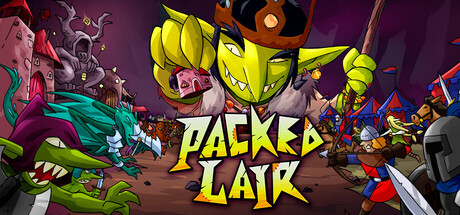
Packed Lair is a roguelike base builder from Fables of Wits, published by Mystic Forge, that released September 22, 2026 on Steam. You play an evil lord with a real estate problem. Heroes keep breaking in, your lair is tiny, and the only way out is to draft buildings, rotate them into place, and squeeze a monster army out of every last floor tile.
Three genres share the screen. Inventory management decides which buildings fit where. Base building turns placement into production. An auto-battler resolves the wave fights your army has to survive. A Steam reviewer called it "Tetris meets Base Building" and nothing has described it better since.
Target audience: players who liked the packing pressure of Backpack Hero or the spatial puzzles of Shapez, and anyone who wants a strategy roguelike that runs in 30 to 60 minute sessions.
Difficulty: the game has three modes. Easy wins in about an hour and is the right place to learn the draft loop. Normal is the intended experience. Hard is where the spatial puzzles actually bite, because wave budgets scale up while your floor space does not.
| Fact | Detail |
|---|---|
| Developer | Fables of Wits |
| Publisher | Mystic Forge |
| Genre | Inventory management / base building / auto-battler roguelike |
| Platforms | Windows (PC) |
| Release | September 22, 2026 |
| Price | $7.99 USD |
| Achievements | 20 |
| Modes | Easy, Normal, Hard, Endless |
| Session length | 30-60 minutes per run |
Getting Started: The First Run
The opening loop teaches three verbs: draft, rotate, pack.
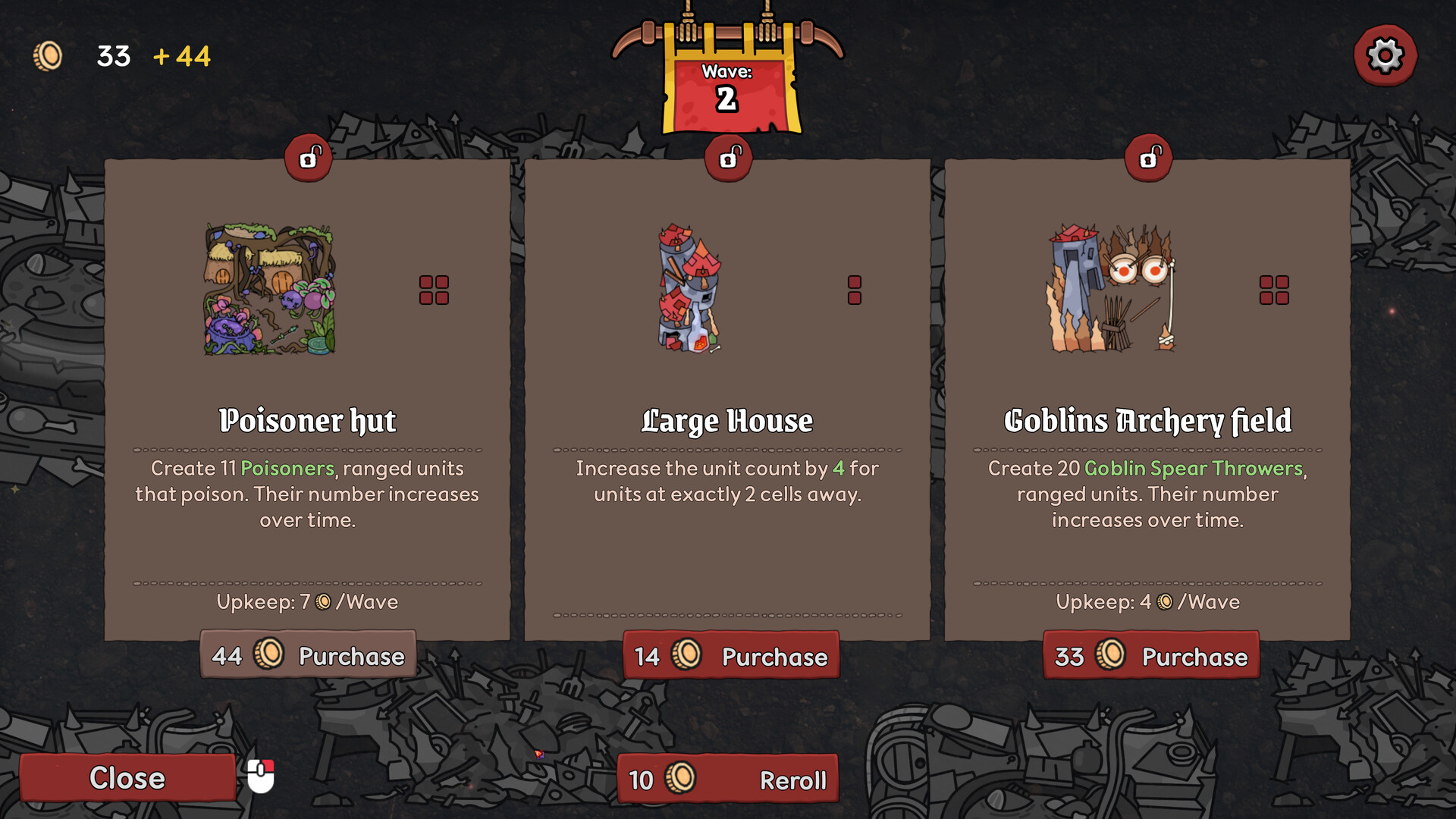
- Draft a building each turn. Every turn offers a choice of buildings. Gold buys more drafts through the shop, and rerolling costs gold too, so early spending discipline matters more than any single pick.
- Rotate before you place. Buildings produce and spawn along specific edges. A spawner facing a wall wastes its output. Tap R (or right-click) until the productive side points where your army flows.
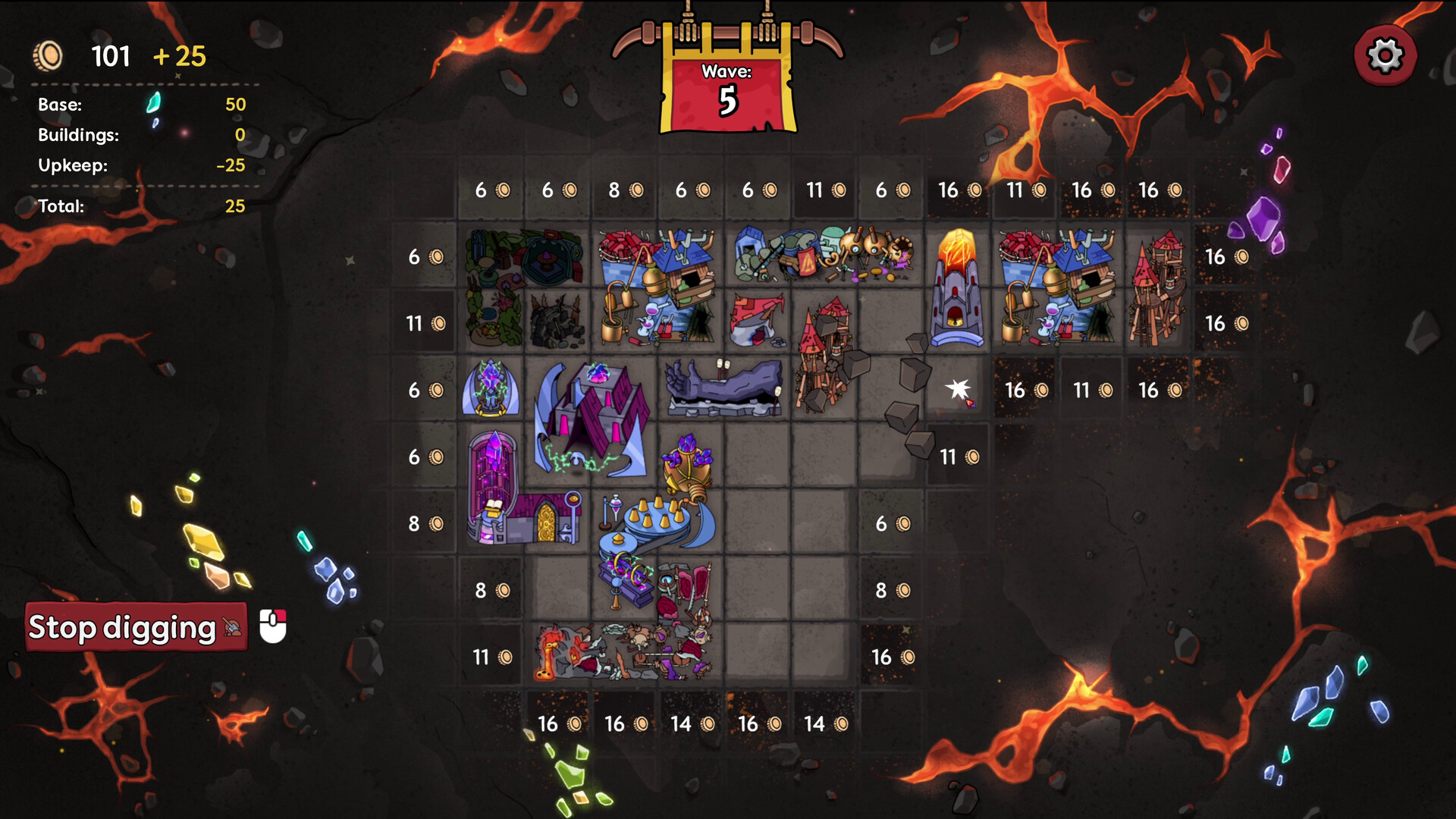
- Pack first, expand later. Digging new cells costs gold that early builds would rather spend on drafts. A tight lair with good adjacencies beats a sprawling one with none.
- Send waves when your production is ready, not when the game asks. You control wave timing between fights. Waiting one more turn to finish a spawner is usually worth more than rushing a half-built defense.
- Read the hero comp before committing. Later waves telegraph what is coming. Armor-heavy hero waves punish pure damage builds; swarm waves punish builds that have no AoE.
First-Run Priorities
| Priority | Why |
|---|---|
| One unit producer by wave 2 | An empty army loses the early waves for free |
| One gold building by wave 3 | Gold income compounds; starting late costs the mid game |
| Keep 2 empty cells minimum | Hoarding space you cannot use is worse than a stopgap producer |
| Learn one starting building's win route | The faction victories are achievement-tied, see below |
Core Mechanics Explained
The Lair Grid and Rotation
Your lair is a small grid of cells. Digging expands it. Every building occupies one or more cells and has facing: unit spawners emit from one edge, production buildings chain from their inputs and outputs. Rotation is free and instant, and placed buildings can be rearranged later, so a bad placement is recoverable. Gold spent is not. The economy punishes indecision more than the grid does.
Adjacency Synergies
Buildings buff what touches them. The review consensus and the achievement list agree the strong patterns are rows, columns, and diagonals: a column of poisoners that all feed one another, a row of spawners that empties into the same corridor. The game never states this, but the buildings' bonus text always names a direction or a neighbor type. Read those lines while you draft, because a building that does nothing alone can anchor a whole row.
The Draft and the Economy
Gold is the only currency and it does four jobs: buy drafts, reroll the draft, dig cells, and cast some battle spells. Splitting gold four ways is how runs die. The working split for most builds is roughly 60% drafts, 20% digging, 20% held for emergency spells. Rerolls are a trap early: the first two or three buildings you see are nearly always playable, and the gold is better spent on the next draft.
Waves, Armies, and Spells
Combat resolves itself. Your minions walk out and meet the hero wave, and numbers, buffs, and type matchups decide it. Your job during battle is the spell bar. Spells are the difference between a lost wave and a clean clear, and the AI-pilot metaphor is real: you built the army, now you coach it. Cast disruption at the hero front line, not into the middle of the pile.
Difficulty Modes and Endless
Easy, Normal, and Hard change wave budgets and the strictness of the achievement conditions. Endless drops the win condition and asks how far your engine can stretch. The two Endless achievements, reaching wave 40 (2.1% of players) and wave 60 (1.4%), are pure engine-quality checks: if your build cannot hit 40, it was never actually good, it just won.
The 20 Achievements and What They Tell You
The achievement list doubles as a skill tree for the whole game. Unlock rates come from Steam community stats and tell you where the actual difficulty spikes are.
| Achievement | Requirement | Unlock % | What It Teaches |
|---|---|---|---|
| PLANNER | Unlock 5 buildings | 53.3% | Draft breadth first, depth later |
| ARCHITECT | Unlock 15 buildings | 53.7% | A full run sees most of the catalog |
| Keep going | Lose 5 times | 16.0% | Losses are lessons; the game expects 5 |
| Horde | 6 unit-producing buildings in Normal or Hard | 8.1% | Spawner stacking is a real archetype |
| SERIAL SHOPPER | Reroll 4+ times in one turn | 7.4% | Rerolling is a tool, not a habit |
| Orcish victory | Win with orcs as your starting building | 5.6% | First faction route |
| DIGGER | Dig 99+ cells in Normal or Hard | 4.9% | The expansion archetype; economy-first builds |
| GOLD RUSH | Hold 300+ gold | 3.5% | Teaches when to stop spending |
| Monsters tamer | 3 monstrous units in your lair | 3.5% | Mixing unit tiers pays off |
| Hard mode | Win on Hard | 3.5% | The real game begins here |
| Explosive victory | Win with TNT throwers as start | 2.8% | Ranged-focused route |
| Scaly victory | Win with poisoners as start | 2.8% | DoT stacking route |
| Goblin victory | Win with goblins as start | 2.4% | Swarm route; volume beats quality |
| Sorcerous victory | Win with sorcerers as start | 2.4% | Spell-slinging route |
| CARAPACE | A unit with 60+ armor | 2.1% | Tank stacking is achievable |
| Endless 40 | Reach wave 40 in Endless | 2.1% | Engine quality test |
| COLLECTOR | Unlock all buildings | 1.7% | Full-catalog knowledge |
| Easy mode | Win on Easy | 1.7% | Most players skip Easy entirely |
| Endless 60 | Reach wave 60 in Endless | 1.4% | Top-tier engine check |
| DRAGON SHOWDOWN | Fight the gold dragon with a red dragon | 0.1% | The game's rarest secret |
The Faction Victory Routes
Five of the achievements ask you to win with a specific starting building: orcs, TNT throwers, poisoners, goblins, sorcerers. Each is a different build philosophy. Orcs want a wide board with many cheap spawners. Goblins want overwhelming volume, so adjacency buffs that boost spawn count outperform damage buffs. Poisoners want long fights, so their route is the one where you invest in armor walls that stall while damage over time stacks. Sorcerers lean on the spell bar, which makes them the hardest route for players who hoard gold. TNT throwers are the ranged route and pair well with DIGGER's expanded floor plans because range needs spacing.
The order that works: goblins first (teaches adjacency), poisoners second (teaches stalling), orcs third (teaches board width), TNT fourth (teaches spacing), sorcerers last (teaches spell economy). By the fifth route you will have the building catalog mostly unlocked for COLLECTOR anyway.
Tips: Beginner Mistakes to Avoid
| Mistake | Why It Hurts | Fix |
|---|---|---|
| Digging early | Gold spent on cells is not buying you army | Expand only when a placement actually blocks a synergy |
| Hoarding gold | Unspent gold wins nothing; GOLD RUSH exists for a reason | Hold a reserve, not a vault |
| Ignoring facing | A spawner pointed at a wall produces nothing | Rotate before placing; check after moving |
| Rerolling every turn | Reroll costs compound silently | Take playable picks; save rerolls for faction-locked runs |
| Treating combat as a waiting screen | Spells swing every close wave | Watch the front line and cast into it |
| One giant corridor | Hero comps with AoE delete single-file armies | Two lanes spread the risk |
| Skipping the demo habit | The demo taught the loop to most early players | The full game starts where the demo ended; do not over-slow early waves |
Advanced Strategy
The Spawner-Stack Archetype
The Horde achievement (8.1%) hints at the strongest simple archetype: six unit producers in Normal or Hard. The build works because spawn count scales with adjacency more reliably than unit quality does. Pack producers into a two-by-three block, all facing the same corridor, and let volume win. The weakness is gold starvation in the mid game, so pair the block with one high-yield gold building and dig late.
Reading the Codex Complaint
The most common criticism in early reviews: once you reach the Codex, choices flatten into "which unit and which buff." The players enjoying the game most answer that complaint by playing faction-locked runs. Constraining your starting building restores the puzzle the sandbox dilutes. If the mid game feels samey, the fix is not more power, it is fewer options.
Endless Wave Benchmarks
Endless mode is the honest scoreboard. Waves 1 through 20 test your draft discipline, 20 through 40 test your gold engine, and past 40 every wave is a stress test of the whole layout. The 40-wave unlock sits at 2.1%, which means most players' engines collapse in the twenties. The two common collapse points: gold income that never scaled past wave 15, and an army that leaned on one unit type the late hero comps counter for free.
The Dragon Secret
DRAGON SHOWDOWN sits at 0.1%. Fight the gold dragon with a red dragon. The community has not widely documented the route yet, and that scarcity is exactly why the guide ecosystem around this game is still open ground. Get a red dragon unit into your army and take the gold dragon wave; the achievement is the fight itself, not the win.
Steam Deck and Performance
Packed Lair ships Windows-only, but the game is a 2D grid strategy title with modest requirements. Steam Deck users report smooth play through Proton, and the turn-based structure means any frame dips never touch the important moments. Cloud saves via Steam means your run moves between desktop and Deck without fuss.
Monetization and DLC
One purchase, $7.99, no DLC, no microtransactions. The publisher Mystic Forge has a track record of supporting indie titles post-launch, and the devlog history (demo updates through Next Fest, a level design roadmap) suggests post-launch content is planned rather than sold.
Developer Background
Fables of Wits is a small studio with Packed Lair as its Steam debut. Mystic Forge, the publisher, is a Dutch label that has built its catalog on indie strategy and management titles. The demo pipeline told the story of the development: four demo updates between May and September 2026, each tuned by Next Fest feedback, and a launch that arrived one day after the "Launches Tomorrow" news post promised.
Comparison With Similar Games
| Game | Shared DNA | Where Packed Lair Differs |
|---|---|---|
| Backpack Hero | Inventory tetris, spatial synergies | Packed Lair resolves its packing into real-time battles |
| Backpack Battles | Adjacency building builds | Packed Lair is single-player roguelike, not PvP |
| Dome Keeper | Tight resource loop under pressure | Packed Lair's pressure is spatial, not temporal |
| They Are Billions | Base vs. waves | Packed Lair is a 45-minute run, not a 10-hour siege |
| Luck be a Landlord | Draft + synergy roguelike | Packed Lair's synergy is spatial instead of symbolic |
The closest single comparison: imagine Backpack Hero where the backpack loads into an auto-battler. That is Packed Lair.
Community and Support
The Steam news hub is the developer's main channel: launch announcement, demo changelogs, and balance posts all land there first. Reviews are running Positive in the game's first days with the fight between "fantastic core idea" and "mid-game depth" playing out exactly as you would expect for a $8 roguelike. Wishlist-level discourse lives on the Steam forums; there is no official Discord linked from the store page yet.
FAQ
Is Packed Lair on consoles or Mac? No. Windows only for now. The grid interface would translate well to touch or gamepad, but nothing is announced.
How long is a run? 30 to 60 minutes for a full win. Endless runs stretch as long as your engine survives.
Is there a demo? The demo was live through Next Fest and came down at launch. If it returns, it is the fastest way to learn the loop.
Does building placement matter more than unit choice? Yes. Units are interchangeable in most comps; the facing and adjacency around them is the actual build.
Can you rotate buildings after placing? Yes, and you can move them. Only gold is truly spent, which is why the economy, not the grid, is the real puzzle.
What is the hardest achievement? DRAGON SHOWDOWN at 0.1%. Fight the gold dragon wave with a red dragon in your army.
Is Endless endless? Functionally, yes. The achievements stop at wave 60 (1.4%), but waves keep coming.
Is it worth it at $8? Positive reviews in launch week say yes, with the caveat that faction-locked runs are where the game's depth lives past the first two wins.
Quick Reference Card
| Topic | Key Number |
|---|---|
| Release | September 22, 2026 |
| Price | $7.99 |
| Achievements | 20 |
| Starting building routes | 5 (orcs, goblins, poisoners, TNT, sorcerers) |
| Endless milestones | Wave 40 (2.1%), wave 60 (1.4%) |
| Rarest achievement | DRAGON SHOWDOWN (0.1%) |
| Session length | 30-60 min |
| Platforms | Windows PC |
The one-line strategy: rotate before you place, dig only when placement demands it, and let five faction runs, not one sandbox run, teach you the game.
Screenshots