Official game
Play Nomori
This game is hosted by Steam. Continue to the official page to play or download it.
Play on SteamOverview
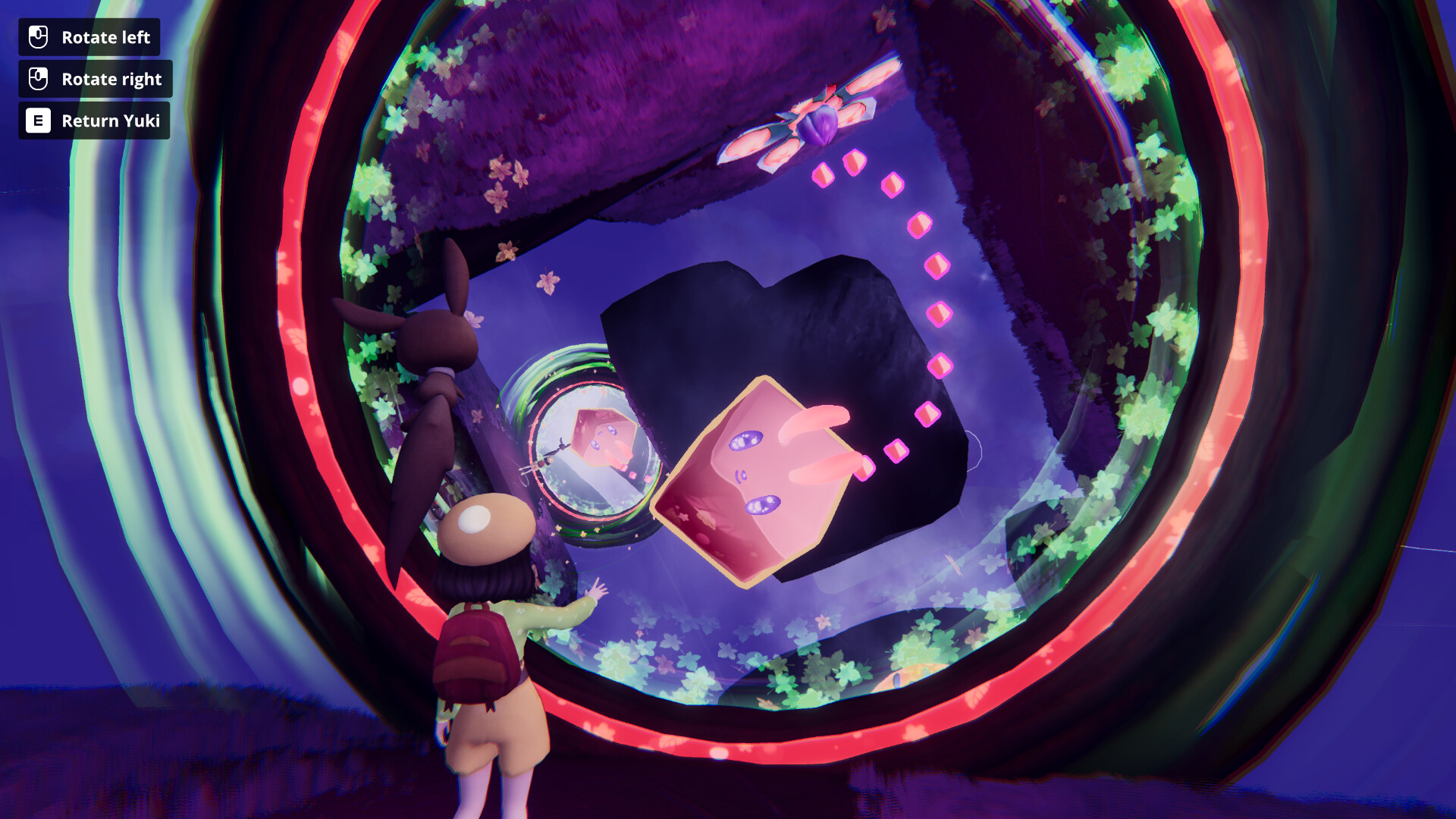
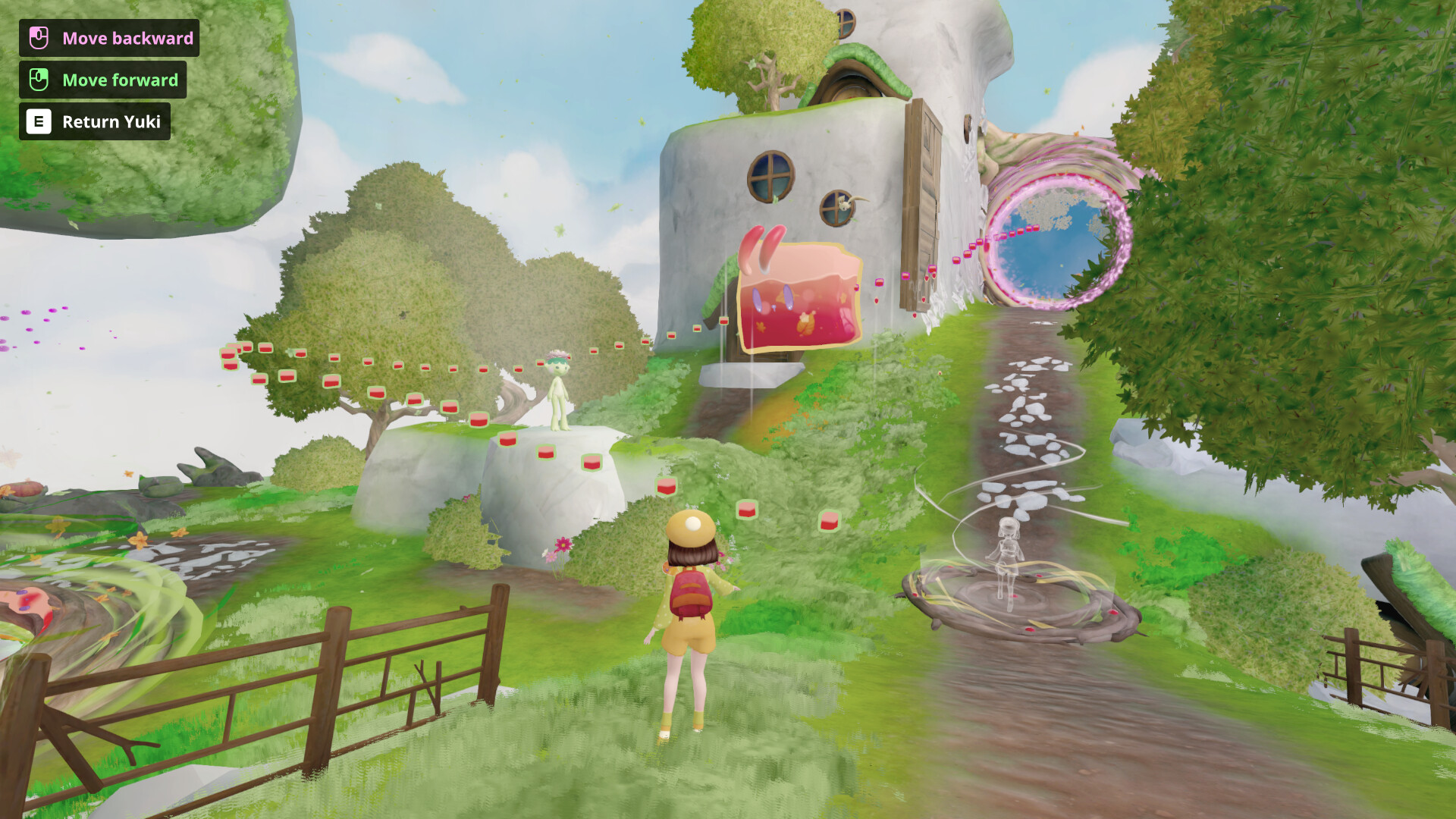
Nomori is a physics puzzle adventure from Enchanted Works that launched September 23, 2026 on Steam for $16.99. You play Kiko, a curious girl stuck in a whimsical spirit world that has come apart at the seams. Up and down lose meaning fast: you place, shift, and rotate portals to bend gravity in any direction, manipulate the gravity of other objects directly, and turn every surface into a floor. Getting home means healing Nomori, one puzzle island at a time, and reuniting the Spirits who live there.
The pitch is a literal mechanical description, which is rare. "Make every surface a floor" is not marketing fluff; it is the core verb set. The game hands you three tools and asks for everything: portals connect any two surfaces, rotation decides which way gravity pulls through them, and Spirit Powers bend time and seasons. Slimebuns, the little blue blob creatures, are the physics toys that tie it all together.
Who this is for: players who finished Portal 2's workshop and wanted more, fans of cozy puzzlers like A Little to the Left who want real logic under the cuteness, and anyone who enjoyed the gravity experiments of Manifold Garden or Superliminal.
Difficulty: gentle by design. There are no fail states, no death counters, no timed inputs. Fall off a ledge and you do not die; you land somewhere interesting or respawn where you were. The accessibility list is unusually complete: Camera Comfort, Playable Without Timed Input, Save Anytime, Custom Volume Controls, subtitle options. Early islands take two minutes. Late seasonal chambers will eat a whole tea break. The curve is a slope, not a wall.
| Fact | Detail |
|---|---|
| Developer / Publisher | Enchanted Works |
| Genre | Physics puzzle adventure |
| Platforms | Windows (PC); demo also on Xbox One and Series X|S |
| Release | September 23, 2026 |
| Price | $16.99 USD |
| Achievements | 10 |
| Levels | 42, across four seasonal domains |
| Session length | 30-60 minutes per island cluster |
| Accessibility | Camera comfort, no timed inputs, save anytime |
| System requirements | i5-750, 2 GB RAM, Nvidia 460, 3 GB storage |
The minimum specs deserve a highlight: a 2009 quad-core and a 2 GB RAM stick run this game. Old laptops need not apply elsewhere; Nomori will not struggle back.
Getting Started: The First Two Hours
Your Opening Moves
- Play the first island without skipping dialogue. The spirit characters teach portal placement, shifting, and rotation one verb at a time, and later puzzles assume all three verbs are muscle memory. A reviewer who skipped the dialogue spent an hour confused about mechanics the tutorial had already explained. Do not be that player.
- Learn the three portal verbs in order: place, shift, rotate. Placement decides where the connection sits. Shifting slides a portal along a surface without breaking the link. Rotation changes which way gravity pulls through the gate. Most early solutions are just remembering rotate exists.
- Throw a Slimebun through everything. The moment you have two portals up, throw a bun through and watch its speed and spin. The entire physics vocabulary of the game lives in that one experiment.
- Fall off things on purpose. Falling is never punished. The "Wrong exit" achievement (6.7%) wants you to fall out of the Crossroads hub, and optional content hides below edges the game never marks. Treat every cliff as an invitation.
- Visit Oshosan's teahouse and drink the tea. It hides a 5.5% achievement and some of the best writing in the game. The teahouse also teaches that interactive objects react to what you carry: "Slime stew" (4.9%) wants a Slimebun in the stew pot.
- Backtrack after every new Spirit Power. Each seasonal power rewrites old islands. New routes open, old barriers become passable, and optional Kodama rescues only become possible with later powers. The game tells you this once, early, and never again.
The Prologue Curriculum, Decoded
The opening islands are a deliberately sequenced physics course. Knowing the syllabus helps you see where each mechanic is headed:
| Level | Teaches | The rule it smuggles in |
|---|---|---|
| Portals | Basic connections | Portal basics carry every level after this |
| Gate | Echo Stones, sealed gates, Slimebuns | Falling off ledges is harmless; goo-cleared gates are the standard lock |
| SlimeBun | Telekinesis dragging | Buns are inventory, not decoration |
| Recursion | Multiple portals at once | Chains compound; two gates beat one clever trick |
| Slime Bun Size | Traveler-only gravity | A portal changes the gravity of what passes through it, and nothing else |
| Perspective | Bun gravity flipping | Push a bun through a gate and its gravity points the other way: instant bridge material |
| Slimebun Anchor | Two-bun coordination | One spawner sustains exactly one bun; two slimekeepers mean two buns and real engineering |
That last lesson is the game's thesis in miniature. In Slimebun Anchor you spawn one grounded bun, drag it in front of a wall flower so a second bun (whose gravity points away from the wall) cannot drift into space, then use the small bun as a step to climb the big one, and finally telekinesis-lift a bun onto the plateau to ungoo the sealed gate. Spawn management, gravity direction, momentum, and object stacking all in one level. When a full-game chamber stumps you, ask which of those four tools you are forgetting.
First-Session Priorities
| Priority | Why It Matters |
|---|---|
| Finish the tutorial island completely | Every later mechanic chains off tutorial verbs |
| Ride one Slimebun | Surfing is movement tech, not a gag; an achievement (14.7%) is built on it |
| Find your first optional Kodama | Backtracking routes radiate from the Crossroads |
| Rotate every portal you place | Rotation is where the skill ceiling lives |
| Check the sky at dusk | Day/night switching hides secrets and one achievement |
Beginner Mistakes to Avoid
| Mistake | Why It Hurts | Fix |
|---|---|---|
| Treating portals as two-point doors | Rotation changes gravity direction; ignoring it makes chambers feel impossible | Rotate every placed portal once before solving |
| Skipping spirit dialogue | Puzzle hints live in conversation; the giant cat will tell you flat out that portals shift perspective | Read every spirit scene |
| Leaving Slimebuns behind | They are tools, not mascots; most optional content needs one | Carry a bun whenever the game allows it |
| Forgetting spawner limits | One slimekeeper sustains one bun; a drifting bun may mean you need to block it with another object first | Anchor before you spawn |
| Rushing to the final island | Three achievements need post-game backtracking with all powers | Keep a save before the last island |
| Importing a demo save | The demo does not transfer progress | Start fresh and plan for 8-12 hours |
Core Mechanics Explained
Portal Placement, Shifting, and Rotation
Every portal has two properties that matter: the surface it sits on and the direction it faces. A portal on the floor drops you through. The same portal rotated ninety degrees turns that floor into a wall cannon. The team reworked character blobshadows specifically so platforming through rotated space stays readable, which means the game gives you a guarantee: your shadow always shows the surface you will land on. When a chamber confuses you, look down first.
Shifting is the underrated verb. Sliding a portal along a curved wall changes the exit angle continuously, and several late chambers are tuned so the correct shift position is a few centimeters from the obvious one. If a throw keeps missing, move the exit portal before you change your throw.
The Physics of Momentum
Objects keep their speed and spin through portals. This single rule generates most of the game's solutions. Four consequences matter in practice:
- Long falls are accelerators. A Slimebun dropped down a deep shaft arrives fast enough to shatter barriers that resist gentle throws. When a barrier will not break, do not throw harder. Throw deeper: route the bun through a vertical portal pair first to build speed, then into the target.
- Spin survives the trip. A bun thrown with rotation arrives rotating, which matters for angled targets and for "Feeling dizzy?" (2.4%), which wants a bun rotated on every axis.
- Kiko is also an object. Your body keeps momentum through gates. Walk in slowly and you tip out gently. Sprint in and you launch. Late-game "stand on the ceiling" chambers are all about controlling your own entry speed.
- Gravity is traveler-only. A portal rewrites gravity for what passes through and nothing else — the bun you send through flies off in its new down while the world stays put. This is why drifted buns make bridges (they fall sideways onto gaps) and why anchored spawns need blocking before they wander.
Split Gravity and Direct Manipulation
Stand half in a gate and the game splits your weight across two gravity wells. This is the mechanic behind late-game chambers where Kiko stands sideways on nothing, and behind "Now you're thinking without portals" (4.2%), an achievement asking you to finish an island with zero portal walks. Later powers add direct gravity manipulation of other objects: point an object's down at the ceiling and watch it climb. Anything a portal does, a late-game gravity power does without the gate.
Spirit Powers: Time and Season
Time control pauses or slows moving objects mid-flight. The signature application is the freeze staircase: freeze a falling Slimebun at head height, freeze a second one a step higher, and walk up. Any puzzle with a bottomless shaft and three or more buns available is secretly a staircase puzzle. Time control lasts long enough to build four steps.
Each of the four seasonal domains adds its own twist:
| Season | Domain Mechanic | What It Changes |
|---|---|---|
| Spring | Growing vines that hold objects in place | Living anchors for throws and climbs |
| Summer | Movable light sources | Light-activated switches and shadow puzzles |
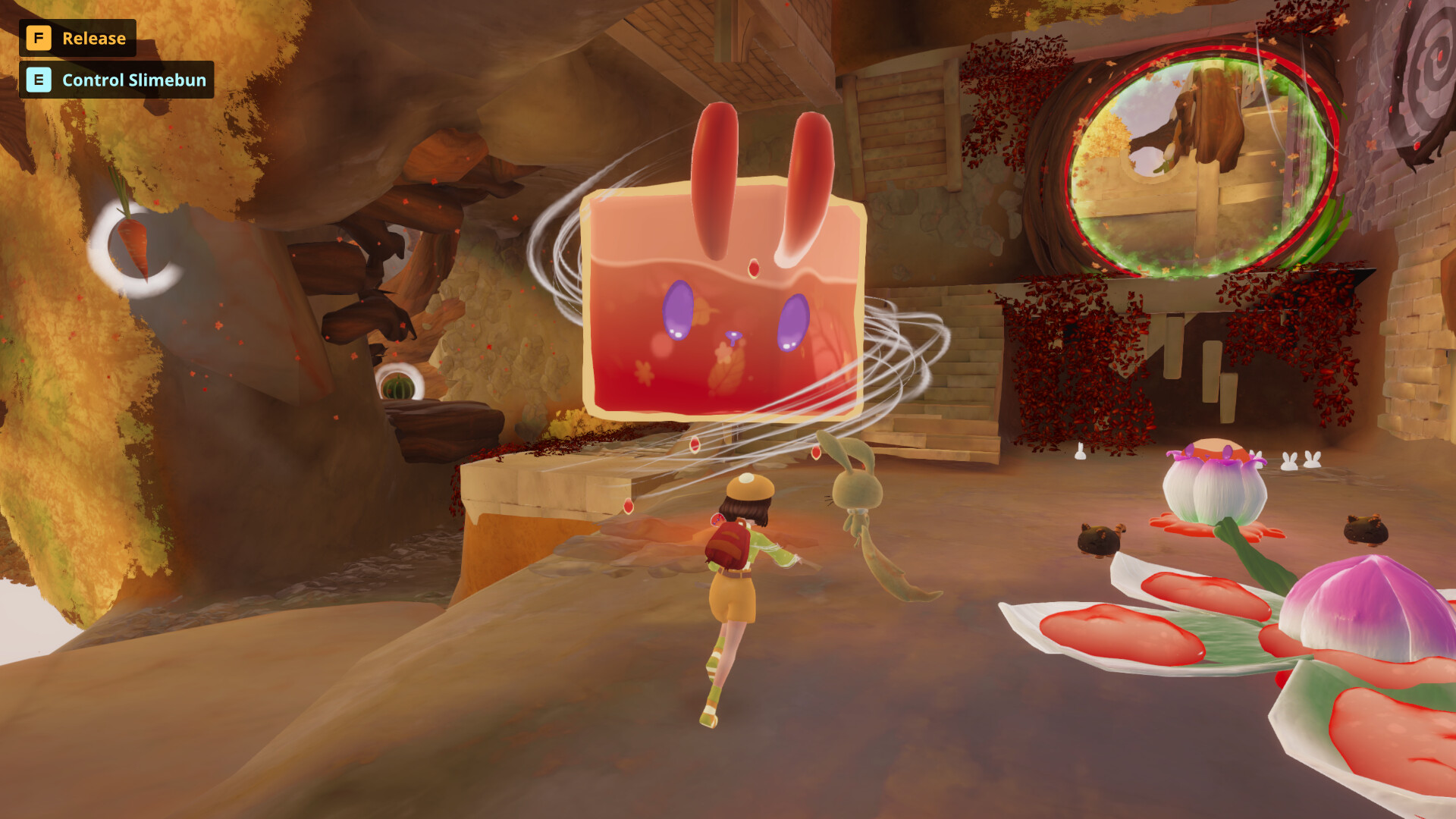
| Autumn | Wind currents | Horizontal momentum for Slimebun flights |
| Winter | Freezing surfaces slippery | Friction becomes a variable you manipulate |
Cross-season physics is the hidden depth. Winter slipperiness breaks several autumn puzzles when applied backwards: freeze a wind current's landing pad and objects slide past obstacles they were never meant to pass. The achievement list never mentions cross-season combinations because the developer saved them as discoveries. When you unlock a new season, replay one old island from the previous season before moving on. The habit pays.
Slimebuns Are Multi-Tools
The blue blobs stack into steps, shatter barriers at speed, ride wind currents, dissolve inside Twilight Objects, and clear the goo off sealed gates. They keep spin through portals. Five of the ten achievements involve doing something unusual with one. The design philosophy is legible: Nomori wants you picking things up and finding out.
The Crossroads Hub
The Crossroads connects all four seasonal domains and acts as the puzzle box at the center of the game. Kodama spirits you rescue can be brought back here, and the hub visibly transforms as you restore it. It is also where the rarest achievements live: "Kodama friend" (0.6%) requires bringing every Kodama to the Crossroads, which demands a full rescue chain across all four seasons plus backtracking.
Day, Night, and the Fourteen Switches
"A fortnight in Nomori" (0.6%) asks you to switch between day and night fourteen times. Several islands rearrange between phases, and secrets hide on the dark side of maps you thought you knew. If a chamber feels complete, flip the light before leaving. Fourteen flips arrive faster than you expect once the habit forms.
Progression Strategy: A Season-by-Season Route
The game never states an order, but the intended flow is spring, summer, autumn, winter, with the Crossroads deepening between seasons:
- Spring (islands 1-10ish). Learn placement and rotation. Collect your first Kodama. Ride a Slimebun down the longest slope you find. Do not skip the teahouse.
- First backtrack, spring islands. Before entering summer, walk the spring islands again with the portal verbs now natural. Chambers you solved by luck resolve into understanding, and one or two optional Kodama routes open here.
- Summer. Light mechanics enter. The infinite mirror moment lives in this stretch, where a misaligned portal pair shows you a corridor of yourselves. Play with it; one optional puzzle hides behind the mirrors.
- Autumn. Wind turns every throw into a trajectory problem. The momentum ledger starts paying rent: bun through vertical gate pair, then into wind, then to target.
- Autumn backtrack with time control. Freeze-staircase solutions appear in earlier islands now. "Now you're thinking without portals" is best attempted on a simple spring island where movement alone genuinely suffices.
- Winter. Slipperiness inverts your intuition. Approach every surface check slower. The final seasonal chambers combine all four mechanics, and nothing in winter is solvable without fluent rotation.
- Pre-final save, then finish. Keep one save before the last island. Three achievements require post-game backtracking with every power.
The 10 Achievements and How to Get Them
Unlock rates from Steam community stats in launch week. Even the most common is under 15%, which tells you how early most players still are.
| Achievement | Requirement | Unlock % | Route |
|---|---|---|---|
| Slimebun surfer | Break a barrier while riding a Slimebun | 14.7% | Find any barrier adjacent to a slope with a rideable bun; momentum does the work |
| Leaving on my own terms | Go sideways into a Gate | 9.2% | Enter any story gate from an angle instead of straight on |
| Wrong exit | Fall out of the Crossroads | 6.7% | Jump off the hub's outer edge; falling is free |
| Tea party | Drink tea at Oshosan's teahouse | 5.5% | Story-adjacent; hard to miss if you talk to everyone |
| Slime stew | Put a Slimebun in the stew | 4.9% | Carry a bun to the teahouse and interact with the pot |
| Now you're thinking without portals | Complete an island with no portal walks | 4.2% | Pick a simple spring island; route it on foot only |
| Feeling dizzy? | Rotate a Slimebun on every axis | 2.4% | Portal-chain a bun through gates facing different directions in one flight |
| Kodama friend | Bring all Kodama to the Crossroads | 0.6% | Full rescue chain; requires cross-season backtracking |
| Reality check | Dissolve a Slimebun inside a Twilight Object | 0.6% | Late-game interaction; keep buns with you in twilight zones |
| A fortnight in Nomori | Switch between day and night 14 times | 0.6% | Flip the light on every island visit; unlocks passively |
The 100% Route
A clean completion run fits inside 15 hours:
- Play seasons one and two normally, grabbing every bun interaction you see.
- On entering autumn, return to every spring island hunting Kodama with time control active.
- On entering winter, do the same for summer and autumn islands.
- Before the final island, bank one save.
- Roll credits, then sweep: fortnight switches, dizzy bun, reality check, and the full Kodama delivery to the Crossroads.
Builds: The Slimebun Engineering Toolkit
Puzzler "builds" are reusable physical contraptions. These four cover nearly every chamber in the game.
Contraption 1: The Velocity Forge
Input:   Deep shaft + portal-acceptable floor at the bottom
Setup:   Portal A at shaft bottom, Portal B facing the target barrier
Action:  Drop the bun into A; it exits B at fall speed
Upgrade: Chain a second vertical pair before B to compound acceleration
Use:     Goo barriers, cracked walls, anything that survives a throw
Contraption 2: The Drift Bridge
Input:   A gap + a spawner whose buns fall away from the gap
Setup:   Block the spawn with a heavy object (another bun, a crate)
Action:  The new bun's gravity points sideways or up, so it parks
         across the gap instead of drifting into space
Use:     Bridges, stepping stones, reaching ledges above voids
Contraption 3: The Freeze Staircase
Input:   Bottomless shaft + 3+ buns + time control
Setup:   None; this is pure execution
Action:  Drop bun one, freeze at head height; drop two, freeze higher;
         repeat to four steps; climb; release only after landing
Use:     Every tall shaft in the back half of the game
Contraption 4: The Wind Router
Input:   A wind current + a distant target
Setup:   Entry portal where the bun starts, exit inside the wind stream
Action:  Send the bun through, then micro-adjust exit rotation until
         gravity bends the arc onto the target
Use:     Autumn island chains and cross-season Kodama recesses
Step-by-Step Strategy: Six Playbooks
Playbook 1: Breaking an Unbreakable Barrier
- Identify the barrier and check for a portal-acceptable surface above a deep drop nearby.
- Place portal A at the bottom of the drop, portal B facing the barrier.
- Carry or lure a Slimebun to the top of the drop.
- Drop the bun into portal A so it exits B at high speed.
- If the barrier survives, add a second vertical gate pair to compound acceleration.
Playbook 2: The Freeze Staircase
- Find a shaft with a high ledge and at least three Slimebuns available.
- Stand at the shaft edge, drop the first bun, freeze it at head height.
- Drop the second bun; freeze it one step higher.
- Repeat for the third and fourth steps.
- Climb, and release the time hold only after you are on the ledge. Releasing early drops you with the stairs.
Playbook 3: Landing on a Rotated Surface
- Place the exit portal on the target surface (wall or ceiling).
- Place the entry portal on the floor a few steps back.
- Walk into the entry portal at normal speed; do not sprint.
- As you exit, hold backward to tip out gently onto the rotated surface.
- If you launch instead, shift the exit portal slightly along the surface and retry; the angle change changes everything.
Playbook 4: Riding the Wind (Autumn Chains)
- Locate the wind current and the direction it flows.
- Throw a Slimebun into the current and watch its arc to map the path.
- Place an entry portal where the bun starts and an exit where you want the arc to end.
- Send the bun through so it exits into the wind stream.
- Adjust exit rotation until gravity bends the arc onto the target. Two or three micro-adjustments usually close the gap.
Playbook 5: Winter Friction Reversal
- On any autumn island with a sliding target, note where the object stops short.
- Apply winter's freeze to the landing surface so it becomes slippery.
- Re-run the throw; the object now slides past the old stopping point.
- If it overshoots, freeze only half the surface to create a brake zone.
- This same logic opens three optional Kodama routes hidden behind "too far to slide" gaps in autumn.
Playbook 6: The Kodama Sweep
- After each new Spirit Power, open the map and list every island with an unreachable-looking recess.
- Route one island per session; fatigue kills backtracking discipline.
- Bring a Slimebun everywhere; several Kodama recesses need a thrown object to trigger.
- Deliver every rescued Kodama to the Crossroads immediately so the counter never stalls.
- Save the twilight-zone islands for last, after "Reality check" conditions are reachable.
Advanced Tips
- Your shadow is the answer key. It always renders the surface you will land on. Confusion is a lighting problem more often than a logic problem.
- Shifting beats re-placing. Sliding an exit portal along a curved wall fine-tunes exit angles continuously. Redo placement only when the surface itself is wrong.
- Throw deeper, not harder. Speed comes from drop height through chained vertical portals, never from the throw animation.
- Anchor before you spawn. A bun whose gravity points away from its flower will drift into space unless something blocks it. Blocking with a first bun is a technique, not an accident.
- The exclamation mark is a hint flag. Interactive objects that want attention mark themselves. When stuck, walk the chamber and look for the mark you walked past.
- Kiko's entry speed is a dial. Walk for gentle exits, sprint for launches. Half the "impossible" chambers are solved by slowing down at the gate.
- Flip the light on every island. Day/night rearrangement hides more secrets than any other single system, and the fortnight achievement rides along free.
- Cross-season physics is the real endgame. Every old island is a new island after a new season. Winter slipperiness, in particular, rewrites autumn solutions.
- Sequence breaks are tolerated; movement tech is intended. Surfing, staircases, and tip-outs survived every patch. The dev team closed story sequence breaks and left the physics toys alone.
FAQ / Common Mistakes
How long is Nomori? Eight to twelve hours for the story. A full completion with Kodama chains and every achievement lands around 15 hours.
Why did my Slimebun drift off into space? Its gravity points away from the spawn flower, and nothing is blocking it. Anchor the spawn with a heavy object or another bun before spawning into open air.
Can a spawner give me a second bun? No. One slimekeeper sustains exactly one bun at a time. Two-bun puzzles place two spawners on purpose; look for the second flower.
Is there a demo? Yes, and it shipped on Xbox One and Xbox Series X|S alongside PC. Demo progress does not transfer to the full game.
Does Nomori have controller support? Full support, including DualShock and DualSense layouts, camera comfort options, and a "playable without timed input" setting.
Is Nomori related to Portal? No official connection. The developer built his reputation testing Portal-style puzzles on video, and the game nods at that heritage with an achievement literally named "Now you're thinking without portals."
Are there difficulty settings? No traditional modes. Puzzles scale naturally, there are no fail states, and accessibility options cover timed inputs.
Does it run on Steam Deck? Windows-only at launch with tiny system requirements; community reports describe smooth Proton play. No official verification yet.
What are the system requirements? Windows 7 or newer, Core i5-750, 2 GB RAM, Nvidia 460, 3 GB storage. This runs on hardware older than some of its players.
Is it kid-friendly? Yes. Cozy art, gentle writing, and no violence beyond tossing cute blob creatures at walls.
Quick Reference Card
| Topic | Key Number |
|---|---|
| Release | September 23, 2026 |
| Price | $16.99 |
| Levels | 42 across 4 seasonal domains |
| Achievements | 10 |
| Portal verbs | Place, shift, rotate |
| Gravity rule | Portals affect only what passes through |
| Spawner rule | One slimekeeper, one bun |
| Session length | 30-60 min per island cluster |
| Story length | 8-12 hours; 100% in ~15 |
| Minimum specs | i5-750, 2 GB RAM, GTX 460 |
The one-line strategy: rotate every portal once before you solve, throw deeper instead of harder, anchor your buns before they drift, and replay old islands every time a new season rewrites the physics.
Screenshots