Official game
Play Golden Swirl
This game is hosted by Steam. Continue to the official page to play or download it.
Buy on Steam — $19.99Overview
Golden Swirl is a dark fantasy, semi-real-time action deckbuilder from developer Snako Production, published by Infini Fun. It hits Steam on September 9, 2026. The pitch breaks the mold of the card-game genre: this is a deckbuilder, but you survive by strategically dodging every attack. It fuses the depth of deckbuilding strategy with the adrenaline of action-combat evasion, moving away from the static, turn-based exchanges of traditional card games.
You are "The Nameless One," forged from the last despair of a dying civilization. In the primordial age the Golden God nurtured all creation, only for the "Great Dreamer" to invade through the Star-Silk. Eldritch whispers drove the living into a cannibalistic frenzy. The deities fell, and the Black Moon twisted into a colossal Swirl poised to devour everything. In their final despair, the survivors united to forge one last glimmer of hope: you. You step into the treacherous Golden Swirl, sworn to uncover the ultimate truth behind the apocalyptic cataclysm.
The core loop fuses calculated strategy with life-or-death execution. You construct a unique deck, equip bizarre relics, and plan your route through the abyss, but you also move, dodge, and seize the perfect moment to play your cards amidst the clash of steel and magic. Mind and reflexes are both essential. A single moment of hesitation, and you meet your end in the very next room. Every deck you build dictates your combat rhythm, and you survive or fall on how well you execute it.
Who it's for: Fans of Slay the Spire-style deckbuilders who want a reflex layer, action-roguelike players, and anyone who loves building synergies across cards, relics, and runes.
Who it's not for: Players who want pure turn-based strategy or who dislike real-time action pressure in their card games.
| Fact | Detail |
|---|---|
| Developer / Publisher | Snako Production / Infini Fun |
| Genre | Semi-real-time action deckbuilder |
| Platforms | Windows |
| Release | September 9, 2026 (out now) |
| Price | $19.99 on Steam |
| Reviews | Very Positive — 242 reviews, ~90% positive at review time |
| Players | Single-player |
| Controller | Full controller support |
| Steam features | Cloud saves, Family Sharing |
| Characters | 4 at full release |
| Content scale | 120+ cards, 100+ relics, rich rune array, 20+ NPCs |
| Minimum specs | Windows 10 64-bit, i3-2100, 4 GB RAM, Intel HD 3000, 3 GB storage |
| Soundtrack | Gothic metal |
Jump to: Overview · Launch Status · Getting Started · Core Mechanics · Progression · Builds & Tier Lists · Step-by-Step Strategies · Advanced Tips · FAQ · Final Verdict
Launch Status
Golden Swirl launched on Steam September 9, 2026 at $19.99 (R$ 67,99 in Brazil), published by Infini Fun. Reception has been strong: 242 Steam reviews landing at "Very Positive" with roughly 90% positive, plus 106 achievements to chase. The free demo (a separate Steam app, live since November 2025) remains available and showcases the semi-real-time combat well before you commit.
| Launch fact | Status |
|---|---|
| Release date | September 9, 2026 |
| Price | $19.99 USD / R$ 67,99 BRL |
| Steam reviews | Very Positive (242 reviews, ~90% positive) |
| Achievements | 106 |
| Demo | Free, separate Steam app (AppID 3506690) |
| Platforms | Windows only |
What this means in practice: the pre-release spec estimates you may have seen elsewhere are now confirmed official — the minimum bar is genuinely low (Intel HD 3000 integrated graphics, 4 GB RAM, 3 GB storage), so almost any Windows machine from the last decade runs it. The recommended tier (Core i5, 8 GB RAM, a GTX 1060-class dedicated GPU, DirectX 11, 5 GB storage) buys you stable frametimes in the busier Swirl encounters, which matters when a frame drop mid-dodge costs a run.
Getting Started: The First 30 Minutes
Before You Launch
- Pick a controller. Full controller support is confirmed, and the dodge-heavy combat rewards an analog stick. Keyboard and mouse work, but the real-time movement feels sharper with a gamepad.
- Learn the two layers early. You juggle two things at once: managing your hand and dodging attacks. The opening is about learning to read enemy telegraphs while your cards sit ready.
- Understand the timing of card play. Every card has a moment when playing it is most effective. The game rewards holding a card for the perfect reposition or attack vector, not just dumping your hand.
- Expect to die. It is a roguelike. Your first runs are about learning enemy patterns and card synergies, not winning. Fewer runs end in victory than in a near-miss that teaches you one new thing.
- Know what mana gates you. Every action runs on mana. If you empty your mana pool on movement, you cannot play cards. The mana triangle (move vs. dodge vs. card) is the real strategic core.
Your First 30 Minutes
- Choose your first character. Each of the 4 characters has unique starting relics and card pools. Pick one whose beginning deck matches how you want to play, then learn it before trying others.
- Do the first dodge tutorial. Understanding i-frames and repositioning is the difference between a card game and a bullet-hell. The opening teaches dodge timing explicitly.
- Build a thin early deck. In roguelike deckbuilders, a small reliable deck beats a bloated one. Early on, add cards that fit your strategy instead of grabbing everything.
- Watch for relic synergy. Relics interact with cards. A relic that boosts a card type you already run multiplies your power. Read relics with your current deck in mind.
- Talk to the first NPC. Over 20 NPCs harbor their own tragic tales, and they tie into the Greed × Fear events that shape your run. Early conversations set up choices that ripple later.
- Experiment with one event choice. The first Greed × Fear event is your cheapest lesson. Take the risky path once, watch how it twists your deck, and learn how the ripples work before your stakes are high.
Beginner Mistakes
| Mistake | Why It Hurts | Fix |
|---|---|---|
| Standing still to play cards | You eat every attack while your hand resolves | Reposition or dodge first, then play your card in the window |
| Dumping your hand instantly | Card timing matters; spamming wastes synergies | Hold cards for the right moment and attack vector |
| Bloated early decks | Too many cards dilute your reliable combos | Add only cards that fit your build strategy early |
| Ignoring relics | Relic synergies multiply card power | Read relics against your current hand, not in a vacuum |
| Neglecting Greed vs. Fear events | They silently twist your deck over time | Weigh every choice against how it distorts your build |
| Never talking to NPCs | You miss run-shaping choices and context | Interact early; their tales feed the friction system |
| Spending mana on moves mindlessly | You walk into a card window with an empty pool | Budget mana: movement first, cards second, dodge always |
| Buying every merchant item | Maddened merchants price greed against survival | Buy only items that fit the build you are actually running |
Core Mechanics Explained
Semi-Real-Time Combat
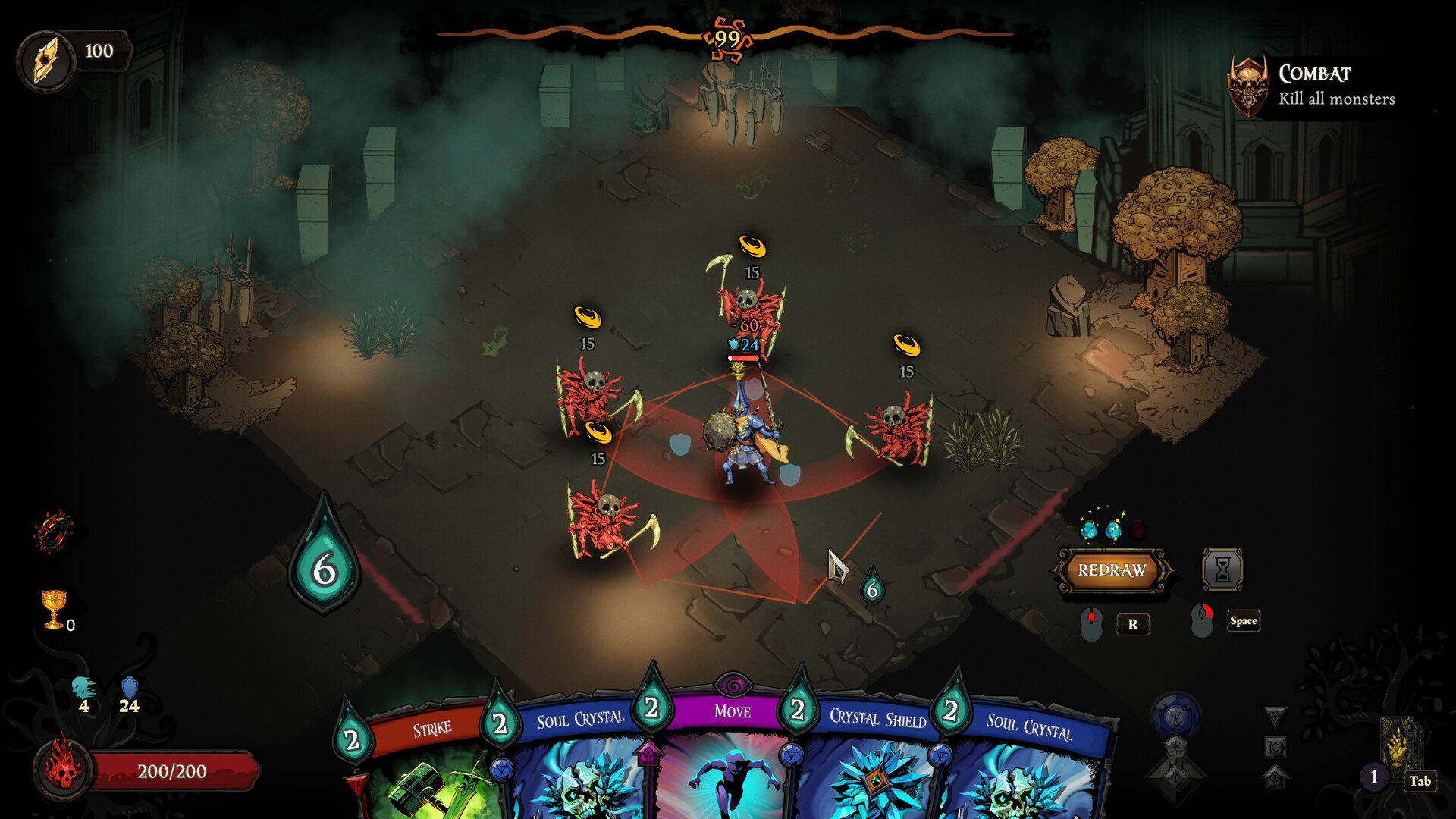
This is the genre's twist. Battles happen in real time, not in turns. You move, dodge, and reposition while managing a hand of cards, and you must time when you play each card around the enemy's attacks. The combat rhythm is dictated by your deck: attack-focused builds push you forward, defensive builds let you wait for openings. It is best described as a deckbuilder where positioning and timing are as important as card choice.
Two details define the execution layer:
- Everything requires a card. Movement across the level is itself a card. Casting spells, dodging, attacking, repositioning: all of it routes through your hand. Your deck is not just your offense; it is your legs and your shield too.
- Card play pauses the world. When you go to use a card, combat pauses, giving you time to choose the right card, direct its effects, and activate it. Everything else continues to move around you in real time, so you can react dynamically to opponents' movements between your plays.
This creates a unique loop: pause to think, release to act, dodge while you wait. Your mind reads the arena during the pause; your reflexes handle the gaps between plays.
Mana Economy
Mana is the binding constraint on everything. Each card costs mana, including movement and dodge cards. You cannot play a damage card if you spent your pool walking into position. The strategic layer of the game is mana budgeting: what you can afford to do in any given window depends on what you spent getting there.
Priorities that work in practice:
- Survival first: a dodge that costs mana beats a card that costs HP.
- Position second: movement cards set up your next attack vector.
- Damage third: attack cards convert the window your positioning created.
- Utility last: buffs and effects are for when the board is already under control.
The Pause-and-Release Rhythm
Because card play pauses the action, every play is a decision point. The best players use the pause to read the whole arena: where enemies are winding up, where projectiles are heading, what the safe lane is. Then they release the card, act, and immediately start planning the next pause. Rushing your card choice wastes the pause; hesitating too long lets the arena change before you release.
Cards, Relics, and Runes
The three-layer customization is the depth of the game. You build your run across three interlocking systems:
- Cards — your actions in combat. The full release features over 120 cards.
- Relics — passive modifiers that persist across the run. Over 100 relics exist, and they interact with your cards to create synergies.
- Runes — a rich array that further tunes cards, letting you tailor a build to each character's traits.
The key to power in Golden Swirl is synergy across all three. Chaining triggered mechanisms from cards that boost with the right relic and rune can exponentially amplify their effect. A build that only looks at one layer is leaving most of its potential on the table.
The Depravity and Swirl Breaching System
Every choice you make triggers a ripple in the run. Interact with an NPC, pick between rewards, or take any decision event, and the "Swirl Breaching" mechanic activates, raising a depravity level. As depravity rises, you suffer unpredictable effects and may trigger events that affect gameplay progression. Making your character stronger literally invites consequences.
The system is a wager engine. You can bet depravity or other buffs you have gained for new cards, relics, or currency. Every wager balances the same moving parts: strength now against instability later. A high-depravity run can be enormously powerful for one act, then punish you in the next. Treat depravity as a resource to spend deliberately, not a meter to max out.
Procedural Dungeons and NPCs
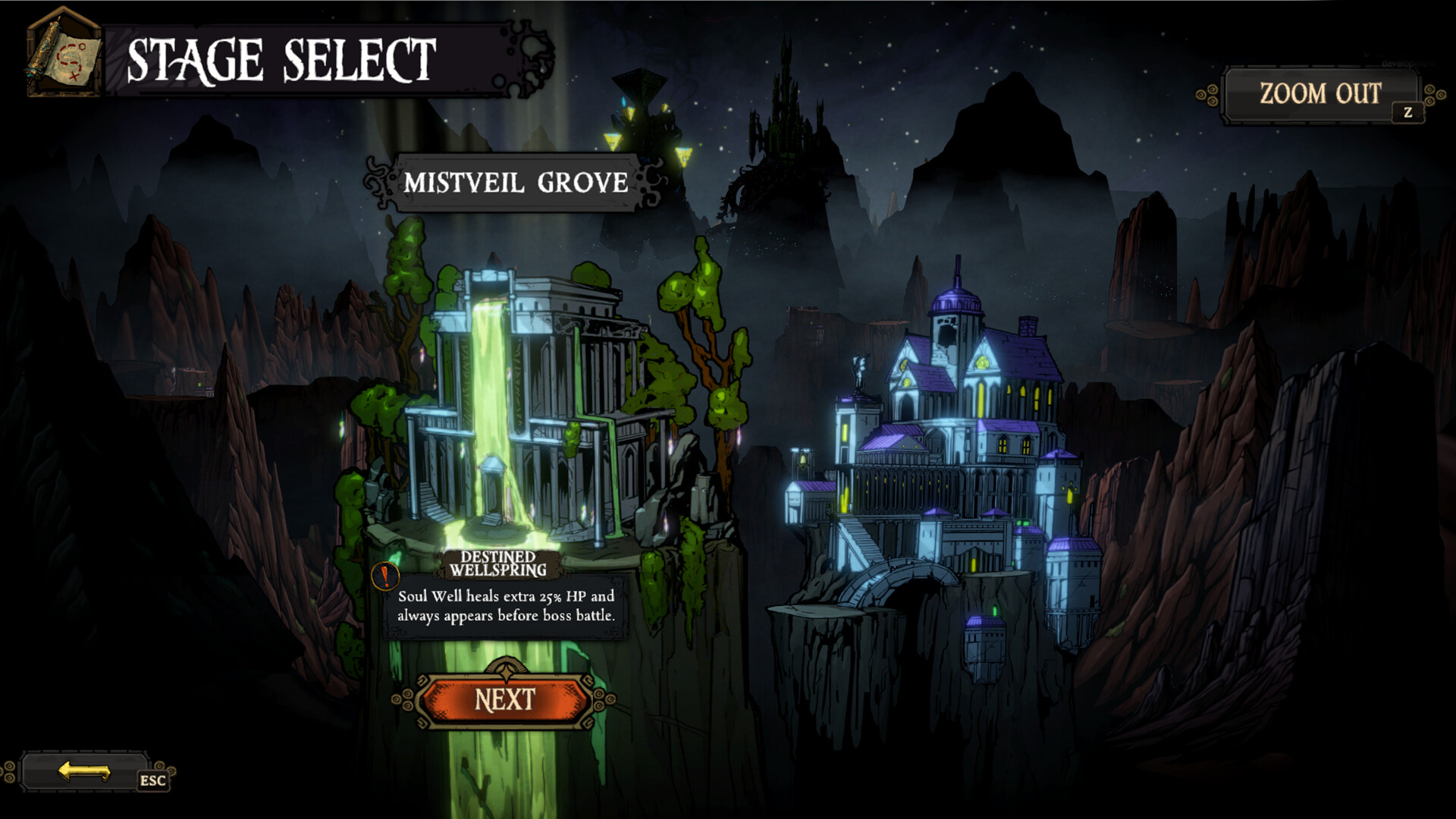
Every expedition generates a unique array of maps, enemies, NPCs, and treasures. Your choices permanently alter your combat rewards and resource progression. Not every soul you meet is a friend: from maddened merchants to silent swordsmen, over 20 NPCs carry their own tragic, Swirl-warped stories. The ever-shifting, shattered realm ensures no two journeys are ever alike.
Greed × Fear
Every choice you make ripples through the "Golden Will." These events dictate your path forward and silently erode your character's state, subtly twisting your deck's composition. Confronted with choices and trials, the whims of fate are tested directly against the deck in your hands. The successes or failures born of calculated risks are a cruel double-edged sword: rewards now, consequences later.
Progression Strategy
Run Planning
A Golden Swirl run has two parallel tracks: the build track (cards, relics, runes) and the route track (dungeons, NPCs, events). Plan both before you commit.
- Decide your build identity by floor 3. Are you a long-range caster, a close-range melee blender, or a defensive attrition engine? Every card choice after that serves the identity.
- Route around bad matchups. The procedural dungeons telegraph their enemies. A room full of enemies your build counters is worth full aggression; a bad matchup is worth routing around. Geography is strategy.
- Spend depravity early, recover late. Early acts are where wagers pay off, because you have time to absorb consequences. Late runs should stop wagering and start consolidating.
- Interact with every NPC once. Even the sad stories feed the Greed × Fear system and unlock choice branches. The context also matters: the card attributes you collect affect which game and story branches appear.
- Consolidate before the final act. Stop taking build risk once your engine is online. Focus on healing, thinning, and upgrading what you have.
What to Unlock and Buy First
- Early: movement and dodge upgrades. A deck that cannot reposition cannot execute anything else. This is your foundation.
- Mid: your win condition card. The one card your build revolves around. Prioritize finding, upgrading, and relic-supporting it.
- Late: relic and rune refinements. Once your core cards are set, chase the modifiers that amplify them.
- Merchant discipline: Buy only what advances your current build. A powerful card that fits another archetype is a trap that bloats your deck.
Build Archetypes
| Archetype | Style | Core Needs | Best Characters |
|---|---|---|---|
| Long-range caster | Keep distance, kite, and nuke from safe lanes | Range cards, mana regeneration, reposition spells | Ranged-leaning characters |
| Melee blender | Close the gap, chain attacks in recovery windows | Dash cards, multi-hit attacks, HP buffer | Melee-leaning characters |
| Attrition engine | Outlast enemies with shields, heals, and debuffs | Defence cards, healing relics, slow effects | Utility-leaning characters |
| Glass cannon | Max damage per window, never get touched | Damage multipliers, dodge efficiency, thin deck | Any, with high-reflex builds |
Builds and Tier Lists
Best Card Archetypes by Situation
| Situation | Best Card Types | Why |
|---|---|---|
| Enemy winding up a big attack | Movement/dodge cards | Reposition is worth more than damage you cannot land |
| Enemy in recovery | High-damage attack cards | The recovery window is your free opening |
| Swarms closing in | Area or multi-hit cards | Clear space before it collapses |
| Boss with predictable pattern | Card upgrades + damage relics | Bosses punish mistakes; stack reliability |
| Low HP, arena chaotic | Defence, heal, and dodge cards | Survival converts into a comeback |
Relic Priority
- Mana-related relics. More mana means more actions per window. This is the strongest scaling in the game.
- Card-type boosts. A relic that boosts the card type your deck runs is effectively a permanent damage multiplier.
- Dodge or i-frame relics. Anything that makes the dodge layer easier frees your attention for card timing.
- Depravity-reduction relics. They let you wager more before consequences bite.
Rune Priorities
Prioritize runes that reduce the cost or increase the reliability of your core card. Cost reduction compounds: a card you can play twice per window doubles your output. Reliability bonuses (accuracy, targeting, consistency) matter more than raw numbers in a game where timing decides everything.
Step-by-Step Strategies
Strategy 1: The First Successful Act Clear
- Pick a ranged-leaning character for your first real attempt. Distance is a softer teacher than melee range.
- Take every movement and dodge card offered in the first two floors. Build the foundation before the damage.
- Learn the boss telegraph cycle in floor 1. Watch one full loop, then identify the recovery window.
- Enter the boss with 20+ cards minimum and at least one upgraded damage card.
- Play the damage card only in the recovery window. Chip between windows with whatever costs the least mana.
- Spend your first wager after the boss, not before. You want the reward without the consequence during the fight itself.
Strategy 2: The Pause-Read-Release Loop
- Pause before every card play. The game freezes for your choice. Use the full pause.
- Read the arena in three beats: where are enemy windups, where do projectiles travel, where is my safe lane?
- Choose your card to solve the biggest threat, not the nearest one.
- Release the card and move immediately after it resolves. Standing in the same spot is how you get hit.
- Track your mana before and after. The next pause starts with whatever pool you have left.
- Repeat until the rhythm is automatic. Fast readers win runs; slow readers lose them.
Strategy 3: Budgeting Mana Through a Fight
- Start each window by checking mana before the pause. Know what you can afford.
- Reserve a dodge's worth of mana at all times. A full pool is a promise of escape.
- Spend movement mana only toward a purpose — a card vector, a safe lane, a pickup.
- Play damage when the pool is high and the enemy is committed. Never spend your last mana on offense.
- Fall back on free positioning when mana is low. Walking between pauses is not always a card; know which movement is free.
- Reassess after every card. The enemy's next telegraph starts the budget cycle over.
Strategy 4: Depravity Wager Management
- Wager only on outcomes that advance your build. A card you will never play is not worth instability.
- Take the small wagers early. One or two depravity points early are absorbed by the rest of the run.
- Stop wagering before the final act. Consequences you cannot outrun will kill a strong build.
- Watch for depravity-triggered events as build information. They reveal what the run is pushing you toward; lean into it if it fits.
- Balance greed against your actual win condition. If your deck wins by attrition, do not gamble your HP on damage cards.
Strategy 5: Boss Killer Setup
- Identify the boss's damage type early. The arena telegraphs it in the first 10 seconds.
- Keep one panic dodge card unplayed until the boss's enrage or second phase.
- Stack your damage into one or two cards instead of spreading it. Upgrades and relics concentrate damage.
- Use the pause to watch the boss's pattern every cycle. Predictability is the boss's weakness.
- Never chase the boss across the arena. Let it come to your safe lane and punish the approach.
- Convert the first phase into a rout. If you can end phase one with most of your HP, the second phase is a formality.
Strategy 6: The Merchant Trap Avoidance Run
- Set a purchase rule before entering any shop: only cards, relics, or runes that fit the current build identity.
- Compare every item against your worst current card. If the item is not better than your worst card, skip it.
- Track gold for the next shop. Hoarding for a known upgrade beats impulse-buying every visit.
- Buy healing over power when low. A dead build deals no damage.
- Never buy a card that dilutes your combo. Even a strong card that does not belong weakens the average draw.
Advanced Tips
The Rearm-Threaten Loop
When an enemy winds up a big attack, reposition first and hold your damage card. Let the enemy commit its swing, dodge it, then play the card in the recovery window. This rearm-threaten loop turns every enemy attack into a free opening instead of a threat you trade with.
Vertical Synergy Building
Build all three layers toward one mechanic, not three scattered themes. If your relic boosts bleed-type cards, chase cards and runes that also touch that effect. A focused triple-layer build exponentially out-damages a generalist one because the triggered mechanisms chain.
Thin Deck Discipline
Hold your deck small by refusing off-theme cards. A 20-card deck where every card synergizes beats a 40-card deck of decent cards. Pass on powerful but unrelated picks; the reliability of drawing exactly what your combo needs outweighs raw card quality.
The Movement-Card Economy
Movement costs cards and mana, so every step has an opportunity cost. Learn which repositioning is free (the gap between pauses) and which requires a card (dashes, teleports, sprints). Budget your expensive movement for the moments that create attack windows.
Read the Room Before the Fight
The procedural dungeons telegraph their enemies. Scan what crossbreeds with your build before engaging: a room of enemies your cards counter is worth full aggression; a bad matchup is worth routing around. Your route is a strategic choice, not just geography.
Risk Only When It Pays
Greed × Fear events explicitly test you. Take the risky choice only when the reward advances your current build. A 2x relic bonus for a minor debuff is a good bet; gambling your whole health bar for a card you will not use is not. Treat every event as a build investment decision.
Depravity as a Tool, Not a Score
Do not treat depravity as a number to keep low. It is a currency. High depravity runs can be the strongest in the game when spent toward the right rewards. The skill is knowing when to stop spending, not when to avoid it.
Play Each Character Once
The four characters play differently enough that their starting relics and card pools change the entire strategy. Run each at least once to learn which rhythms you execute best, then main that one for serious attempts.
Use the Soundtrack as a Timer
The gothic metal score is not just atmosphere. Boss patterns often sync to the music's intensity. Once you notice the beat shifts, you can predict incoming attacks a second early. It is an edge that costs nothing.
FAQ and Common Mistakes
Is Golden Swirl single-player?
Yes, single-player only. There is no multiplayer featured on the Steam listing.
Does Golden Swirl support controllers?
Yes, full controller support is confirmed, and the dodge-heavy combat rewards a gamepad.
When did Golden Swirl release?
September 9, 2026 on Steam — it is out now, $19.99, with full controller support and cloud saves.
How many characters are there?
Four characters at full release, each with unique starting relics and card pools.
How many cards and relics are there?
Over 120 cards, over 100 relics, and a rich array of runes across the full release.
Is combat turn-based or real-time?
Semi-real-time. You move and dodge in real time while managing your hand. Playing a card pauses the action so you can aim and activate it; everything around you keeps moving.
Does everything really require a card?
Yes. Movement, dodging, casting, and attacking all route through your hand. That is what separates Golden Swirl from a traditional card game: your deck is also your legs and your shield.
What is the depravity system?
Every choice in the run raises your depravity through the Swirl Breaching mechanic. Higher depravity triggers unpredictable effects and events, but you can wager it (or other buffs) for cards, relics, or currency. It is a risk resource, not a death sentence.
What platforms is Golden Swirl on?
Windows. No console or macOS version has been announced.
What are the system requirements?
Official Steam specs — Minimum: Windows 10 64-bit, Intel Core i3-2100 or equivalent, 4 GB RAM, Intel HD Graphics 3000 or equivalent, DirectX 9.0c, 3 GB storage. Recommended: Windows 10/11 64-bit, Core i5 or higher, 8 GB RAM, dedicated GPU (GTX 1060 class), DirectX 11, 5 GB storage. It is a lightweight game; see the Launch Status section for what the tiers mean in practice.
How much does Golden Swirl cost?
$19.99 on Steam (R$ 67,99 in Brazil). There is no free-to-play tier; the demo is the free way to try it.
Is Golden Swirl any good?
Early Steam reception is strong: 242 reviews at "Very Positive," roughly 90% positive. Praise centers on the dodge-during-deckbuilding twist; the usual caveat for the genre is run-to-run RNG.
Is there a demo?
Yes, a free demo is available via the Steam page (separate app, AppID 3506690, live since November 2025). It showcases the semi-real-time combat well — still the best way to try before buying.
Do NPC choices matter?
Yes. Over 20 NPCs and the Greed × Fear events shape your run, twisting your deck and altering combat rewards and progression.
Common Mistake: Standing still to play cards
The pause happens when you play a card, but the world resumes immediately after. Standing in the same spot after a play is how you get hit. Always move after every card resolves.
Common Mistake: Treating depravity as a curse
It is a resource. Refusing all wagers leaves power on the table; spending them blindly kills runs. The skill is knowing which wagers advance your build.
Common Mistake: Bloating the deck
Every off-theme card you add makes your combo less likely to appear. Say no to strong cards that do not belong.
Common Mistake: Ignoring mana budgeting
A full mana pool is the difference between escaping and dying. Spend your last points on offense and you have nothing left for the dodge you will need next.
Common Mistake: Buying everything at merchants
Maddened merchants price items in greed and survival. Buying every shiny card fills your deck with off-theme noise. Buy only what fits the build.
Final Tip and Verdict
The master skill in Golden Swirl is reading enemy telegraphs and playing your cards in the recovery window. Dodge first, then strike with a card whose timing and vector you set. Build your run across all three layers — cards, relics, and runes — toward one focused mechanic, keep your deck thin, budget your mana like currency, and treat every Greed × Fear choice as a build investment.
Who should play it: Slay the Spire fans who want a reflex layer, action-roguelike players, and anyone who loves deep triple-layer synergy building.
Who should skip it: Players who want pure turn-based card strategy without real-time action pressure. The dodge layer is core, not optional.
Rating: 4/5 in its niche — now backed by a "Very Positive" Steam score (~90% across 242 reviews). The semi-real-time twist is a fresh take on a crowded genre, the four-character, three-layer build depth gives strong replay value, and the depravity wager system adds a risk layer most deckbuilders never touch.
Last reviewed by Game How To Editorial. We play each game, verify controls against official sources, and update guides when game mechanics change.
Screenshots