Official game
Play Twisted Tower
This game is hosted by Steam. Continue to the official page to play or download it.
Buy on Steam — $14.99What Is Twisted Tower?
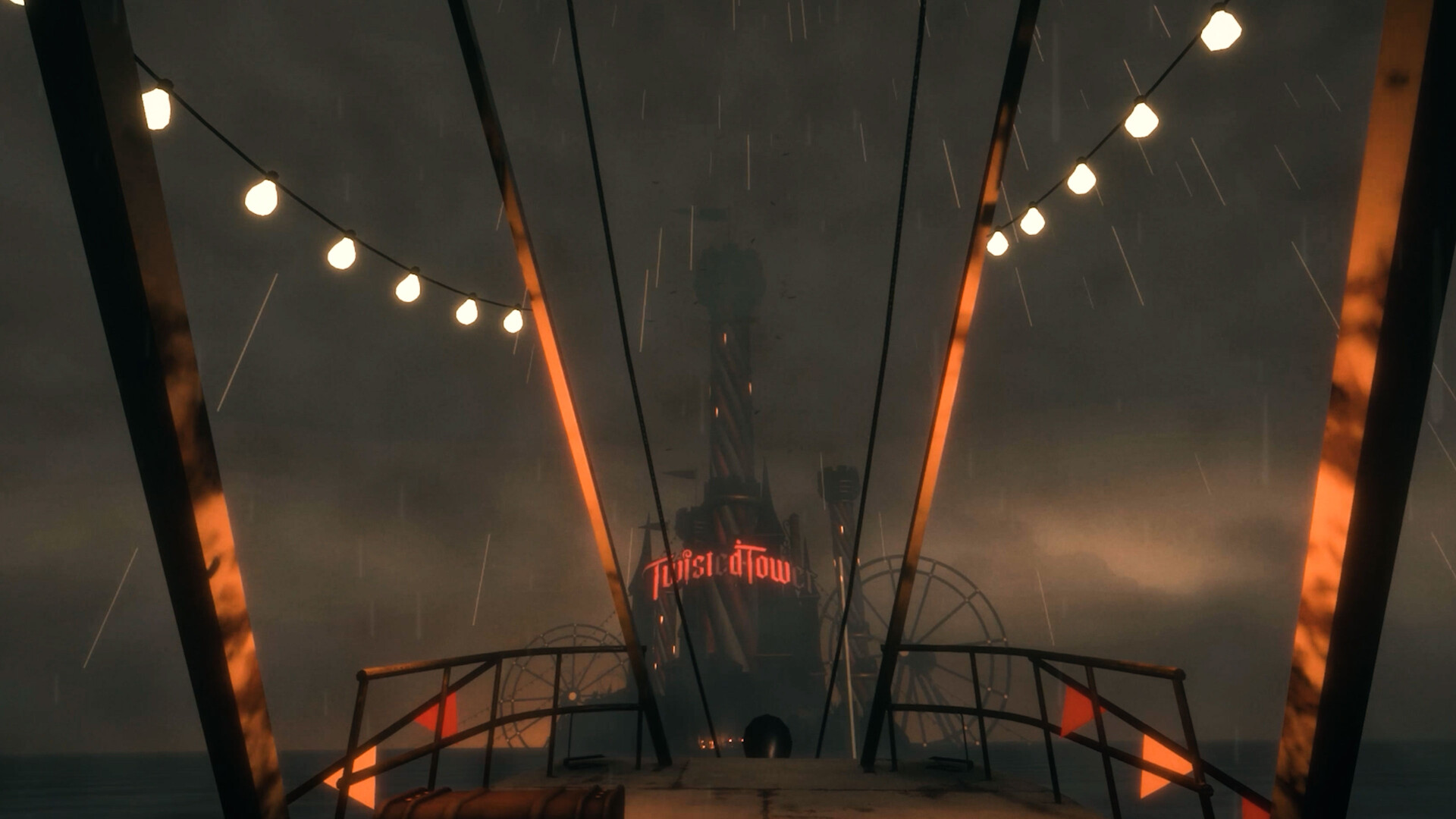
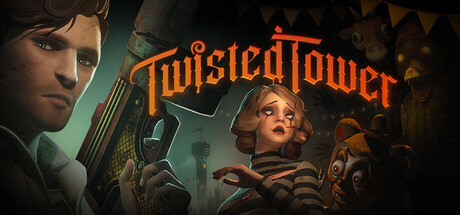
Twisted Tower is a first-person action-adventure game developed by Atmos Games (Thomas Brush) and published by 3D Realms, launching August 18, 2026 on Steam for $14.99. It drops you into an abandoned 1950s theme park where fairy-tale mascots have gone homicidal, carnival rides are death traps, and something dark is hiding at the top.
The game fuses boomer shooter mechanics with escape-room puzzles and a heavy dose of environmental storytelling. You're not just blasting through levels — you're climbing a massive tower that is also a dying amusement park. Each floor is a themed section of the park with its own aesthetic, enemy types, and mechanical puzzles. The goal: reach the top, uncover the truth about your past, and save the love of your life.
The demo was previously available on Steam (App ID 2506090), giving players a preview of the first few floors.
Jump to: Levels · Getting Started · Enemies · Collectibles · Tips · System Requirements · Launch Status & Reviews · FAQ
Developer Background
Twisted Tower is the creation of Thomas Brush, an acclaimed indie developer also known for Pinstripe (2017) and Neversong (2020). Both of those games are story-driven, hand-animated adventures with a dark, whimsical tone — a style Brush carries directly into Twisted Tower. Development took five years, with the team completely scrapping and rebuilding the game's assets multiple times before landing on the final vision.
Thomas Brush cites BioShock (Ken Levine) and Disney World as the two primary inspirations. The result is a game that combines the atmospheric, narrative-first design of BioShock with the colorful, themed environments of a Disney park — then twists both into something sinister.
The game is published by 3D Realms, known for backing indie retro shooters like Ion Fury, WRATH: Aeon of Ruin, and Graven. Their involvement signals confidence in the project and places Twisted Tower within a lineage of fast-paced, old-school inspired action games.
Quick Facts
| Genre | First-person action-adventure (boomer shooter + environmental puzzles) |
| Price | $14.99 USD |
| Release date | August 18, 2026 |
| Developer / Publisher | Atmos Games (Thomas Brush) / 3D Realms |
| Engine | Unity |
| Length | 4-6 hours main path |
| Platform | Windows PC (Steam exclusive, no console/macOS/Linux version) |
| Steam rating | "Very Positive" (~94% of ~1,500 reviews) |
Steam Features
Based on the Steam store page, Twisted Tower includes:
- Single-player campaign
- Steam Achievements
- Full controller support (Xbox, DualShock, DualSense)
- Camera Comfort settings
- Custom Volume Controls
- Adjustable Difficulty
- Playable without Timed Input
- Stereo Sound
- Subtitle Options
- Steam Cloud saves
- Family Sharing
Story
You wake up at the entrance of an abandoned theme park called "Twisted Tower." You don't remember how you got there. Fragments of memory — a carousel, a smiling mascot, a child's laugh — flicker as you move through the park. What you do know: someone you love is at the top, and you need to reach them before it's too late.
The park was built in the 1950s by a mysterious showman named Mr. Jollibee. It was once a vibrant resort destination, shut down after a series of accidents that were never fully explained. The mascots — friendly-faced animals designed for children's rides — remained long after the park closed, their animatronic systems corrupted and their programming twisted into something murderous. Now they patrol the grounds, repeating scripted phrases through corroded speakers while trying to tear you apart.
The story unfolds through environmental storytelling: newspaper clippings pinned to bulletin boards, distorted PA announcements, faded photographs in employee break rooms, scrawled messages on walls left by previous guests who didn't make it out. It's the kind of narrative that trusts you to piece things together rather than shoving exposition in your face.
Memo Pages scattered throughout the tower fill in the backstory of the park's employees, its visitors, and Mr. Jollibee himself. Collecting them reveals the full picture of what happened on the day the park died — and what connection you have to it. The narrative has an emotional core uncommon in the boomer shooter genre, borrowing more from games like BioShock and What Remains of Edith Finch than from Doom.
Levels — The Five Themed Floors
The Steam store page confirms five distinct levels, each with its own theme, enemies, puzzles, and atmosphere. While the exact order may vary depending on player choice (the game advertises "unique paths per playthrough"), the five zones are:
1. The Hotel
The entry point. A decaying 1950s resort hotel where you wake up. Think The Shining meets a roadside motel. This floor serves as the tutorial, introducing basic movement, the melee mallet, and the first enemy types (Clown Scouts). The hotel's ballroom, kitchen, and guest rooms are all explorable. A vintage elevator in the lobby takes you higher — once you restore its power.
2. The Waterpark
A drained and decaying water park with filthy pools, rusted slide towers, and flooded tunnels. Enemies lurk in the murky water and ambush from underwater grates. Some areas require you to drain pools or activate pumps to lower water levels, revealing hidden passages. The water conducts electricity — a key environmental puzzle mechanic introduced here.
3. The Clown Casino
A grotesque carnival casino with slot machines that spit blood, card tables staffed by skeletal dealers, and a central gaming floor patrolled by the toughest mascots yet. The casino's "funhouse mirror maze" distorts your vision while enemies stalk you through the reflections. This floor introduces the Ticket Takers and the first major environmental puzzles involving electrical panels and gas leaks.
4. The Carnival Forest
An outdoor-themed area that was once an "enchanted forest" attraction — now overgrown, polluted, and crawling with corrupted woodland mascots. This level features the Ferris wheel combat arena where you shoot enemies on adjacent carts while managing your balance. The bumper-car chase sequence also takes place here: you ride a bumper car while being chased by a giant mascot.
5. The Space Station
The final level. A surreal, retro-futuristic space station themed area at the top of the tower, built as the park's crowning attraction. This is where the game's narrative comes to a head. The visual shift from rustic 1950s carnival to cold, metallic sci-fi is jarring by design — something happened here that doesn't fit with the rest of the park. The Ringmaster awaits at the summit.
The game advertises "a variety of unique paths per playthrough" — meaning some floors can be tackled in different orders depending on which attractions you activate and which shortcuts you unlock. This adds replay value to what would otherwise be a linear climb.
Getting Started
Twisted Tower plays like a classic shooter with modern polish. You move fast, you carry multiple weapons, and you need to keep moving because standing still is death.
Core Loop
Each floor follows a similar rhythm:
- Explore the themed environment, looking for paths forward
- Fight corrupted mascots using your expanding arsenal
- Solve environmental puzzles (restore power, reroute cables, drain water)
- Ride a carnival attraction (roller coaster, log flume, Ferris wheel, bumper cars) that functions as a combat set piece
- Find the ticket booth for the floor's map fragment
- Defeat the floor's mini-boss or complete its objective to unlock the elevator up
Movement & Platforming
Beyond standard FPS movement, Twisted Tower introduces toys as mobility tools. Scattered throughout the levels are bizarre collectible toys that grant new movement abilities:
- Jump upgrade — reach higher ledges and secret areas
- Dash — dodge enemy attacks and cross gaps
- Grappling hook — pull yourself to distant platforms and enemies
These toys are hidden in optional side rooms and locked behind puzzles, rewarding thorough exploration.
Weapon Progression
You find weapons as you climb — you don't earn them through XP or purchase them. The Steam page lists this toy-inspired arsenal:
| Weapon | Description | Found |
|---|---|---|
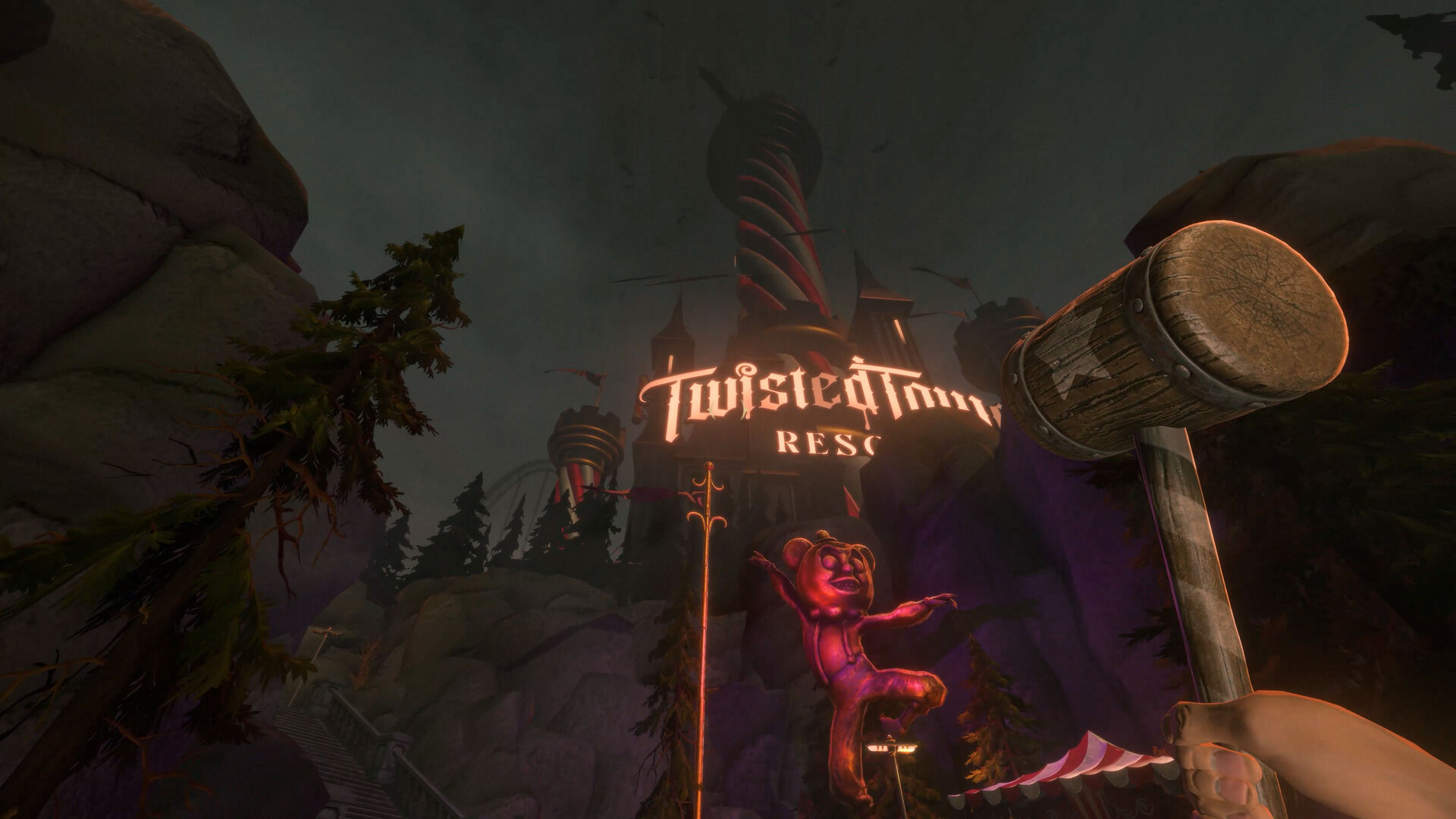
| Whack-a-Mole Mallet | Your starting melee weapon. A padded carnival mallet. Infinite ammo, staggers most enemies. | Floor 1 |
| Rubber-Band Pistol | Your first ranged weapon. Low damage but accurate. Uses rubber bands as ammo. | Floor 1 |
| Dart-Throwing Tommy Gun | Rapid-fire dart gun. Good for groups. Ammo is relatively plentiful. | Floor 2 |
| Fartin' Shotgun | Short-range devastation. The name is silly; the damage is not. Your go-to for tight corridors. | Floor 3 |
| Bubblegum-Spittin' Chain-Gun | High rate of fire. Chews through ammo fast. Bubblegum rounds can slow enemies. | Floor 4 |
| Sniper Slingshot | Long-range precision. Silent. Pins enemies to walls. | Floor 4 |
| Skull-Poppin' Ray Gun | The ultimate weapon. Energy-based, ignores armor. Limited ammo, found near the end. | Floor 5 |
Limited ammo forces resource management. You can't spray and pray. Ammo pickups are scarce, so every shot matters. The mallet never runs out of ammo, which means you'll be using melee more than you'd like. Enemy placement is designed to funnel you into tight corners where melee is risky but conserving bullets is necessary.
Puzzle Design
Puzzles are theme park attractions reimagined as deadly obstacles:
- Broken roller coaster — restore its power by finding fuse boxes and rerouting cables, then ride it as a combat sequence
- Funhouse mirror maze — distorted reflections hide fake walls and enemy ambushes; find the real path by checking for visual inconsistencies
- Ferris wheel — a vertical combat arena where you shoot enemies on adjacent carts while managing your balance
- Bumper cars — drive through an arena while a giant mascot chases you; ram enemies and dodge obstacles
- Log flume — navigate water channels while shooting enemies on the banks; manage the current to avoid being swept into hazards
These aren't simple "find the key" puzzles. They're set pieces that feel like twisted versions of real amusement park attractions, seamlessly blending combat, exploration, and problem-solving.
Replayability
The game explicitly advertises multiple paths per playthrough. Your choice of which attractions to activate, which shortcuts to unlock, and which side rooms to explore changes the order in which you experience content. Combined with collectible Memo Pages (narrative) and Map Fragments (utility upgrades), there's meaningful incentive to replay the game even at its relatively short length.
Enemies
The mascots are the main threat. Each one is a corrupted version of a classic carnival character. Understanding their behaviors and weak points is the key to surviving the climb.
Clown Scouts
- Role: Basic melee enemies
- Behavior: Rush you in groups. Pop out of trash cans, hide behind concession stands, and emerge from vents.
- Weak point: The red nose. A well-placed shot pops it for an instant kill.
- Strategy: The mallet is your best friend here — it staggers them and conserves ammo. Against groups, backpedal and use the Tommy Gun.
Balloon Dogs
- Role: Explosive melee enemies
- Behavior: Float toward you silently. Detonate on contact with significant splash damage.
- Weak point: Any shot will pop them, but timing matters — you want distance.
- Strategy: Shoot them before they reach you. The explosion can trigger chain reactions with nearby Balloon Dogs, clearing groups in one shot. Use this to your advantage in tight corridors. The Sniper Slingshot is ideal for popping them at range.
Carousel Horses
- Role: Stationary ranged enemies
- Behavior: Mounted on a rotating platform. Fire projectiles in a timed pattern as they circle.
- Weak point: The horse's flank when it's facing away from you.
- Strategy: Time your shots between their firing arcs. The rotation is predictable — learn the rhythm and punish the openings. Don't stand still; strafe around the arena to keep the platform between you and their projectiles.
Ticket Takers
- Role: Armored melee/ranged hybrids
- Behavior: Patrol specific areas. Slow but dangerous. Their ticket-slot visor covers their face, making them nearly invulnerable from the front.
- Weak point: Their back. Exposed during their ticket-tearing attack animation.
- Strategy: Bait the attack by staying at mid-range, then circle around while they're locked in the animation. The Skull-Poppin' Ray Gun can damage them from any angle if you have ammo to spare.
The Ringmaster
- Role: Floor boss, appears on the final floor
- Appearance: A massive, tattered figure in a showman's suit. Top hat, cane, and a permanent rictus grin.
- Behavior: Teleports around the arena, summons lesser mascots, and has multiple attack phases.
- Strategy:
- Listen to the music. The carnival track shifts tempo before each attack pattern. Learn the audio cues.
- Clear adds first. The Clown Scouts he summons are a distraction — deal with them before focusing on the Ringmaster.
- His cane slam has a ground-shockwave AOE. Jump to avoid it.
- Phase 2 (below 50% HP) adds faster teleports and a charge attack. Stay mobile.
- The shotgun is effective for burst damage during his attack recovery windows.
Environmental Hazards
The park itself is as dangerous as its inhabitants:
- Gas leaks — shoot them to create explosions that damage nearby enemies (and you, if you're too close)
- Electrical panels — short-circuit when hit, stunning enemies in a radius
- Water puddles — conduct electricity; find a live wire to drop in and electrify the area
- Decaying rides — some structures collapse if you linger too long
- Corrupted animatronics — harmless until activated; some can be turned against enemies
Mastering the environment is as important as mastering your weapons.
Collectibles & Upgrades
Thorough exploration is rewarded across three main collectible categories:
Map Fragments
- Found in the ticket booth on every floor
- Effect: Reveals secret rooms, ammo caches, and shortcut elevators on your HUD map
- Tip: Missing a ticket booth means missing a significant navigation advantage. The booth is never hidden — it's always on the critical path, though finding the key or code to open it may require exploration.
Memo Pages
- Hidden throughout levels in break rooms, offices, behind breakable walls
- Effect: Unlock narrative backstory about Mr. Jollibee, the park's employees, and your own past
- Tip: Listen for the sound of paper rustling — it plays when you're near a Memo Page. Break all lockers, cabinets, and vending machines; pages are often inside.
Health Upgrades
- Permanent max-health increases hidden in optional side rooms
- Effect: Each upgrade adds a small chunk to your health bar, compounding over the course of the game
- Tip: These are the most valuable collectible in practical terms. Prioritize exploration on your first playthrough to find these.
Toy Upgrades
- Grant new movement abilities: jump boost, dash, grappling hook
- Found behind puzzles in hard-to-reach areas
- Effect: Not only enable new exploration paths but also change how combat works (dash through enemy attacks, grapple to high ground)
Tips for Surviving the Tower
Combat Tips
Listen to the music. Each floor has a unique carnival track, but the music dynamically changes when enemies are nearby. The Ringmaster's theme shifts before he teleports. Audio cues are more reliable than visual ones in dark areas. Play with headphones.
Break everything. Lockers, cabinets, vending machines, cardboard boxes — they all can contain ammo, health, or lore notes. The game rewards thorough exploration. If a room has breakable objects, you're meant to smash them all.
The mallet is a valid weapon. It's slow and short-range, but it doesn't consume ammo and it staggers most enemies. Against Clown Scouts and isolated Balloon Dogs, the mallet is more efficient than wasting shells. Save your guns for groups and bosses.
Know your range. The shotgun decimates at close range but is useless beyond 10 meters. The Sniper Slingshot is the opposite. Always have at least one close-range and one long-range weapon equipped.
Use the environment. Gas leaks explode when shot. Electrical panels stun nearby enemies when shorted. Water conducts electricity. The park is a deathtrap for everyone, not just you — turn it against your enemies.
Exploration Tips
Check the ticket booths. Every floor has a ticket booth that contains a map fragment. Maps reveal secret rooms, ammo caches, and shortcut elevators. Missing a ticket booth means missing upgrades and missing narrative content.
Don't skip side rooms. The main path through each floor is obvious, but side rooms contain Memo Pages that unlock the backstory and permanent health upgrades. The game is short enough (4-6 hours) that exploring everything adds only a few minutes per floor.
Look up. Secret paths and collectibles are frequently hidden above eye level — on catwalks, atop cabinets, behind ceiling vents. Look for ledges that a jump boost or grappling hook can reach.
Puzzles have built-in hints. If you're stuck on a puzzle for more than 3 minutes, look for a hint posted nearby. The developers placed contextual clues on bulletin boards and chalkboards in the same room. The game wants you to solve puzzles, not search online.
Boss Tips
Clear adds first. Almost every boss (especially the Ringmaster) summons lesser enemies. Ignoring them means getting flanked while you focus on the boss. Take 10 seconds to clear the room.
The shotgun is your boss weapon. It deals the highest burst damage per shot. Save shotgun shells specifically for boss encounters.
Look for environmental tells. Boss arenas often have interactable elements (explosive barrels, electrical panels, collapsing structures) that can damage the boss. Experiment during the first phase to identify these.
System Requirements
Official specs from the Twisted Tower Steam page (verified after the August 18, 2026 release):
Minimum (64-bit OS required)
- OS: Windows 10 64-bit
- Processor: Intel Core i5-6600 / AMD Ryzen 5 1600X
- Memory: 8 GB RAM
- Graphics: GeForce GTX 670 / Radeon RX 570 / Arc B580
- DirectX: Version 11
- Storage: 8 GB available space
Recommended
- OS: Windows 11
- Processor: Intel Core i5-8400 / AMD Ryzen 5 2600
- Memory: 16 GB RAM
- Graphics: GeForce GTX 1660 / Radeon Vega FE
- DirectX: Version 11
- Storage: 8 GB available space
What this means in practice: Twisted Tower is a stylized Unity game, not a demanding one. Any quad-core CPU from the last eight years paired with a GTX 1050-class GPU or better will comfortably clear the minimum. The 8 GB storage figure is nearly 4× what pre-release sources estimated — make room before you download. If you're on an older quad-core CPU (i5-2400 era) or a 2 GB GPU, expect to drop resolution and shadows to hold 60 FPS in the busier casino and carnival floors.
Note: The game is Windows-only. No macOS or Linux versions have been announced, and the Steam page lists no Proton/Steam Deck verification.
FAQ
When does Twisted Tower release? It released on August 18, 2026 for $14.99 on Steam. You can buy and play it now.
Is there a demo? A demo was previously available on Steam (App ID 2506090). It covered the first few floors and one boss fight. As of mid-2026, the demo may no longer be available as the team focuses on the full launch.
How long is the game? About 4-6 hours for a first playthrough completing the main path. Exploring thoroughly and collecting all Memo Pages adds 1-2 hours. Speedruns will likely push under 2 hours.
What's the difficulty like? Moderate. Regular enemies aren't punishing, but the puzzles and boss fights require attention. The Steam page lists Adjustable Difficulty as a feature, though specific settings haven't been detailed yet.
Is it horror or action? It's action with a horror atmosphere. Think Doom 2016 meets BioShock's environmental storytelling. There are jump scares (enemies bursting from lockers, sudden mascot appearances) but the game doesn't rely on them. The tone is more "unsettling carnival" than "pure survival horror."
Controller or keyboard? Both work well. The game was designed with mouse-and-keyboard in mind (classic shooter), but Steam Input makes controller feel natural. The Steam page confirms full controller support including Xbox, DualShock, and DualSense controllers.
Are there achievements? Yes. The game ships with 18 Steam Achievements, covering combat milestones, collectibles, and story progression.
Is there cloud saving? Yes, Steam Cloud is supported.
Who is making this game? Developed by Atmos Games (Thomas Brush, creator of Pinstripe and Neversong) and published by 3D Realms.
Will there be mod support? No mod support has been announced. The game is built in Unity (based on Thomas Brush's previous titles), which supports modding, but no official tools have been promised.
Is there replay value? Yes. The game advertises multiple paths per playthrough, meaning your choice of routes and order of attractions changes the experience. Combined with collectibles and difficulty options, there's meaningful replayability.
Comparing Twisted Tower to Other Games
Twisted Tower sits at an interesting intersection of genres and influences. Here's how it compares to similar titles:
| Aspect | Twisted Tower | BioShock | Doom 2016 | Pinstripe (same dev) |
|---|---|---|---|---|
| Setting | Abandoned 1950s theme park | Underwater city Rapture | Hell / Mars facility | Hand-drawn hellish dreamscape |
| Storytelling | Environmental + Memo Pages | Audio logs + environmental | Minimal (codex entries) | Narrative-driven, hand-animated |
| Combat | Fast-paced boomer shooter | Slower, methodical | Pure speed and aggression | 2D melee, slower |
| Puzzles | Environmental, attraction-based | Minimal (hacking, locks) | None | Light puzzle-platforming |
| Tone | Whimsical dark horror | Philosophical horror | Brutal power fantasy | Dark fairy tale |
| Length | 4-6 hours | 12-15 hours | 10-12 hours | 3-4 hours |
The comparison that comes up most often is "BioShock meets a boomer shooter at Disney World." It's an apt description. The environmental storytelling, the lonely atmosphere, and the mysterious benefactor figure (Mr. Jollibee echoes Andrew Ryan) are straight out of BioShock. The movement speed, weapon-switching, and lack of reloading mechanics come from the boomer shooter tradition. And the theme park theming — complete with mascots, rides, and ticket booths — is pure Disney World, filtered through a dark carnival lens.
Developer Profile: Thomas Brush & Atmos Games
Thomas Brush is an indie game developer based in the United States. Before Twisted Tower, he created:
- Pinstripe (2017) — A 2D action-adventure game set in a hand-painted hell. A man searches for his daughter through a frozen, demonic underworld. Notable for its unique art style, emotional story, and soundtrack composed entirely by Brush on the piano.
- Neversong (2020) — A dark action-adventure game about a boy searching for his missing friend in a world infected by a sleeping sickness. Shares Pinstripe's hand-crafted visual style and emotional storytelling.
Both games share DNA with Twisted Tower: dark fairy-tale aesthetics, emotional narratives about love and loss, and a blend of action and exploration. Twisted Tower represents Brush's first foray into 3D first-person game development and his partnership with a major publisher (3D Realms).
The development cycle for Twisted Tower spanned five years and involved multiple complete asset overhauls. In his own words from a Steam news post: "It started as a completely different concept, and after disposing of pretty much every asset in the game 2 or 3 times over, we finally figured out what this game is."
Launch Status — Released & Verified (Updated September 2026)
Twisted Tower launched on August 18, 2026 at $14.99 on Steam, and early reception has been strong: the game holds a "Very Positive" rating on Steam (around 1,500 reviews, roughly 94% positive) in its first two weeks. Key launch facts:
- Price: $14.99 USD (no launch discount observed)
- Reviews: "Very Positive" on Steam — players single out the atmosphere, boss fights, and Thomas Brush's soundtrack
- Achievements: 18 Steam Achievements at launch (fewer than the 20 typical of similar indie releases — a manageable completion run)
- Demo: Delisted for the full launch, as expected
- DLC: A single DLC entry exists on Steam (App ID 4806470) but its contents remain unannounced
For a $15 single-player shooter with a 4-6 hour runtime, the consensus is that the price matches the content, especially for fans of Pinstripe, Neversong, or BioShock-style environmental storytelling.
The game was announced on September 30, 2023 via a trailer on 3D Realms' channels. The demo launched in early 2025, and the release date trailer dropped in July 2026.
Developer Links & Community
- Steam store page: store.steampowered.com/app/1575990
- Developer Website: http://atmosgames.com/
- Support/Contact: [email protected]
- The 3D Realms Discord and Subreddit are active communities for discussion
Why Twisted Tower Stands Out
The theme park setting is what sells it. Most retro shooters go with industrial complexes, hellish landscapes, or sci-fi facilities. A 1950s amusement park is fresh territory, and the developers lean hard into the aesthetic — neon signs, ticket booths, cotton candy machines, carousel music. The juxtaposition of colorful carnival visuals with gory violence creates a unique tone that's more unsettling than straight horror.
The toy-based arsenal is another standout. While most shooters use realistic or sci-fi weapons, Twisted Tower's weapons are all carnival games come to life. A dart gun Tommy Gun. A bubblegum chain-gun. A farting shotgun. It's juvenile and it knows it — and that tonal consistency with the theme park setting makes it work.
The 3D Realms publishing deal signals confidence in the project. They've backed several successful indie shooters, and Twisted Tower fits their portfolio of fast-paced, retro-inspired action games. Combined with Thomas Brush's track record of emotionally resonant indie hits, Twisted Tower has a strong pedigree.
With a tight 4-6 hour runtime, a distinctive setting, creative weapons, and meaningful replayability through multiple paths, Twisted Tower delivers on what the demo promised — and its "Very Positive" launch reception confirms it as one of the more interesting indie shooter releases of 2026.
Guide last updated: September 2026. Information based on the official Steam store page (verified post-launch), developer communications, and review data. Check the official Steam page for the most current information.
Screenshots