Official game
Play SHED
This game is hosted by Steam. Continue to the official page to play or download it.
Buy on SteamOverview / Game Introduction
SHED is a competitive digital card game built around a punishingly simple premise: get rid of every card in your hand before your opponents do — or suffer the humiliation of being the last one left holding the pile. Developed by indie studio Patchrat and released on Steam in June 2026, SHED takes the classic tavern card-shedding genre (think Palace, President, or Tien Len) and injects it with chaotic modern energy: magic cards that reverse turns, boss fights with unique rules, a Bullet mode played against a ticking clock, and enough unlockable cosmetics to keep you chasing "just one more round."
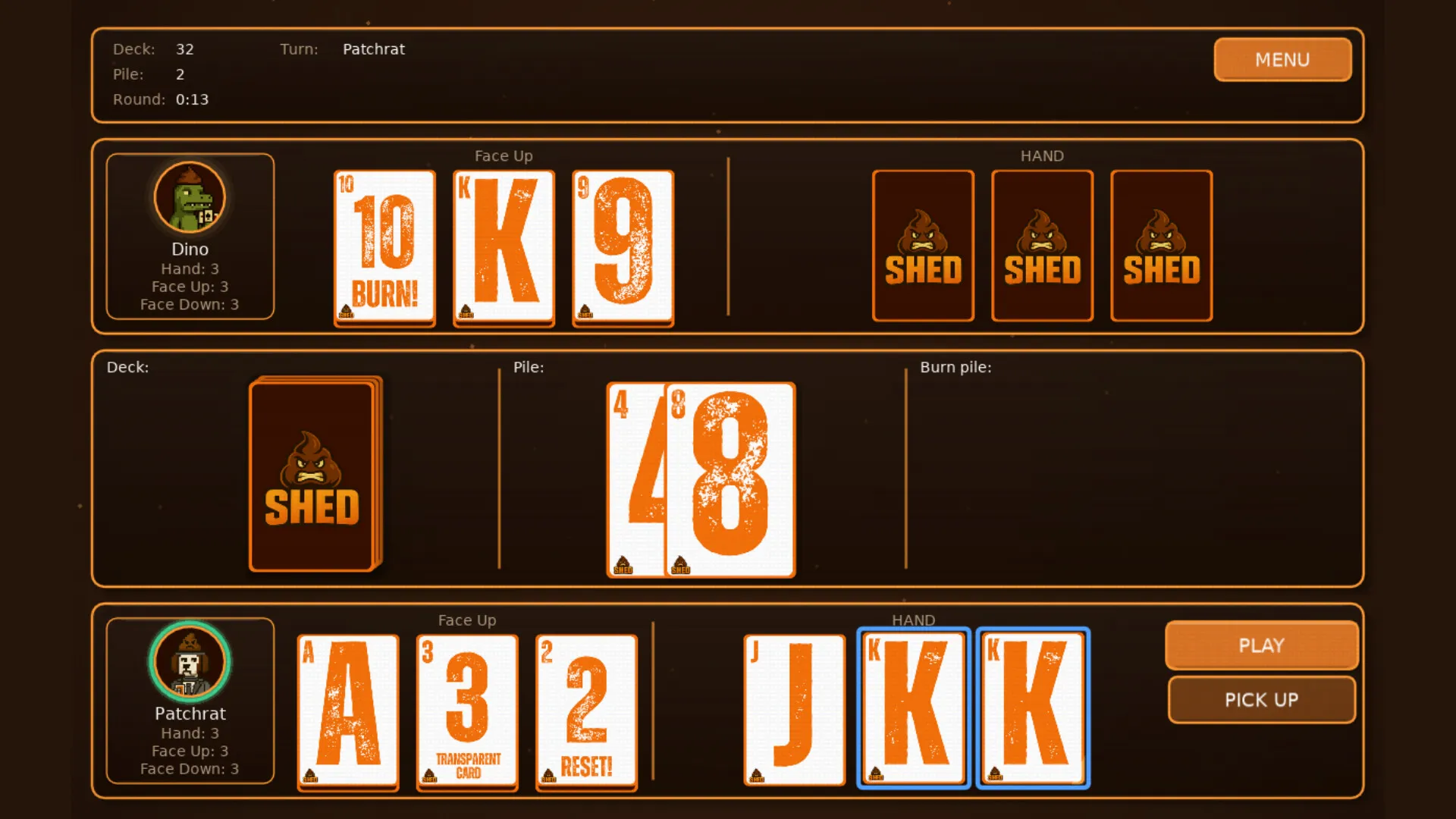
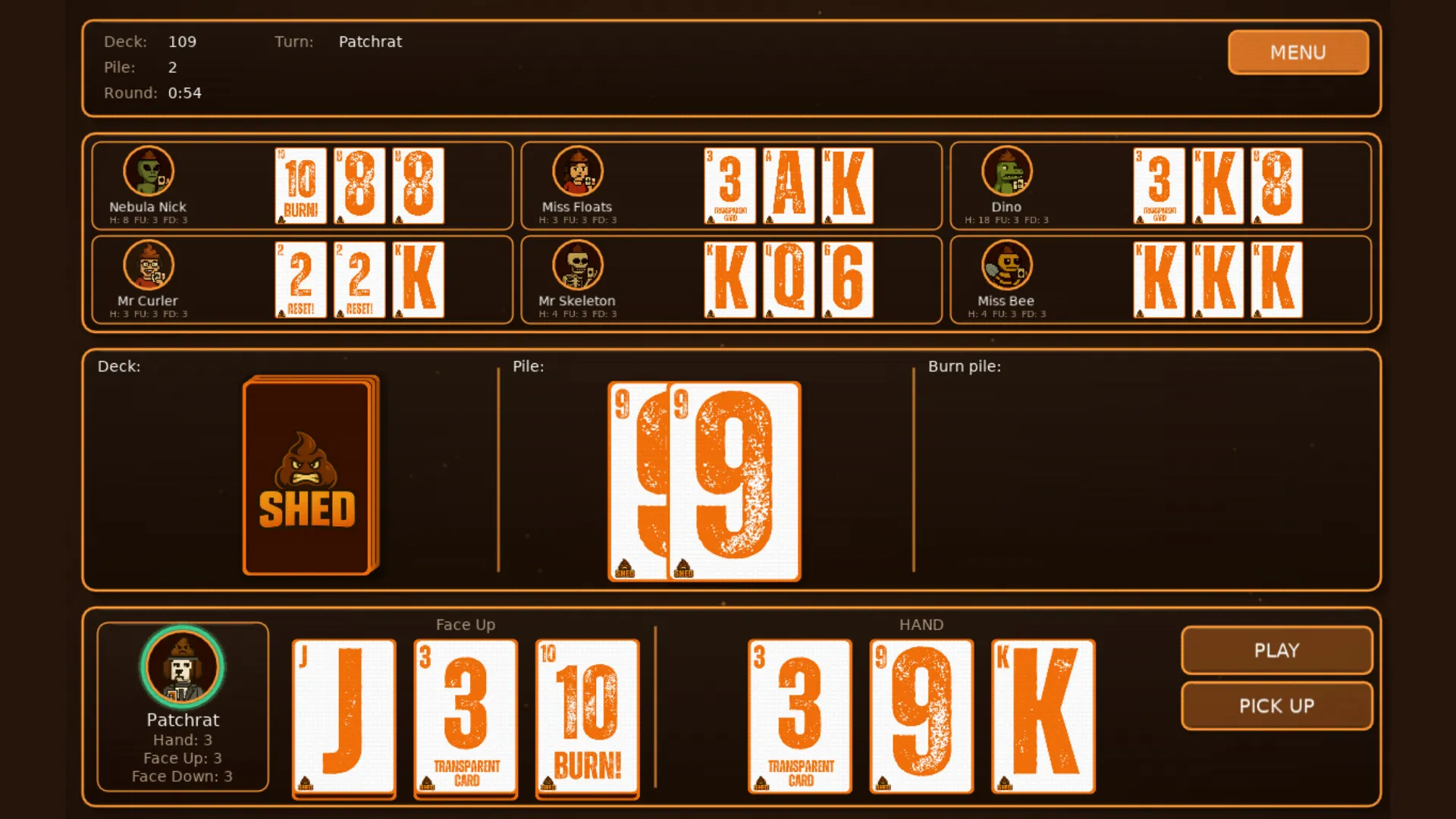
The core loop is brutally elegant. Each round, players take turns laying cards onto a central pile — matching rank, building sequences, or playing special magic cards that flip the round upside down. If you can't or won't play, you pick up the entire pile. The first player to empty their hand wins the round. Matches are fast — a full game rarely overstays 15 minutes — making it equally suited for a quick lunch-break session or an extended couch-war with friends.
SHED launched with a surprising amount of content for a $4.99 indie title: a full single-player campaign against 16 unlockable bosses (each with their own gimmick rule set), 12 curated Trials challenges, tournament brackets for solo or up to 8 players, and a frantic "Bullet" mode where the pressure comes from a countdown timer. Online multiplayer supports cross-platform play, and the offline mode works with adjustable bot difficulty. With 68 achievements, 13 unlockable card decks, 31 avatars, and 72 shop items earned purely through in-game currency (no microtransactions), SHED respects your time and your wallet.
| Detail | Info |
|---|---|
| Genre | Casual / Indie / Strategy (Card-Shedding) |
| Developer | Patchrat |
| Publisher | Patchrat Games |
| Platform | Windows, Linux (Steam, cross-platform multiplayer) |
| Price | $4.99 USD (no microtransactions) |
| Players | 1–8 (offline vs bots, online PvP, tournaments) |
| Release Date | June 23, 2026 |
| Controller Support | Full (keyboard + mouse + touch only options) |
| Steam Features | Cloud saves, achievements (68), leaderboards, stats, family sharing |
| Languages | 14 including English, French, German, Spanish, Japanese, Chinese, Welsh |
Target audience: This game is for anyone who enjoys competitive card games where reading the table matters more than memorising combos. If you grew up playing President, Palace, or Mao with a physical deck and wished they had proper matchmaking, unlockable cosmetics, and a boss-rush mode, SHED scratches that itch exactly. It's casual enough for half-watching a stream, but the Bullet mode and high-difficulty bosses demand real attention. The lack of any pay-to-win mechanic makes it an easy recommendation for parents too.
Getting Started — First 30 Minutes
Critical First Moves
1. Start a Quick Game against 3 bots on Easy difficulty. Use the default Classic deck to learn turn flow, the pass mechanic, and card matching without pressure.
2. Learn the golden rule: you can only play cards that match the top of the pile. If the top card is a 7, you can play any 7 (any suit), or a sequence starting with 7 (7-8-9 of the same suit). Single cards, pairs, triples — all valid if they match rank. The game highlights playable cards for you.
3. Pass only when you absolutely have to. Hitting SPACE to pass dumps the entire pile into your hand. That's how a winning position turns into a losing one in one button press.
4. Right-click to auto-sort your hand. A sorted hand (ascending rank, grouped by suit) makes it dramatically easier to spot sequences and matching pairs.
5. Peek at Magic Cards by hovering. Cards with a coloured border are Magic Cards — hover to read their effect before playing. Experiment with one per round in your first game.
6. Finish your first game even if you're losing. The winner is the first to reach 100 points across multiple rounds. Stick around to see how endgame pressure changes decision-making.
7. Jump into Trials Mode — Trial 1. Trials are short, curated scenarios that teach one concept at a time. Complete a couple before touching multiplayer.
Advanced Tips
| Mistake | Why It Hurts | How to Fix |
|---|---|---|
| Passing too early | Every pass makes you pick up the entire discard pile — you gain 5–15 cards at once. This loses more games than any misplay. | Only pass when you have zero valid plays. If you have even one matching card, play it. |
| Holding onto low cards "for later" | Low cards (2s, 3s, 4s) are dead weight — hard to sequence, rarely control the pile. | Lead with your lowest playable cards early. The pile resets each round, so there's no penalty for burning weak cards. |
| Ignoring Magic Cards | Magic Cards are the only way to break a stalemate, skip a dangerous opponent, or clear the pile. | Play at least one Magic Card per round in your first 10 games to internalise how they change the board. |
| Not watching opponents' hand sizes | If someone has 2 cards left and you play a card they can match, they win the round. | Glance at the player panel every turn. If someone is low, prioritise Skip or Reverse cards. |
| Over-splitting sequences | A 5-card run dumps 5 cards but leaves you with no control over the next pile. | Hold a 2–3 card sequence back so you have something to play on your next turn. |
| Skipping the trials | Trials teach edge cases (stacking Magic Cards, Burn interactions). Skipping means costly trial-and-error. | Run all 12 trials once. They take 2–3 minutes each. |
| Sticking to one deck | Each of the 13 decks has different rank distribution and Magic Card frequency. | Unlock 2–3 decks and rotate. Different card backs help you associate different strategies. |
Core Mechanics Deep Dive
1. The Shedding Cycle — Turn Flow and Valid Plays
The player who won the previous round leads with any single card, matching set (pair, triple, quadruple), or valid sequence (3+ consecutive cards of the same suit). Subsequent players must play cards that match or beat the rank of the top card on the pile, or play a Magic Card.
- Singles: If the pile top is an 8, play any 8 (any suit).
- Pairs/triples: A lead of pair 5s requires a pair of equal or higher rank.
- Sequences: A lead of 7-8-9 hearts requires a sequence of equal length with a starting rank ≥ 7, same suit.
If you cannot match, you pick up the pile — all discard cards join your hand. Play passes to the next player, who leads on an empty field. The round ends when one player empties their hand.
2. Magic Cards — The Chaos Engine
Magic Cards (coloured border) break normal matching rules and are the swing factor that separates SHED from traditional shedding games.
Common types:
- Reverse: Flips turn order. Devastating when the player about to win is next in the old order.
- Skip: The next player loses their turn. Use it when an opponent is down to 1–2 cards.
- Burn: Clears the entire discard pile. You then lead whatever you want on an empty field.
- Draw X: Forces the next player to draw cards from the deck.
- Swap: Exchange one card in your hand with one from an opponent's hand.
Magic Cards can be played on any pile, regardless of rank. They stack — multiple effects resolve in play order.
3. The Pile — Your Greatest Enemy and Ally
When a player passes, they take the entire pile into their hand — not just the top card. This creates a push-your-luck dynamic. A small pile (2–3 cards) is tempting to pick up. A massive pile (15+ cards) can end a player's chances.
- Lead with high ranks (10, J, Q, K, A) when the pile is small to force opponents to play high or pick up.
- Lead with low ranks (2, 3, 4) when the pile is large — if the next player picks up, they're eliminated from the round.
- A Burn on a huge pile is the single most powerful play in the game.
4. Scoring and Win Conditions
When a player sheds out, they score points equal to cards remaining in all opponents' hands. Losers score 0. The match target defaults to 100 points (4–8 rounds in a 4-player game).
Last Card rule: When playing down to your last card, you must announce it (the game auto-prompts). In local play, forgetting triggers a penalty draw from the deck.
5. Decks and Progression
Each of the 13 decks varies in rank distribution, Magic Card density, and suit balance. The 72 shop items and all avatars are unlocked with in-game credits earned by playing — no microtransactions.
Advanced Strategies
The "Dry Hand" Gambit
Keep your hand as small as possible from turn one. Lead with your highest cards immediately and accept that you'll burn through your power cards early. A small hand (3–5 cards) gives perfect information — you know exactly what you can play. Opponents with 10+ cards face hard choices. Execute this when you are round leader, have a Burn card as a safety net, and have 3+ opponents.
Pile Manipulation in 4+ Player Games
Play a card you know the player two seats ahead cannot match. If you've tracked discards and know Player C hasn't seen a King, lead with a King. Player B may match it, but Player C is stuck. Watch play-speed tells — hesitation often signals a weak hand.
Magic Card Sequencing
- Burn → Lead: Clear the pile, then lead your strongest card.
- Reverse → Skip: Reverse order, then Skip the player who was originally about to play. You've removed two opponents from rotation.
- Draw → Swap: Force a draw, then Swap a junk card for one of their new cards.
Pro tip: Magic Cards go to the pile like any other card — an opponent could pick up and reuse your Burn. Consider whether playing a card now means giving it to the enemy later.
Boss Bowl — Adapting to Boss Rules
- The Hoarder: Every card must be a pair or higher. Save pairs, don't lead singles.
- The Speedster: 10-second turn timer. Pre-plan moves; right-click sort is vital.
- The Magnet: Picking up the pile also draws from the deck. Never pass.
- The Jester: Magic Cards disabled. Pure shedding — best sequencer wins.
Bullet Mode — Playing Against the Clock
A shared 60-second countdown replaces pass/pick-up. If the timer hits zero, whoever holds the most cards loses. Playing cards pauses the timer briefly.
- Lead singles or pairs only (fastest to resolve).
- Avoid sequences longer than 3 cards — animation eats your clock.
- Hold Burn for the last 10 seconds to scramble the table.
- Skip Reverse/Skip — they waste precious seconds.
FAQ
Q: How many players can play in a lobby? A: Up to 8 in standard multiplayer and Bullet mode. Single-player supports up to 6 bots with adjustable difficulty.
Q: Does SHED have microtransactions? A: No. All cosmetics are unlocked with in-game credits earned by playing. The $4.99 purchase is the only money you'll spend.
Q: What happens on disconnect? A: The game pauses 60 seconds for reconnection. If you don't return, a bot replaces you for the remainder of the round.
Q: Can I play offline? A: Yes. Quick Game, Boss Bowl, Trials, and single-player tournaments all work fully offline.
Q: Are the 13 decks purely cosmetic? A: No — rank distribution, Magic Card density, and suit balance differ across decks.
Q: How do I unlock bosses? A: 4 tiers of 4 bosses each. Beating a boss unlocks the next. Clearing a tier unlocks the next tier.
Q: Is there cross-platform play? A: Yes, across all supported platforms.
Final Tip / Verdict
Final tip: The single most important habit in SHED is never passing unless you have zero valid plays. The temptation to pass when you have a weak play is enormous — especially when the pile is small. But every pick-up is a setback. Play something every turn. The only exception is Bullet mode, where passing can run down an opponent's clock.
Verdict: SHED is a rare indie title that knows exactly what it wants to be — a fast, social, slightly chaotic card-battler — and delivers with zero friction. The $4.99 price is a steal given the content volume: 68 achievements, 16 bosses, 12 trials, full multiplayer, cross-platform, and free cosmetics. No monetisation beyond the upfront purchase is genuinely refreshing. If you have any fondness for President, Palace, or UNO and want more strategic depth, SHED earns a permanent spot in your library.
Last reviewed by the Game How To Editorial team.
Screenshots