Official game
Play My Room Philosopher
This game is hosted by Steam. Continue to the official page to play or download it.
Buy on SteamOverview
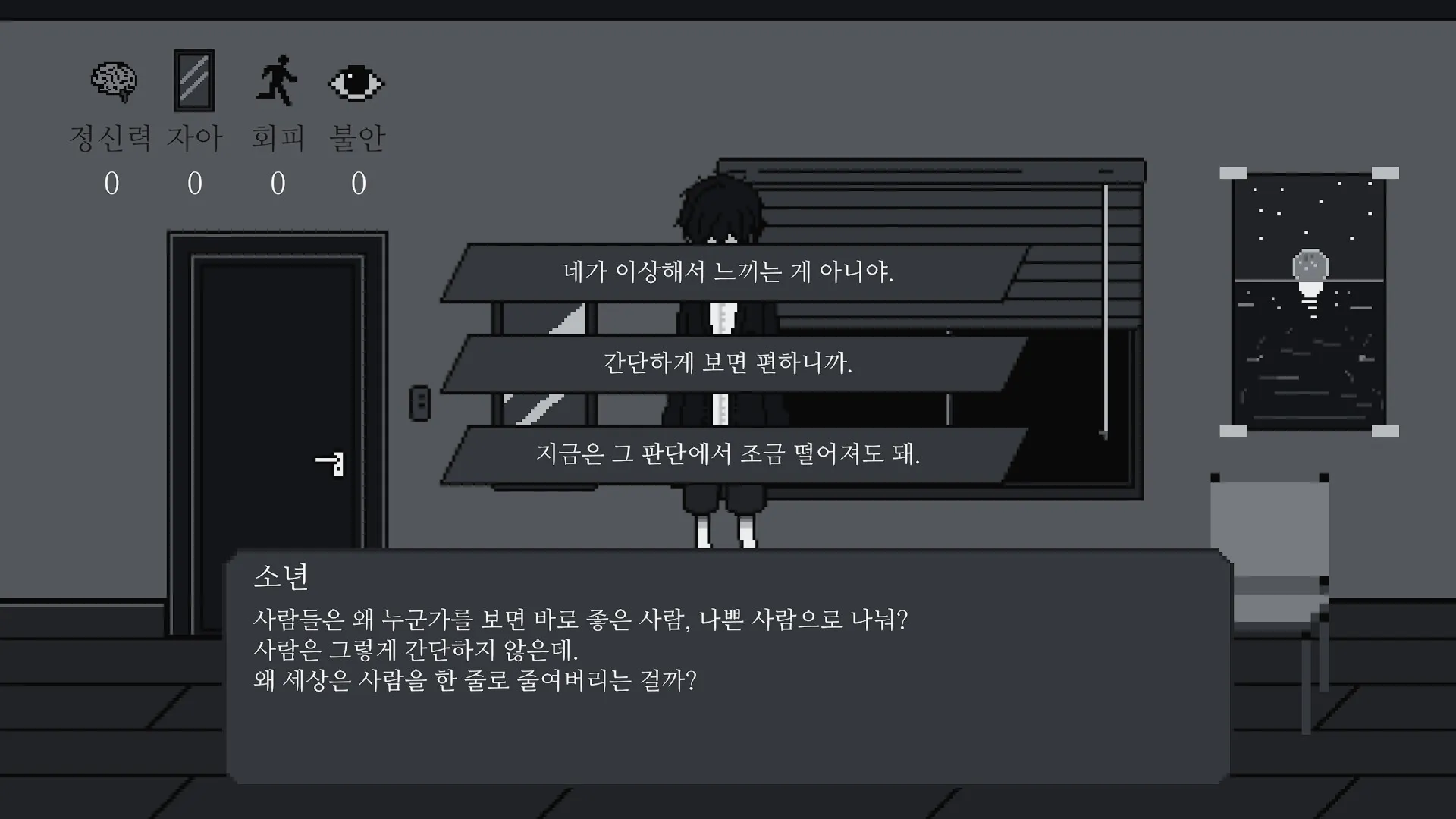
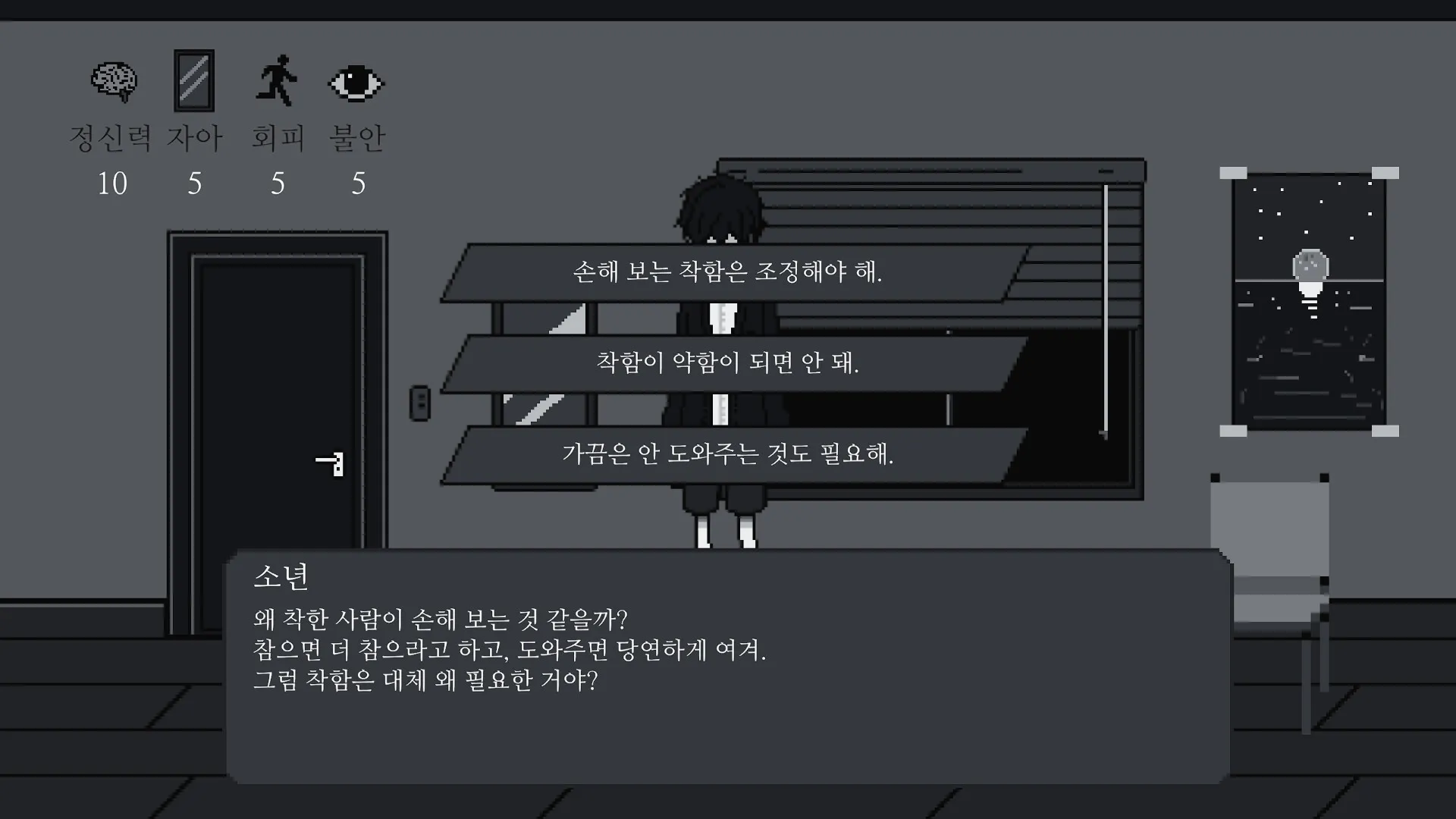
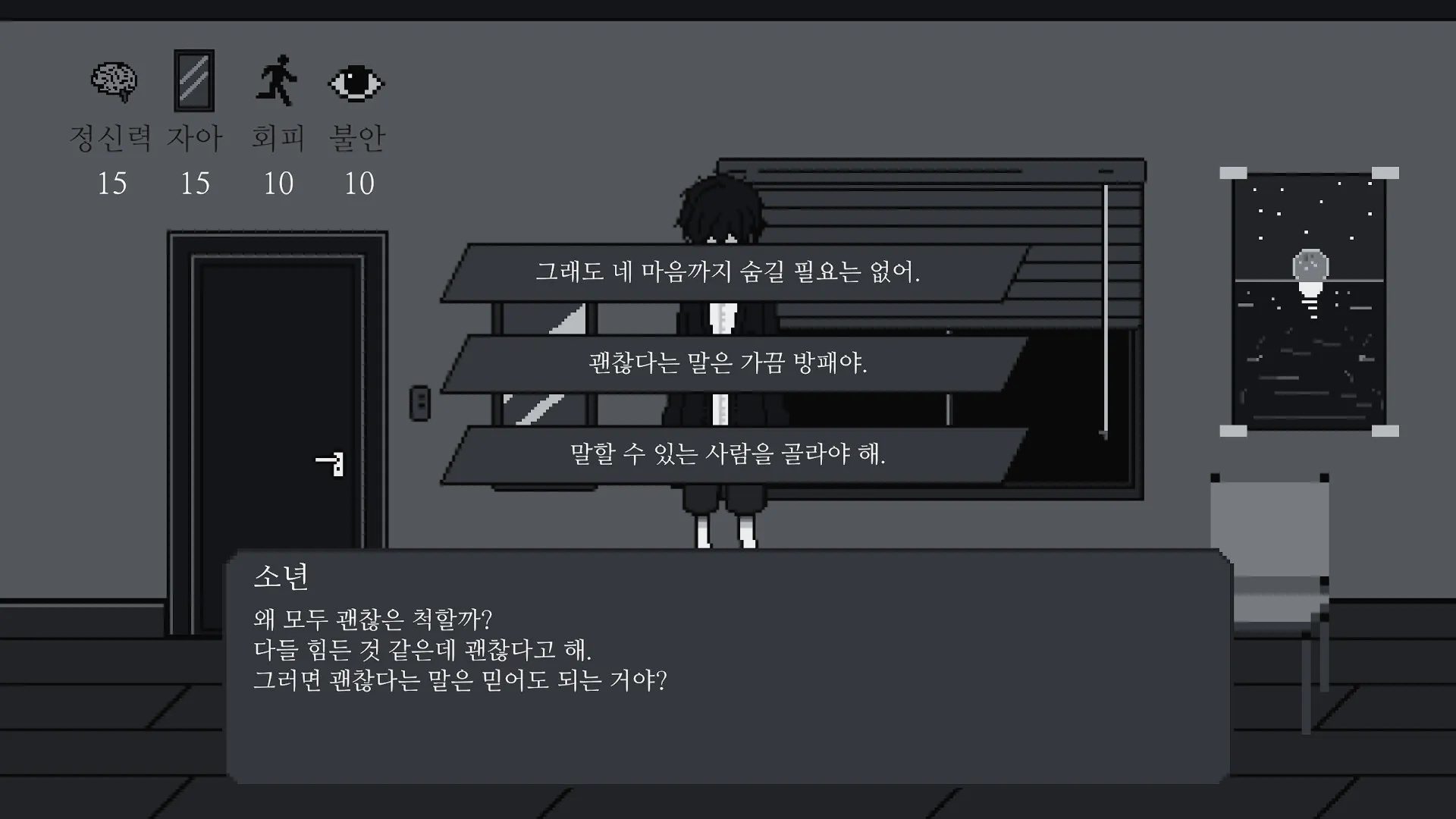
My Room Philosopher (Korean: 내 방에서만큼은 누구나 철학자 — "In my room, everyone is a philosopher") is a message-driven visual novel from solo Korean developer SEO MINJAE. Unlike traditional games with puzzles to solve or stats to optimize, My Room Philosopher is a conversation — a 30-to-60-minute dialogue where a young boy asks you questions about identity, purpose, morality, death, and freedom.
There are no wrong answers. There is no fail state. Every choice leads to the same ending. The game's purpose is not to challenge your skill but to challenge your thinking.
This guide covers the boy's conversational psychology, dialogue response frameworks, theme-by-theme engagement strategies, replay approaches, and the philosophical undercurrents that make this game more than its simple presentation suggests.
Understanding the Boy
The boy is the only character you interact with. His personality is described by the developer as "cold and rational." He is not hostile, but he is probing — like a therapist who refuses to let you deflect.
The Boy's Conversational Personality
| Trait | How It Manifests |
|---|---|
| Analytical | He breaks down emotions into logical components |
| Persistent | He circles back to questions you avoided |
| Non-judgmental | He never scolds or praises your answers |
| Curious | He genuinely wants to understand how you think |
| Mirroring | He reflects your answers back with deeper implications |
The boy is not trying to win a debate. He is trying to understand. Treat him as a conversation partner, not an opponent.
What the Boy Responds To
Through testing different response patterns, certain approaches consistently lead to more interesting conversations:
Gets a deeper response:
- Saying "I don't know" then explaining why
- Answering with a personal story
- Acknowledging contradictions in your own thinking
- Asking the boy what he thinks
Gets a surface response:
- Giving a one-word answer
- Being dismissive
- Parroting a philosophical position without personal connection
- Trying to "win" the exchange
Dialogue Response Categories
Responses in My Room Philosopher generally fall into four categories. Each leads to a different conversational branch:
1. Empathetic / Emotional
These responses engage with the feeling behind the question rather than its intellectual content.
Example scenario: The boy asks "Do you think people can ever truly know each other?"
Empathetic response: "No, but I think the effort to try is what matters."
Tends to lead toward: The boy sharing his own feelings. Deeper emotional territory. Conversation about relationships and loneliness.
Best for: First playthrough. Connects you to the game's emotional core.
2. Rational / Logical
These responses treat the question as a puzzle to be solved.
Example scenario: Same question.
Rational response: "Define 'truly know.' If knowledge requires certainty, then no. If knowledge requires understanding patterns, then yes, partially."
Tends to lead toward: Epistemological discussion. Definitions and frameworks. Abstract reasoning.
Best for: Players who enjoy intellectual sparring. Reveals the game's philosophical structure.
3. Skeptical / Questioning
These responses challenge the premise of the question itself.
Example scenario: Same question.
Skeptical response: "Why is 'truly knowing' someone the goal? Maybe the distance between people is what makes relationships meaningful."
Tends to lead toward: Meta-conversation about the questions themselves. The boy adjusts his framing.
Best for: Second playthrough. Shows the game's ability to pivot when challenged.
4. Personal / Experiential
These responses ground the answer in your own life.
Example scenario: Same question.
Personal response: "I had a friend who I thought I knew completely, then they did something that totally surprised me. So I'd say we can know parts of people, not wholes."
Tends to lead toward: The boy asking follow-up questions about specific experiences. The conversation becomes more personal.
Best for: Getting the most out of a single playthrough. Creates memorable moments.
Theme-by-Theme Engagement Guide
The game's questions cluster around several core themes. Here is how to engage each one for maximum depth:
Identity — "Who Am I?"
Common questions: What makes you you? If you lost all your memories, would you still be the same person? Do others define you?
Engagement strategy:
- Consider the "ship of Theseus" problem (if you replace every part of a ship, is it still the same ship?)
- Apply it to yourself — are you the same person you were 5 years ago?
- The boy is particularly interested in the gap between how you see yourself and how others see you
Depth multiplier: Answer with a specific memory. "When I was X age, I thought I was Y, but then Z happened."
Purpose — "Why Are We Here?"
Common questions: What is the meaning of life? Is happiness the point? What if there is no purpose?
Engagement strategy:
- Avoid grand philosophical declarations ("Life is meaningless" — that's a conversation ender)
- Instead, talk about what gives YOUR life purpose, even if it's small
- The boy is testing whether you can find meaning without a cosmic guarantee
Depth multiplier: Talk about a time when you felt most alive or most engaged. Purpose is revealed through action, not abstraction.
Morality — "Right and Wrong"
Common questions: Is there absolute right and wrong? How do you make ethical decisions? What would you do in X dilemma?
Engagement strategy:
- The boy often presents moral dilemmas. Don't solve them — sit in the discomfort
- Explain the tension between competing values, not just your final choice
- He respects complexity over certainty
Depth multiplier: Admit when you're not sure. "I think X, but I can see why someone would think Y, and that makes me uncomfortable."
Relationships — "Connecting With Others"
Common questions: Is loneliness inevitable? What does it mean to truly connect? Can we understand each other?
Engagement strategy:
- The boy's questions here are the most emotionally charged
- He may be working through his own feelings about isolation
- Empathetic responses consistently yield the richest conversations in this category
Depth multiplier: Talk about a specific relationship — parent, friend, partner — and what worked and what didn't.
Death — "What Happens at the End?"
Common questions: What do you think happens when we die? Should the awareness of death shape how we live?
Engagement strategy:
- Don't jump to "I believe X" about the afterlife. Talk about how death affects life
- The most interesting responses acknowledge the fear without being paralyzed by it
- The boy is looking for a way to live well despite mortality, not a theory about what comes after
Depth multiplier: "I'm afraid of death, but I think that fear makes me value my time more."
Getting Started
First Playthrough — Discovery
Goal: Experience the game without overthinking
- Answer instinctively, not strategically
- Mix response types — be empathetic for one question, rational for the next
- Don't try to "see everything" in one run
- Sit with uncomfortable questions instead of rushing past them
- When you reach the ending, sit quietly for 2-3 minutes before closing the game
Expected length: 30-45 minutes Outcome: A genuine, unrepeatable first impression
Second Playthrough — Depth
Goal: Access conversations you missed
- Consistently choose the response type you used LEAST in your first run
- If you were mostly empathetic, go rational this time
- If a question made you uncomfortable the first time, choose the option you avoided
- Notice how different responses reveal different facets of the boy
Expected length: 25-40 minutes Outcome: Understanding the game's hidden structure
Third Playthrough — Philosophical Framework Matching
Goal: Test specific philosophical lenses
- Choose a framework before starting:
- Stoicism: Focus on what you can control. Accept impermanence.
- Existentialism: Emphasize freedom and responsibility. Create your own meaning.
- Buddhism: Question attachment. Talk about impermanence and suffering.
- Pragmatism: Ask "what works?" and "what are the consequences?"
- Try to answer every question through that framework
- See how the boy reacts to consistent philosophical positions
Expected length: 30-45 minutes Outcome: The game as a philosophical sparring partner
Technical Details
System Requirements
| Component | Minimum | Recommended |
|---|---|---|
| OS | Windows 10 64-bit / macOS / Linux | Windows 10/11 64-bit |
| CPU | Intel Core i3 or equivalent | Intel Core i3 or equivalent |
| RAM | 2 GB | 4 GB |
| GPU | Intel HD Graphics | NVIDIA GT 1030 or equivalent |
| Storage | 200 MB | 200 MB |
| DirectX | Version 11 | Version 11 |
Language Support
| Language | Interface | Audio | Subtitles |
|---|---|---|---|
| English | ✔ | ✔ | ✔ |
| Korean | ✔ | ✔ | ✔ |
| Japanese | ✔ | ✔ | ✔ |
AI-Generated Content Disclosure
The developer states that AI-generated content was used across all phases of development. This is worth noting for players who have opinions about AI in creative works. The game itself does not feel "AI-written" in the moment — the dialogue flows naturally — but the disclosure allows you to make an informed purchase.
FAQ
Q: Is this a "game" or more of an interactive art piece? A: Both. It's sold as a game and has game-like elements (choices, progression to an ending) but its purpose is closer to interactive art or a guided journaling exercise.
Q: How long is it? A: 30-60 minutes for one playthrough. Total content across all paths is roughly 2-3 hours of unique dialogue.
Q: Can I save mid-conversation? A: The game is designed as a single-sitting experience and does not require saves. You can alt-tab or put your computer to sleep without issue.
Q: Is there any gameplay beyond choosing dialogue options? A: No. You read text, reflect, and choose responses. That is the entire experience.
Q: Is it worth replaying? A: Yes, if you approach each replay with a different mindset or response style. The mechanical content is the same ending, but the emotional and intellectual content changes dramatically based on your answers.
Q: Is the game appropriate for teenagers? A: The content is philosophical — discussions of death, identity, purpose, and morality. There is no sexual or violent content, but the themes are mature.
Q: Does it run on Steam Deck? A: The developer lists Windows, Mac, and Linux support. Proton compatibility on Steam Deck should work, though controls are mouse-only.
Advanced Tips
My Room Philosopher is not trying to be a game in the traditional sense. It's a conversation — one that asks more of you than it asks of your reflexes or strategic thinking. The boy is patient, probing, and surprisingly insightful for a character generated through AI-assisted development.
Is it worth $5.99? If you want a dopamine loop of achievements and unlocks, no. If you want to sit with uncomfortable questions and see where your own mind takes you, it's a bargain. The game's real value is measured not in hours of content but in minutes of genuine self-reflection.
Rating: 7/10 — A successful execution of a specific artistic vision. Limited appeal but deeply rewarding for the right player.
Developer: SEO MINJAE. Steam App ID: 4789620. $5.99 on Windows/Mac/Linux. Supports English, Korean, and Japanese.
Screenshots