Official game
Play MONOMOON
This game is hosted by Steam. Continue to the official page to play or download it.
Buy on SteamWhat Is MONOMOON?
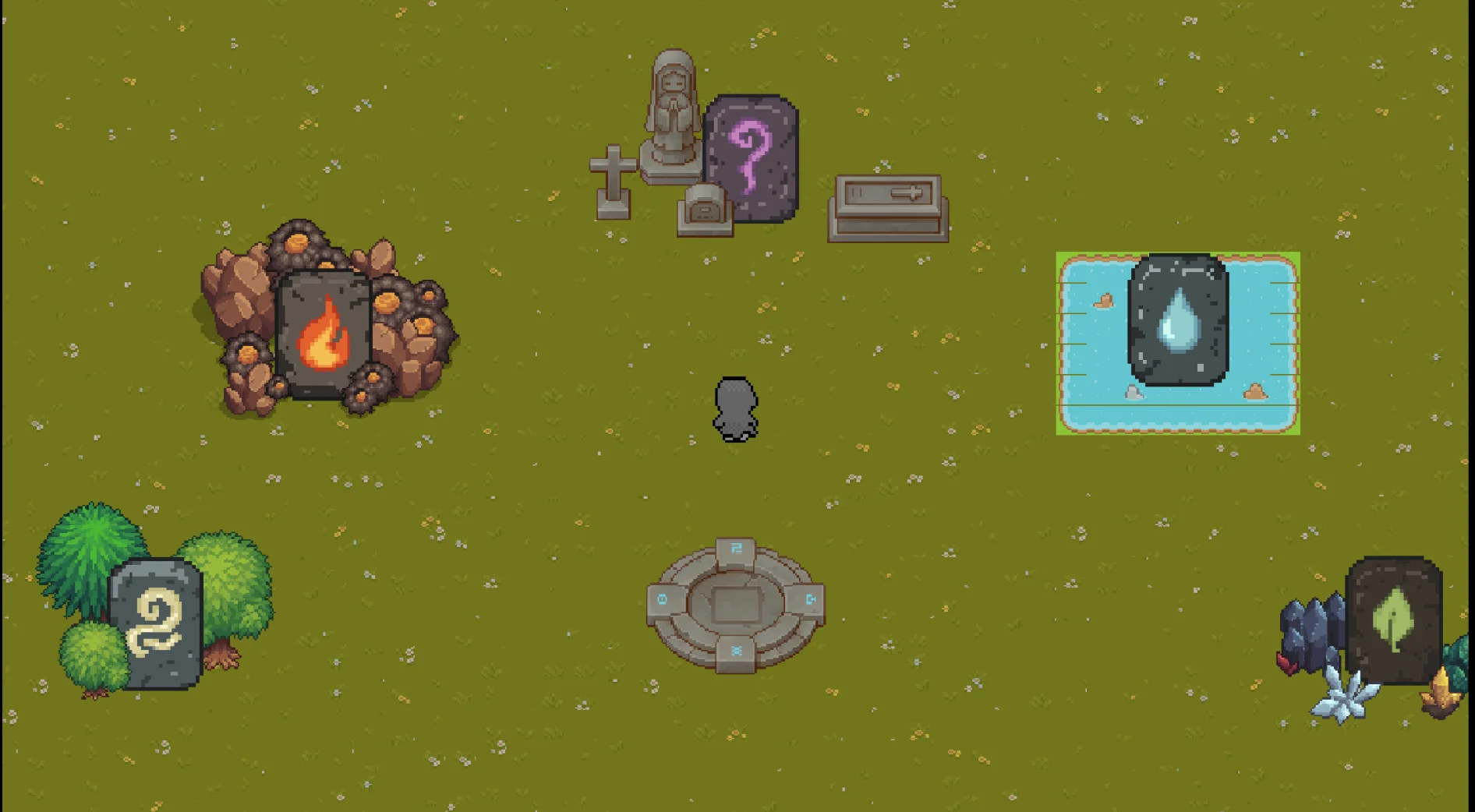
MONOMOON is a nonlinear exploration game from Gentle Giant Games, the studio behind Spiritfall. It launched on Steam on November 11, 2026, and within three days it had collected nearly 300 reviews sitting at 98% positive, which is remarkable for a game that refuses to explain itself. The pitch is simple to say and hard to do: a tiny open world, moonlight as your only guide, and zero proper instructions. Everything you accomplish, you accomplish because you deduced it.
The developer calls it a "Metroidbrainia," a term borrowed from the Outer Wilds school of design. In a metroidvania your unlocks are items; in a metroidbrainia your unlocks are understanding. The gate that blocks you is never really a locked door. It is a puzzle, a hidden mechanic, or a truth about the world that you had not noticed yet. MONOMOON leans all the way into that idea and wraps it in pixel art and a genuinely strange little moonlit world.
| Field | Detail |
|---|---|
| Genre | Exploration / puzzle platformer (metroidbrainia) |
| Developer | Gentle Giant Games |
| Publisher | Gentle Giant Games (self published) |
| Platforms | Windows (Steam) |
| Price | $11.99, 10% launch discount to $10.79 |
| Players | Single player |
| Release | November 11, 2026 |
| Length | Around 10 hours to "complete," far more to fully uncover |
| Controls | Keyboard and mouse (recommended), controller supported |
| Steam reviews | Very Positive, 98% of ~297 reviews at launch |
| Achievements | 15 |
One warning before you start: the store page itself says the game "doesn't end after the credits roll." If you stop playing when the story stops, you will see maybe half of what this game is hiding.
Getting Started: Your First Hours
MONOMOON deliberately gives you no objectives list. Here is how to spend your opening hours without stalling out.
- Touch everything that looks interactive. The game teaches through interaction, not tutorials. Walk into objects, click on suspicious terrain, press keys near anything glowing. If something reacts, remember where and how.
- Watch the moonlight. The moon is not decoration. Light and shadow point at things the game will never mention out loud. When you feel lost, look up and see what the moon is doing.
- Make your own notes. There is no quest log and no objective marker, so your notebook is your progression system. Write down places you could not enter, symbols you saw twice, odd reactions the world had to something you did.
- Do not chase 100% early. The world is small on purpose. Circuit it once, meet its systems, and let questions accumulate. Answers tend to arrive while you are looking for something else.
- Try the keyboard first. Movement mixes platforming with point-and-click. A controller works, but the developer says outright that keyboard and mouse is the optimal way to play, and the puzzles occasionally want precise cursor input.
- Accept confusion as progress. Ten minutes of standing in a room thinking is not wasted time in this game. That is literally the gameplay.
How the World Teaches You (No Instructions, All Deduction)
The core loop works like this. You notice something odd. You form a guess about why. You test the guess somewhere else. If the world responds, your model of the game just grew. There is no text box confirming any of this, and that is the point.
Three practical consequences follow from that design. First, every unusual reaction you trigger is information, even when it looks like nothing happened, because "nothing happened" eliminates a hypothesis. Second, the game layers its secrets, so the place you fully explored yesterday may hide something that only becomes visible after you learn a mechanic three areas away. Third, clues are all in the game itself. The developer promises no outside knowledge is required, but also openly encourages discussing your playthrough with a friend, because comparing half-understood observations is how most players crack the harder mysteries.
Controls: Keyboard, Mouse, and Controller
MONOMOON mixes two control schemes, and knowing which one a puzzle wants saves a lot of frustration.
- Platforming movement runs on the keyboard, in classic 2D platformer style. Jumps are short and readable; precision demands are modest.
- Point-and-click interactions use the mouse. Many environmental puzzles are solved by clicking, aiming, or dragging with the cursor rather than by pressing movement keys.
- Controller support exists and basic traversal feels fine on a pad. The developer still lists it as "not recommended for the optimal experience," mainly because several puzzles assume cursor precision.
The store page tags the game as a puzzle platformer with point-and-click elements, so expect your hands to alternate between the two halves constantly. Keep the mouse near the center of the screen while platforming and you will lose less time switching modes.
Exploration and Progression
Progression in MONOMOON is player-driven in the purest sense. Nothing unlocks because you hit a level; you go further because you understand more. A few routing habits make the small world feel much bigger.
- Revisit everywhere after every revelation. The world is intentionally tiny, which means any new insight can open five older locations at once. Looping back is not backtracking, it is the main activity.
- Geography is a hint system. If a structure looks deliberately placed, it probably is. The layout of the world encodes rules, and reading the map like a document is more useful than treating it as scenery.
- Simple puzzles sit near complex ones. The secrets range from basic logic puzzles to cryptic mysteries and hidden mechanics. When an area feels too easy, that ease is usually scaffolding for a harder trick nearby.
- Talk about it. The developer explicitly suggests playing alongside a friend. Two players with half a picture each often assemble the whole thing faster than one player grinding solo.
Advanced Tips for Late-Game Secrets
Once the credits roll, the real game starts. A few habits for the deep layers:
- Question the interface itself. The Steam tags include "Nonlinear" and "Atmospheric," but the more dangerous tag is the design philosophy: if the game taught you a rule quietly, it can break that rule quietly too. Things you assumed were fixed (menu behavior, what counts as a wall, what the cursor can touch) may not be.
- Listen for silence. Big discoveries in games like this are usually telegraphed by changes in sound or atmosphere before anything visible happens. The pixel art hides a lot of small animation work; watch for it.
- Log your solved puzzles by mechanism, not location. Late secrets combine mechanics from distant areas. A notebook organized by "how it worked" rather than "where it was" makes combinations obvious.
- The 15 achievements are a loose difficulty ladder. Most sit on the natural path of a curious player. If an achievement lists something that sounds like a mechanic rather than a milestone, treat the description itself as a puzzle statement.
Steam Achievements
MONOMOON ships with 15 achievements. The list is intentionally spoiler-light, and most unlock through exploration and puzzle solving rather than grind. Because the game's whole appeal is deduction, this guide will not spoil specific achievement solutions. General shape of the list, based on the game's structure:
| Type | Roughly | Note |
|---|---|---|
| Exploration markers | About half | Awarded for reaching or uncovering specific places and truths |
| Puzzle solutions | Several | Tied to cracking the game's more cryptic mysteries |
| Mechanical mastery | A few | Hidden mechanics you must find and then use properly |
| Endgame | The rest | Content beyond the credits, as promised on the store page |
FAQ
How long is MONOMOON? The developer estimates about 10 hours to "complete" the game, with quotes doing real work in that sentence. Players digging for every secret should expect substantially more, since post-credits content is explicitly part of the package.
Is there a storyline? Yes, but it is told the same way as everything else: through deduction. You uncover hidden truths about the world as you explore, guided by moonlight. Expect atmosphere and mystery over cutscenes.
Do I need to play Outer Wilds or other metroidbrainias first? No. All clues exist within the game itself, per the developer's own promise. Familiarity with knowledge-driven games helps you trust the process, but it teaches nothing specific about MONOMOON.
Controller or keyboard? Both work. The developer recommends keyboard and mouse because the game mixes platforming with point-and-click puzzle input, and the cursor matters.
Is it hard? Not in the action sense. Nothing is trying to kill your reflexes. The difficulty is intellectual, and it spikes hard in the late-game secret layers. If you are stuck, the intended fix is patience, note-taking, or a friend.
Is there a demo? No demo was listed at launch. The 98% positive launch reception and the 10% launch discount window make the full game the realistic entry point.
Does it run on Steam Deck or Mac? The store page lists Windows only. Steam Deck players run it through Proton, but there is no official support or verified status at launch.
Who made it? Gentle Giant Games, the studio behind Spiritfall, an action roguelike inspired by platform fighters that shipped on Switch, PlayStation, and Xbox. MONOMOON is a complete change of pace from that game: no combat stats, no builds, just you and a moonlit world that refuses to explain itself.
Quick Reference Card
| Question | Answer |
|---|---|
| Game type | Nonlinear exploration puzzle platformer (metroidbrainia) |
| Developer | Gentle Giant Games (Spiritfall) |
| Released | November 11, 2026 (Windows, Steam) |
| Price | $11.99 (10% launch discount) |
| Length | ~10 hours to complete, more for full secrets |
| Controls | Keyboard + mouse recommended; controller supported |
| Reviews | Very Positive, 98% of ~297 at launch |
| Achievements | 15 |
| Golden rule | Notice something odd, form a guess, test it elsewhere |
The single most useful mindset: treat every mystery as solvable and every solution as already in front of you. MONOMOON is small enough to hold in your head, and that is exactly why it works.
Screenshots