Official game
Play HELLBOUND INC
This game is hosted by Steam. Continue to the official page to play or download it.
Buy on SteamOverview
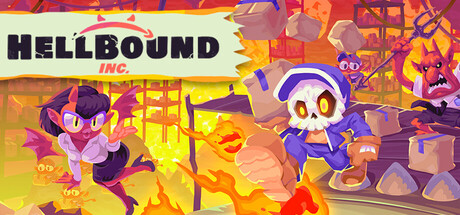
HELLBOUND INC is a rage-inducing precision platformer from Templo and Rewilder, released on Steam on August 11, 2026 for $8.49. You play an undead courier trapped in a fulfillment center recently purchased by Satan himself. You are the newest hire in Hell's most infernal logistics startup, and your job is to deliver cursed packages across treacherous warehouse zones, dodge deadly traps, solve devilish puzzles, and make sure everything arrives on time. In Hell, missing a delivery deadline is eternal damnation. Again.
The game's premise is corporate satire taken to its logical extreme. Satan is the CEO, workplace safety is a suggestion, HR is always watching, and the levels are organized as 8 Circles of Corporate Hell, from the red tape of HR to the bottomless greed of Accounting. It is a 2D puzzle-platformer with 47 handcrafted levels, a hellish workplace soundtrack, and the kind of difficulty that makes streamers rage. Behind the comedy sits a genuine Dante's Inferno structure: descending through departments of a company maps almost too perfectly onto descending through Circles of Hell, with Limbo becoming onboarding and orientation.
The core promise is precision. Every room is a tightly designed challenge that tests both your reflexes and your problem-solving skills. You push crates, flip switches, activate conveyor belts, bounce off objects, and time your jumps to get each delivery to its destination. You will die a lot, but that is okay, because you are already undead. Instant respawns keep the pace fast as you retry and learn each delivery route.
The design philosophy comes straight from the developer's own words: the game stands on the lineage of rage games like Jump King, Getting Over It, and Bread & Fred, crossed with Sokoban-style puzzle-logistics and the workplace comedy of Wilmot's Warehouse. The guiding idea is endurance, not victory. Like Sisyphus, you are not trying to "win"; you are trying to survive one more shift.
Who it is for: Fans of precision platformers like Celeste and Super Meat Boy, players who loved the corporate satire of games like Death and Taxes, and anyone who enjoys puzzle-platformers with dark humor. The "deliver or die" loop is genuinely addictive.
Who it is not for: Players who want a chill, relaxed experience. This game is designed to make you rage. If you do not enjoy pixel-perfect jumps and retrying rooms dozens of times, it will frustrate you more than entertain you.
| Fact | Detail |
|---|---|
| Developer | Templo, Rewilder |
| Publisher | Templo, Rewilder |
| Genre | Precision platformer / puzzle-platformer |
| Platforms | Windows |
| Release | August 11, 2026 |
| Price | $8.49 |
| Players | Single-player |
| Levels | 47 handcrafted (6 orientation tutorials + 41 puzzle rooms) |
| Circles | 8 departments of corporate hell |
| Achievements | 19 |
| Collectibles | Hidden "Corporate Audit" items in dangerous corners |
| Challenges | Time trials and limited deaths |
| Save system | Room-based with instant respawns |
| Controller | Partial support |
| Languages | English |
| Requirements | Windows 7 SP1+, dual-core 2 GHz, Intel HD 4000, 1.22 GB storage |
| Runtime | 5-8 hours main clear, 10+ for 100% |
Getting Started: The First 30 Minutes
Before You Launch
- Understand the delivery loop. Every level is a delivery puzzle. Grab your package, navigate the hazards, and get it to the destination before the clock runs out.
- Expect to die constantly. Death is the game's design. Instant respawns mean you retry a room dozens of times. That is normal, not a failure state.
- Know the 8 circles structure. The game is organized into 8 departments, one per Circle of Hell. HR (Limbo) is the first; the game's last circles map to Greed, Sloth, Wrath, Envy, and Pride before the final descent.
- Play the 6 tutorial levels. They teach the core mechanics: jumping, carrying, throwing, and using environmental objects. Do not skip them.
- Set your controls before the first room. Movement is the entire game. Precision platformers live or die by how the controller feels, and the developers said getting jump arcs and bounce feel exactly right took longer than anything else. Give yourself the same care.
Your First 30 Minutes
- Clock in at HR. The first circle introduces you to the fulfillment center's hazards with gentle levels. It is the game's "Limbo": orientation that never quite ends.
- Learn the package mechanics. Carrying a package changes your jump physics. Throwing it is a separate skill. Practice both early.
- Master the bounce mechanic. One of the game's signature moves is bouncing off objects and enemies. Players specifically praise the combination of throwing and jumping. The bounce is not a gimmick; it is the game's second language.
- Find your first hidden collectible. Every circle has hidden items tucked into dangerous corners. Start hunting early; they are easy to miss and the completion achievements require them.
- Beat your first delivery gauntlet. The end of every circle has a high-stakes section that pushes your skills. Expect the first one after HR. It is your first real difficulty spike.
Beginner Mistakes
| Mistake | Why It Hurts | Fix |
|---|---|---|
| Rushing the jumps | Precision platforming punishes haste | Line up each jump before committing |
| Ignoring the throw | Throwing is a core mechanic, not a gimmick | Practice combining throw and jump |
| Skipping collectibles | They are the completion economy and feed achievements | Check dangerous corners every level |
| Panicking on the clock | The timer makes you sloppy | Focus on the route, not the countdown |
| Giving up on a room | Every room has a solution | Restart and observe the pattern first |
| Fighting the bounce instead of using it | Bounces create the height and distance you need | Bounce first, then throw mid-air to chain movement |
| Playing with bad keybinds | Movement matters more than anything | Set up comfortable keys before the hard circles |
Core Mechanics Explained
The Delivery Puzzle Loop
Each level is a delivery puzzle. You grab a cursed package, navigate spikes, flame jets, demonic machinery, haunted forklifts, and collapsing platforms, and deliver it to the destination. Environmental objects matter: push crates, flip switches, activate conveyor belts, and time your jumps. Every area is a tightly designed challenge that tests both reflexes and problem-solving. Every room has a solution, but it may not be the one you expect. The official description captures the loop perfectly: "Deliver the packages. Hit your quotas. Survive your shift."
The 8 Circles of Corporate Hell
The game's structure is 8 departments, reimagining Dante's Inferno as a corporate org chart:
| Circle | Dante's Original | Corporate Hell Equivalent |
|---|---|---|
| Circle 1 | Limbo | HR / Onboarding. Orientation that never ends, red tape, basic hazards |
| Circle 2 | Lust | The art-style turning point. Flame jets and sensory overload start here |
| Circle 3 | Gluttony | Where characters and effects click into charm; conveyor-fed hazards |
| Circle 4 | Greed / Avarice | Accounting. The bottomless pit of greed; the game's most punishing depth |
| Circle 5+ | Sloth, Wrath, Envy, Pride | Later departments with remixed mechanics, trap timing, and boss-tier gauntlets |
The developers confirmed the mapping: descending through Circles of Hell maps onto descending through departments of a company. Limbo becomes onboarding and orientation, "and it only gets worse from there." A fuller Envy level and co-op multiplayer were cut during development, so the shipped Envy circle is a tighter, solo-only version that remixes mechanics from the other worlds.
The 47 Handcrafted Levels
The level list is 6 orientation tutorials plus 41 increasingly hellish puzzle rooms. Each room is handcrafted, not procedurally generated. This means every room has a designed solution, and learning it is the game. The developers broke each level into small, achievable goals on purpose: players explore, die, retry, and gradually uncover more of the puzzle instead of facing one big wall of failure.
The Bounce-Throw System
The signature mechanic is bouncing. You can bounce off objects, crates, and enemies to gain height, then throw your package mid-air to solve the room. Reviews consistently highlight "the bounce mechanic and combining throwing and jumping." This is what separates HELLBOUND INC from a generic precision platformer: the carry and throw are not inventory chores, they are movement tools.
Final Delivery Gauntlets
At the end of every circle, a high-stakes delivery gauntlet pushes your skills to the absolute limit. These are the game's difficulty spikes. The trail of the 25/25/25 challenge from the demo era tells you what the designers consider mastery: complete the whole demo in under 25 minutes with 25 deaths or fewer. The full-game gauntlets are the same spirit scaled up.
The Corporate Audit (Collectibles)
Hidden collectibles are tucked away in the most dangerous corners of the fulfillment center. They feed the "Collectio" achievement series (Crudis, Callida, Culta, Solertia, Suprema). They are the game's completion economy, and one of the few reasons to explore off the optimal delivery path.
Reward Density
The developers leaned hard on reward density: extra item quests, funny dialogue snippets, and a ton of immediate, bite-sized goals scattered through every level. The core platforming stays punishing, but the level is never only punishing. There is always a smaller win to chase alongside the big one. If a room is defeating you on the main route, go find its side objective and collect the small win.
Progression Strategy
What to Prioritize First
- Master the bounce-throw combo. Players consistently praise the bounce mechanic and the combination of throwing and jumping. This is the game's advanced skill. Learn it early.
- Hunt collectibles as you go. Backtracking is possible, but grabbing hidden items during your first clear of each circle is more efficient.
- Learn the route before worrying about time. In the main levels, completion beats speed. Speed matters for the time trial challenges, not the main campaign.
- Restart freely. Every room has a solution, and instant respawns make restarting the correct response to being stuck.
- Save the time trials for after the campaign. The 41 puzzle rooms teach you the skills the challenges demand.
Circle Order Logic
The circles are linear, but your approach to each one should be consistent:
- Clear the tutorial levels to learn the mechanics.
- Play each circle's puzzle rooms to learn its hazard theme.
- Hunt the circle's hidden collectibles before the delivery gauntlet.
- Beat the delivery gauntlet to advance.
- Return for time trials and limited death challenges after the campaign.
The "AHA!" Pivot
The developer's stated goal for the first 30 minutes is the pivot from "I hate this" to "oh, I get it now." That pivot happens the moment you use a mechanic or item in your favor instead of fighting it. If you are stuck on a room, the answer is almost always a mechanic you are underusing: the bounce, the throw, or the environmental object you have been walking past.
Builds and Strategies: The Courier's Toolkit
HELLBOUND INC has no character builds, but it does have a toolkit of techniques. Treat these as your loadout:
| Technique | When to Use | Common Mistake |
|---|---|---|
| Precision jump | Most rooms | Jumping before lining up the landing |
| Package throw | Crossing gaps, hitting switches, moving deliveries | Treating throw as optional |
| Bounce chain | Gaining height, redirecting mid-air | Landing instead of bouncing again |
| Crate push | Blocking hazards, creating platforms | Pushing crates into dead ends |
| Switch flipping | Opening paths, altering conveyor direction | Flipping switches without watching the result |
| Wait-and-watch | Trap timing rooms | Moving while hazards are mid-cycle |
Technique Priorities by Circle
- HR (Limbo): Precision jump and basic carry. The tutorials teach these gently. Your job is to build the habit of lining up jumps.
- Lust: Start using the bounce. The visual style comes together here, and so does the mechanical depth.
- Gluttony: Master the throw. Conveyors and feeding hazards demand you deliver packages to moving targets.
- Accounting (Greed): Combine everything. The bottomless depth punishes panic. Every jump needs a plan.
- Sloth / Wrath: Tight timing. Watch hazard cycles and learn the "audio and visual count" of each trap before moving.
- Envy / Pride: Full toolkit. Expect remixed mechanics from every earlier circle in gauntlet form.
Step-by-Step Strategy
1. First Clear Route (5-8 hours, completionist-leaning)
- Clear the 6 tutorial levels. Do not skip a single one; they pre-teach the precise jumps the gauntlets will demand.
- For each circle: clear all puzzle rooms in order, scanning every dangerous corner for collectibles as you go.
- Before the circle's delivery gauntlet, make sure you have seen every hazard the circle introduced. The gauntlet is a greatest-hits of that circle's mechanics.
- Beat the gauntlet, then move to the next circle. Do not stop to grind time trials yet.
- After completing the final circle, sweep missed collectibles, then attack time trials and limited-death challenges with your full knowledge.
2. The Watch-First Method (any trap room)
- Enter the room. Do not move.
- Watch the full hazard cycle: flame jets, conveyor direction, spike timing, moving platforms.
- Identify the one safe path from spawn to delivery.
- Execute the path in one continuous sequence. If you hesitate mid-sequence, restart; hesitation is what kills.
- After success, note the cycle timing. The next run of the same room becomes a rhythm exercise.
3. Bounce-Throw Chain (advanced movement)
- Drop the package near a bounce point. Carrying it slows your jump arc.
- Bounce off the object or enemy to gain height.
- At the top of your arc, throw the package toward its delivery target or a high ledge.
- Land, re-grab, and repeat. Practice this as a single rhythm: bounce, throw, land, grab, bounce.
- Use it in reverse too: throw the package first to clear a path, then bounce through yourself.
4. Collectible Sweep Pattern
- At the start of each circle, assume every room has at least one hidden item.
- Scan the edges first: above door frames, below platforms, behind flame jets, at the top of conveyor exits.
- Look for ledges that serve no obvious purpose. An out-of-the-way platform with nothing on it is a collectible spot.
- Check after the puzzle is solved, when hazards are calmer, then replay the room to grab anything missed.
- Use the Collectio achievements as a checklist. Each one names a collection tier you can verify against.
5. Limited Death Challenge Strategy
- Choose the earliest circle you can complete cleanly. Short levels mean fewer chances to die.
- Replay each room until you can clear it three times in a row without dying.
- Only then attempt the full challenge run. Your failure rate should be near zero before you start.
- Use the watch-first method on every room. Do not improvise.
- If you die mid-run, finish the run anyway to log the data, then restart with the exact route you had planned.
6. Time Trial Strategy
- Learn the route perfectly before worrying about the clock. Speed is the last thing you add, not the first.
- Drop the package at delivery points as early as possible; do not carry it further than necessary.
- Combine bounce-throw chains to skip ground segments entirely.
- Cut corner-jumps: many rooms have a shorter arc that skips a platform if you time the jump at the exact frame.
- Replay immediately after a good run. Timing knowledge decays fast.
Advanced Tips
Route Planning Over Reaction
The best HELLBOUND INC players do not react; they plan. Before moving, look at the room, identify the hazards, and plot the full route from spawn to delivery. Then execute. The timer punishes hesitation, but it punishes aimless movement more. In a game where every room is handcrafted, the room is a puzzle to solve once, then a dance to repeat.
The Bounce-Throw Economy
The bounce mechanic is the game's signature. Combining throwing and jumping lets you reach platforms and cross gaps that are impossible otherwise. Practice bouncing off objects mid-air and immediately throwing your package to chain movement. The key insight: the package is not a burden, it is a tool. Throwing it mid-bounce gives you a second, independent movement option that most precision platformers never offer.
Collectible Hunting Patterns
Hidden collectibles live in dangerous corners. After clearing a room's puzzle, scan the edges: above doors, below platforms, behind flame jets. If a room has an out-of-the-way ledge with nothing on it, that is probably where the collectible is. The developers designed the Corporate Audit specifically to reward players who explore "the most dangerous corners," so danger itself is the hint.
The "Watch First, Then Act" Rule
When you enter a new room, do not move. Watch the hazards cycle for a few seconds. Learn the timing of flame jets and conveyor belts. Then move. This one habit cuts your death count in half. Every hazard in the game is on a fixed cycle, which means every hazard is learnable.
Death Tracking for Replay Value
The game tracks your deaths and time per level. Use these as your personal challenge metrics. Beating a level with fewer deaths than your first clear is a satisfying secondary goal. The developers built the game around the idea that small, achievable goals keep "fail again and again" from turning into "give up." Apply that to your own runs: set a target, hit it, move on.
The Guidance System
The developer mentioned a guidance system that helps players read what a jump is actually asking of them. Pay attention to the visual language of each platform and gap. If a jump feels impossible, you are probably missing the intended setup: a bounce pad, a crate, or a conveyor you can ride. The game tells you what it wants; the trick is learning to read it.
Reward Density Scavenging
When a gauntlet is frustrating you, step back and explore the circle for side objectives instead. Extra item quests and dialogue snippets are scattered everywhere. The change of pace resets your frustration, and the gameplay practice keeps your skills warm. Coming back to the gauntlet after a side quest round is often the fastest way through.
Achievement Guide
All 19 achievements. The Latin names map directly to the circles and collection tiers:
| Achievement | Likely Condition | Difficulty |
|---|---|---|
| Limbi Lectio | Complete the Limbo / HR orientation circle | Easy |
| Petitio Prima | Complete your first delivery request | Trivial |
| Pactum Perditum | Complete a lost / failed contract condition | Easy |
| Pactum Perfectum | Complete a perfect contract (limited deaths) | Hard |
| Querela Cupida | Complete the Lust circle | Medium |
| Epulae Edaces | Complete the Gluttony circle | Medium |
| Avaritia Insatiabiles | Complete the Greed / Accounting circle | Hard |
| Somnus Interuptus | Complete the Sloth circle | Medium |
| Furoris Vociferatio | Complete the Wrath circle | Hard |
| Invidiae Oculus | Complete the Envy circle | Hard |
| Superbia Sublimis | Complete the Pride circle | Very Hard |
| Collectio Crudis | First collectible tier (raw collection) | Easy |
| Collectio Callida | Second collectible tier (clever collection) | Medium |
| Collectio Culta | Third collectible tier (cultivated collection) | Medium |
| Collectio Solertia | Fourth collectible tier (skilled collection) | Hard |
| Collectio Suprema | All collectibles (supreme collection) | Very Hard |
| Mandata Completa | Complete all main delivery mandates | Hard |
| Beata Vacatio | Earn a rest / vacation ending condition | Medium |
| Mensis Meritus | Survive a full month of shifts (meta completion) | Very Hard |
Completion Order
- Play through the campaign and collect every Corporate Audit item as you go.
- Beat the final circle (Superbia Sublimis) first; the campaign teaches you everything.
- Sweep any missed collectibles against the Collectio series.
- Attack Pactum Perfectum and Mandata Completa next with your route knowledge.
- Mensis Meritus last, as a full-game mastery run.
FAQ and Common Mistakes
Is HELLBOUND INC hard?
Yes, deliberately. It is a rage-inducing precision platformer in the lineage of Jump King and Getting Over It, softened by instant respawns and dopamine-dense side objectives. The difficulty comes from pixel-perfect jumps and puzzle timing. Death is constant, but instant respawns keep it fair. Players describe it as "challenging, yet straightforward," with levels "calculated" and "well designed."
How long is the game?
With 47 levels across 8 circles, a full clear takes roughly 5-8 hours. Time trials, limited death challenges, and collectible hunting extend that significantly toward 10+ hours for completionists.
Does it have controller support?
Partial controller support is listed. One recurring review complaint is that keyboard movement defaults to arrow keys rather than WASD. If that annoys you, remap before the hard circles. The developers spent more time on controller feel than anything else, so pad players get the smoothest experience.
Is it single-player only?
Yes, strictly single-player. A co-op mode was cut during development (and might return as DLC), so do not expect multiplayer.
Does it run on low-end PCs?
Yes. The minimum requirements are Windows 7 SP1+, a dual-core 2 GHz processor, and Intel HD 4000 graphics. It runs on most low-end systems, laptops, and integrated GPUs.
Are there difficulty settings?
The game does not advertise difficulty sliders. Its difficulty curve comes from the level design, with the 6 tutorial levels easing you in and the delivery gauntlets spiking. The time trials and limited-death challenges are the optional hard modes.
What are the collectibles for?
The Corporate Audit collectibles are hidden items for completionists, feeding the Collectio achievement series. They are one of the few reasons to explore off the main delivery path, and the developers hid them in the most dangerous corners on purpose.
Common Mistake: Panicking when the timer is low
The clock is the enemy, but panic is worse. When the timer is low, slow down, look at the room, and execute one clean sequence. A clean late run beats a sloppy early one.
Common Mistake: Ignoring the throw
Throwing is not optional. Many rooms require you to throw packages across gaps or into delivery points. Practice it in the tutorial levels until it is muscle memory.
Common Mistake: Treating every room the same
Each circle has a different hazard theme. What works in HR's red tape may not work in Accounting's greed. Adapt to each circle's mechanics.
Common Mistake: Fighting the bounce
The bounce is not an obstacle to avoid; it is the tool the room is asking for. Bounce first, then throw, then move. Players who "get the idea" stop fighting the mechanics and start flowing, and the game becomes forgiving exactly when that clicks.
Common Mistake: Skipping the side objectives
The reward density is deliberate. Side item quests and dialogue are not filler; they are the frustration valve. When a room is beating you, go find the small win, then return.
Final Verdict
HELLBOUND INC is a tight, funny, rage-inducing platformer with a great hook. The corporate hell satire is committed and hilarious, the 47 handcrafted levels are genuinely well-designed, and the bounce-throw mechanics give the precision platforming a distinct identity. The instant respawns keep the rage fair, and the low system requirements mean almost anyone can play it. The Dante structure is more than window dressing: each circle teaches a mechanic theme, and the gauntlets demand you combine them. It won Best Game at Pixelatl's VMX showroom before release, and the early player reviews reflect real enthusiasm for the art, the puzzles, and the comedy.
Buy it if you love Celeste-style precision platforming with a dark sense of humor. Skip it if you do not enjoy retrying rooms dozens of times. At $8.49, it is an easy recommendation for the genre's fans.
Last reviewed by Game How To Editorial. We play each game, verify controls against official sources, and update guides when game mechanics change.
Screenshots