Official game
Play Dog in the Machine
This game is hosted by Steam. Continue to the official page to play or download it.
Buy on SteamOverview
Dog in the Machine is a tactical turn-based roguelite from French indie Studio Chahut, published by Goblinz Publishing, that shipped on September 29, 2026 for $17.99. The premise is a machine-city gut-punch: robot pet dogs branded "useless" are trying to escape Automatown and reunite with their exiled humans, and you train one of them to fight its way out. The pitch that stuck with reviewers is a cyberdog cousin of Into the Breach, where the enemy roster and compact grid are familiar but the build system is a twist.
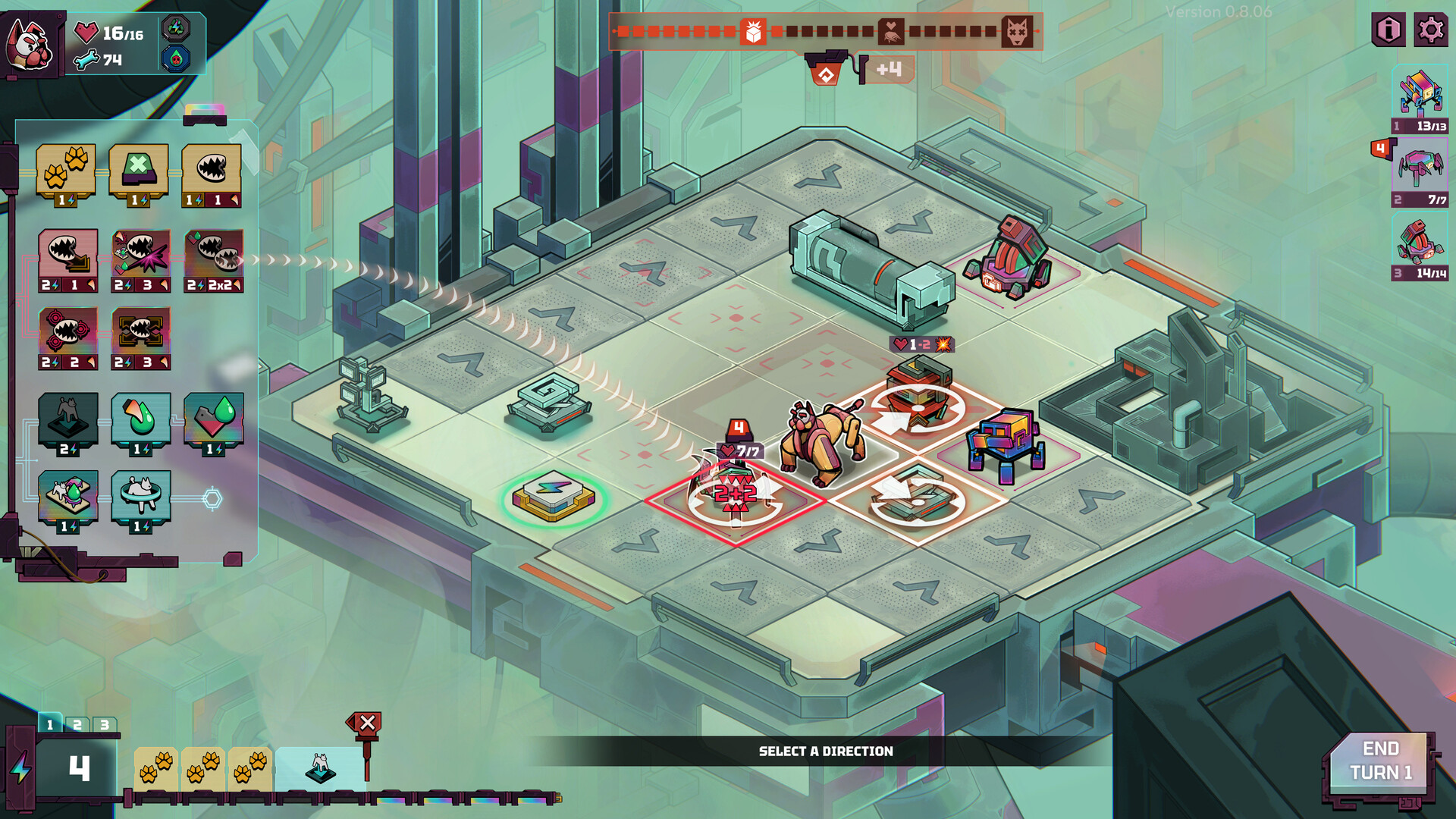
That twist is the Trick system. After every battle your AutoDog learns a Trick, and the real game is combining two Tricks into a third, freely, into increasingly strange custom commands. Everything on the battlefield pushes the same idea: conveyor belts, explosive obstacles, domino collision physics, reactive enemies, and buttons exist so your five-step plan turns into a twenty-kill chain reaction. A real-time preview shows exactly how your sequence plays out before you commit, which kills the genre's usual trial-and-error frustration. If you lose, the design philosophy is blunt: it was your strategy, not a misclick.
| Fact | Detail |
|---|---|
| Developer / Publisher | Studio Chahut / Goblinz Publishing |
| Genre | Tactical turn-based roguelite with deckbuilding |
| Platforms | Windows and Mac (Steam) |
| Price | $17.99, 20% off the first two weeks |
| Release | September 29, 2026 |
| Playable dogs | 8 breeds, distinct starting kits |
| Levels | Procedurally generated runs across Automatown districts |
| Achievements | 42 |
| Free demo | Yes, with a bonus second chapter ("Save Queenie!") |
Who it is for: Into the Breach players who finished it and wanted more build variety, puzzle players who like arranging dominoes, and anyone who has ever wanted to program a robot dog to do crimes.
Who it is not for: real-time strategy fans and players who want long tactical grinds. Fights are compact, and the preview system removes most of the friction hardcore tactics players enjoy sweating through.
Getting Started: Your First District
Play the Demo First, Even If You Own the Game
The demo's two chapters are the tutorial the full game assumes you played. Chapter one teaches one dog across two districts; the "Save Queenie!" chapter introduces the Shover, a cunning dog whose whole kit is displacement. The full game's first hours re-tread this ground at a faster pace, and the preview system is the one mechanic worth drilling until it is reflex: every command you queue shows the exact outcome animation before you confirm. Cancel is free. Retry is free. Use both without guilt.
Your First Run Plan
- Pick a dog breed for its passive, not its look. All eight breeds reach the same content, but starting kits differ. The Wrecker's achievement (Not Just Bark, 22.2%) tells you it is a common first pick because raw damage is the easiest chain to extend.
- Win the first fight without raising the Alarm. Sleepy Automatown (65.5%) is the first real skill check: it teaches you that enemy awareness is a resource you manage, not just a bar that fills.
- Buy the first autoDog upgrade early. K9 Training (33.3%) unlocks the upgrade shop, and the early economy upgrades compound across a run.
- Chase Dog-Eat-Dog. Making an enemy hit another (62.2% of players manage it) is the core verb of the whole game. Collisions are damage that does not cost you an action.
- Do not hoard Tricks. The Trick Library is a toolbox, not a museum. Two medium Tricks merged into one great one beats five situational ones clogging your hand.
Beginner Mistakes to Avoid
| Mistake | Why it costs you the run |
|---|---|
| Queuing a full sequence without previewing each step | The preview exists so you never guess. Skipping it turns the game into the trial-and-error slog it was designed to avoid |
| Ignoring buttons and environmental props | Chain Reactions (10% of players destroy 20 enemies with reactive obstacles) is a lifestyle upgrade, not a trophy. Props are free actions |
| Buying a new Trick every hub | The deck fills with situational dead weight. Buy upgrades for the Tricks you actually use |
| Walking into Alarm radius for one extra pickup | Tough Hide (58.8%) rewards no-damage fights; Alarm aggro is the usual reason that streak dies |
| Keeping the same dog all run out of loyalty | Different breeds unlock different run achievements. Elite autoDog (5.5%) and Veteran autoDog (3.3%) require Elite Dog difficulty with specific dogs |
Core Mechanics Deep Dive
The Preview System: Chess With an Undo Button
Every command you queue renders the full outcome: your dog's path, each enemy's reaction, every collision, every chain step. Commit or cancel. The design consequence is enormous: difficulty comes from planning under constraints, not from execution. When a plan fails, re-watch the preview and find the exact step where the chain diverged. The game's own promise: if you lose, it was a flaw in your strategy, not a careless mistake.
Tricks and the Merge Menu
After each fight, the AutoDog learns a Trick. At upgrade points, you combine two Tricks into a third, custom command. Blueprints exist for tested combinations, but free combination is where the game peaks: a pull plus an explosive creates a detonating leash, a dash plus a shield creates a ramming bubble, and the community's weird builds are mostly undiscovered. Creative Trainer (11.1%) marks your first custom command; Agility dog (4.4%) marks using the Through Pipe command 100 times, which is what happens when a merged Trick becomes your signature move.
The Chain Reaction Economy
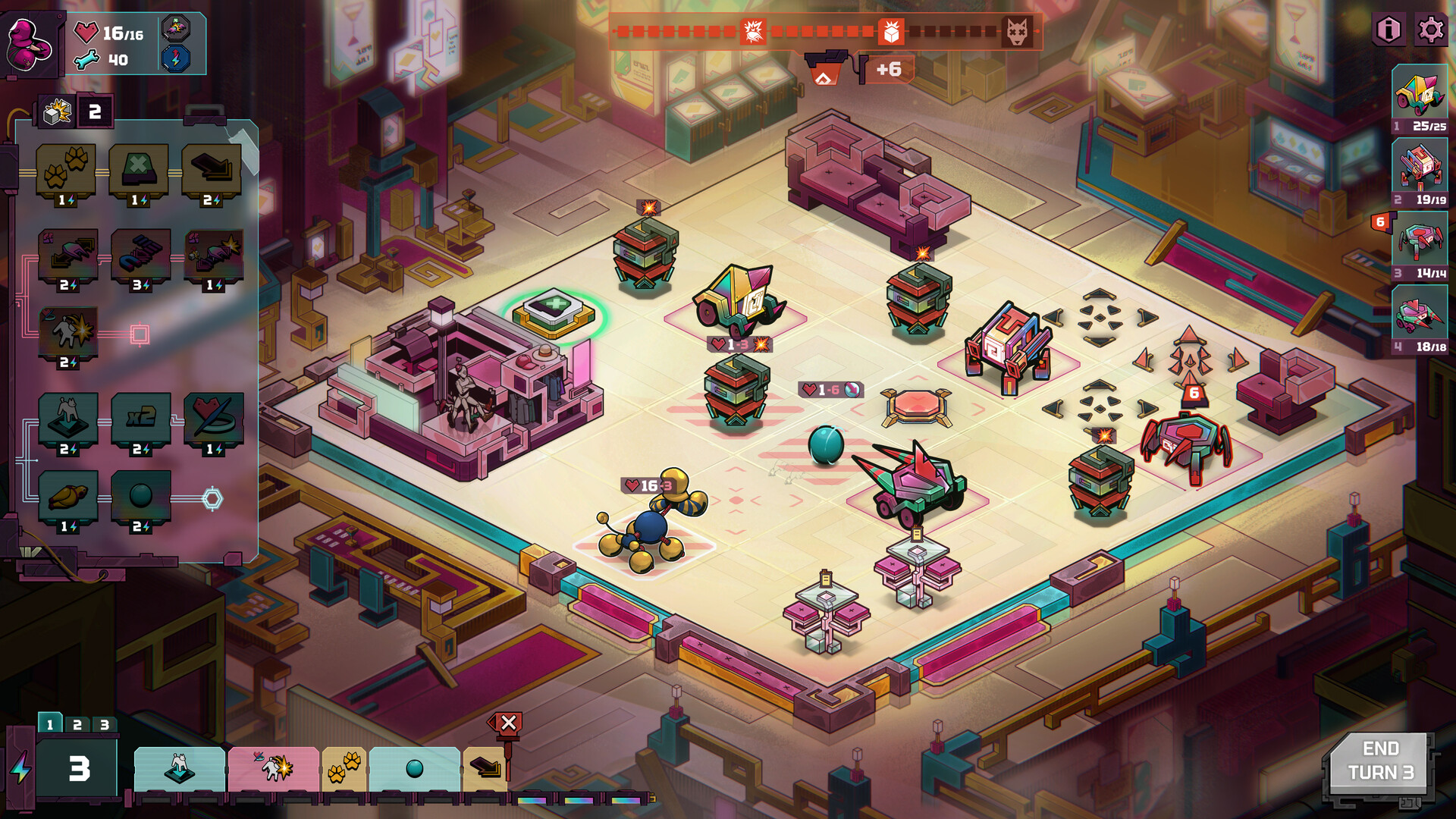
Automatown's grids are built as reaction playgrounds: conveyor belts reposition enemies, buttons open hazards, explosive barrels convert a push into a blast, and domino collision physics turn one shove into a five-enemy pileup. The achievements encode the skill curve: Massacre (40%) is four kills in one turn, Another One Bites the Dust (20%) is four enemies with one Wrecker attack, Collision Chain (16.6%) is four collisions from a single attack. Notice the ladder: same idea, wider splash. Your build question every fight is "which of my Tricks turns one action into four?"
Status Effects: Corroded and Hunted
Two effects matter enough to have kill-quotas attached. Drooly (15.5%) wants 15 kills on Corroded enemies; Hunting autoDog (13.3%) wants 15 on Hunted. Corroded amps subsequent damage, which makes it the setup half of a burst combo. Hunted marks a target that other enemies and hazards prioritize, which turns the map itself into a weapon. Both effects come from specific Tricks, so your Trick picks determine which status engine you are building.
Districts, Hubs, and the Run Structure
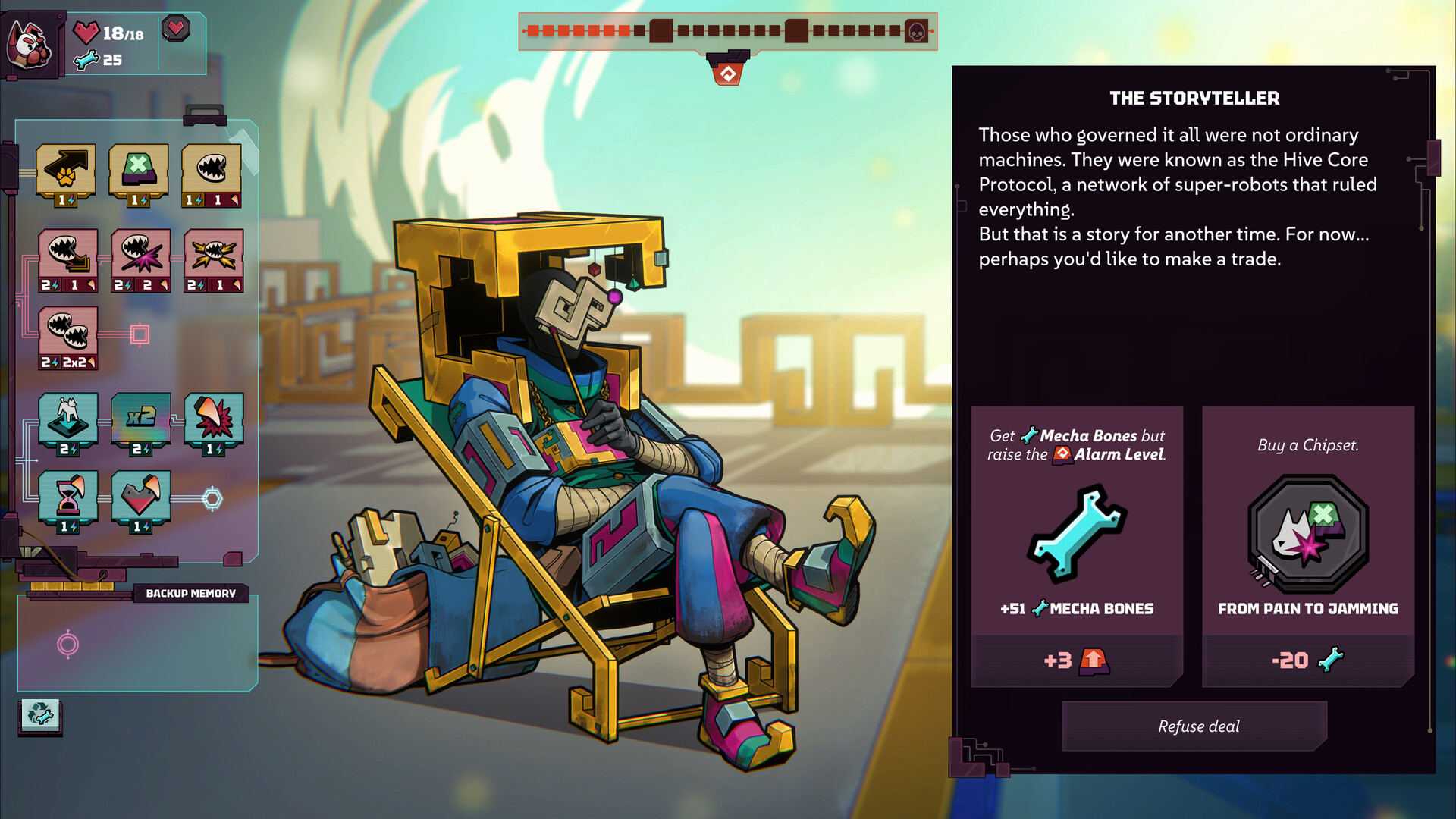
A run climbs through Automatown's districts, each capped by a boss: The Scrap Crusher (Junkyard Dog, 44.4%), The Neighborhood Vigilantes (Watchdog, 30%), The Compressor (Underdog, 23.3%), The Market Crasher (21.1%), and eventually The Nexus Bulwark (Automa-Down!, 4.4%). Between fights, quirky characters offer deck choices, trades, and thefts, and each hub visit advances the story of the machine-city. Win or lose, permanent upgrades and features open up between runs, and the difficulty ladder runs from Doggo (6.6% finish a run) through Elite Dog 1 (5.5%) to Elite Dog Max (Lazy Dog, 3.3%) and Elite Dog 6 (Veteran autoDog, 3.3%).
Advanced Tips & Strategies
The Alarm patience build. Sleepy Automatown and Tough Hide together define a stealth-flavored opening game: route plans that never touch enemy vision cones, Tricks that reposition rather than damage, and pickups grabbed only when the path is provably clean. The reward is economy: no-Alarm fights pay better and no-damage fights preserve the HP you will need against district bosses.
Blueprint-then-break. Follow a blueprint for your first custom command to learn what the merge menu values (action economy, status stacking, collision enablement), then break the pattern. The blueprints teach grammar; the free combos are where your run's identity comes from. A good rule: every third Trick pickup should be a merge candidate, not a new card.
The two-turn boss rhythm. District bosses punish turn-by-turn improvisation. The preview makes two-turn planning viable: turn one sets conveyor positions and Corroded stacks, turn two triggers the whole board. Practice the rhythm on The Scrap Crusher, whose patterns telegraph cleanly, then reuse it on The Compressor, where the Underdog achievement waits for players who learned it.
Breed-specialist difficulty climbs. The Elite Dog ladder is where breed passives matter. The Shover's displacement kit trivializes hazard-heavy grids but stalls on kill-timed bosses; the Wrecker's raw damage chews bosses but bleeds HP in swarms. Pick one breed for your Elite Dog 1 climb (Elite autoDog, 5.5%), learn its failure modes, then decide whether to counter-pick or respec the Trick Library.
Obstacle-first routing. Before each fight, inventory the board: how many barrels, belts, and buttons, and where they cluster. Route your opening moves through the obstacle-dense quadrant even if it costs a turn of positioning. One barrel chain worth four kills pays for a turn of setup, and Chain Reactions (10%) is the achievement that proves most players leave that money on the table.
FAQ
How much does Dog in the Machine cost? $17.99 on Steam with a 20% discount during the first two weeks after the September 29, 2026 launch.
Is there a free demo? Yes, and it is unusually generous: chapter one plus a second chapter, "Save Queenie!", which introduces the Shover. The demo also has graphics options and runs in German, Simplified Chinese, Japanese, and Korean.
What platforms does it support? Windows and Mac. The Mac build needs macOS 11.0 with an Intel Core i5 or Apple M1. There is no Linux version.
Do I need to know Into the Breach to enjoy it? No. The comparison is about genre DNA, not difficulty. The real-time preview makes this more approachable than Into the Breach, not less deep.
How long is a run? A full escape route through Automatown is a few hours at first, shorter once builds click. Districts are compact, and the preview system speeds up decisions.
Does progress carry between runs? Yes. Permanent upgrades and features open up between runs regardless of outcome, and every difficulty tier from Doggo to Elite Dog Max has its own completion achievement.
How many dogs are there? Eight breeds, each with a distinct starting kit. Run achievements are breed-gated, which drives replays.
Is there controller support? The Steam page lists Single-player with Steam Cloud and Family Sharing; the game is mouse-driven by design, with keyboard shortcuts for commands.
What are the minimum specs? Windows 10, dual-core 2.0 GHz, 8 GB RAM, GTX 1050, DirectX 11, 4 GB storage.
How many achievements? 42, from Sleepy Automatown (65.5%) down to Lazy Dog and Veteran autoDog (3.3% each) on the Elite Dog ladder.
Last reviewed by Game How To Editorial. We play each game, verify controls against official sources, and update guides when game mechanics change.
Screenshots