Official game
Play Tin Coffins
This game is hosted by Steam. Continue to the official page to play or download it.
Wishlist on SteamWhat Is Tin Coffins?
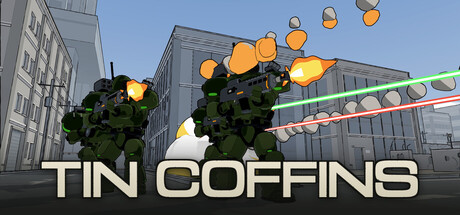
Tin Coffins is a cel-shaded third-person mech roguelite from solo developer Nathaniel Voorhies, working as Hexmonger, coming to Steam in December 2026 for $9.99 on Windows, macOS, and Linux. A free demo is on the store page right now. You pilot Talon-22, a four-meter combat clone mech printed this shift, and twenty-one of you did not come home. When you die, the war does not rewind. The front line keeps what you won and lost, the casualty board takes your name, and the next iteration wakes up to keep fighting.
The pitch that matters: this is not a game about being a god in a giant robot. You are infantry in an armored suit. Cover, sightlines, and reload windows decide fights, mechs die in seconds under sustained fire, and that includes you. On the other side, enemy squads run a real commander AI that hands out roles (anchor, flank, suppress, overwatch, retreat) and hunts you by actual line of sight.
Tin Coffins Details
| Detail | Info |
|---|---|
| Genre | Third-person mech roguelite shooter |
| Developer | Hexmonger (Nathaniel Voorhies, solo) |
| Publisher | Hexmonger |
| Engine | Godot 4.6 |
| Platforms | Windows, macOS, Linux (Steam) |
| Price | $9.99 |
| Players | Single-player campaign, online co-op up to 4, LAN co-op |
| Release | December 2026 (free demo available now) |
| Languages | English voice; Japanese, Chinese (S+T), Korean, Russian, Ukrainian, Polish, Spanish, Brazilian Portuguese subtitles |
| Store ID | Steam app 4943260 |
How to Play Tin Coffins
The Core Loop: Four Sorties, One Life
Roguelite runs are four sorties with one life and no respawns. Death is not a failure state in the story sense; it is a personnel change. The salvage you banked survives you, and it buys weapons that outlast your body. The campaign front itself also persists between your deaths, pushed forward or lost by your sorties across a three-act structure with a finale operation per act.
That structure changes how you should think about risk. A cautious run that banks salvage feeds your long-term arsenal. A reckless run that dies on sortie one still leaves the front line worse off. Play like your replacement inherits your choices, because it does.
Combat Fundamentals
Peek, fire, displace. The game's own doctrine, and it wins fights. Standing in the open trades damage at even rates, and even rates favor whoever has more armor. Get your shot, break line of sight, move to different cover.
Respect the stamina pool. Walk, sprint, crouch, lean, and the dive-roll all draw from one stamina bar. The dive-roll is committed, meaning you cannot cancel it mid-roll. Roll into cover, never into open ground, and never roll with an enemy already tracking you.
Aim for the legs or torso. Per-limb damage cuts both ways. Losing an arm or even your head does not stop your mech; losing your torso or legs does. Enemies go down fastest when you break the parts that carry them, so sustained fire on legs and torso beats flashy arm shots.
Reload behind hard cover. Reload windows are the exact moment the AI squad pressures you. Their suppress role exists to pin you while a flanker moves. Start relocations before your magazine runs dry, not after.
Fighting the Squad AI
Every enemy squad has a commander distributing roles, and individual pilots decide for themselves when to peek, push, reload, and fall back. Three behaviors to exploit:
They only shoot what they can see. Line of sight is the whole ballgame. Pop smoke and you vanish. Break contact and they search where you were, not where you are.
They hunt your last known position. After you break sight, do not stop behind the next wall along the same axis. Displace sideways or backward before re-engaging.
Rookies crack under fire. Enemy pilots lose their nerve under pressure and drop off comms; veterans hold the order. When you suppress a squad, the weakest link routs first, and a pilot without comms stops receiving commander orders. Kill the routed ones while they are deaf.
Use the Tactical Replay after every sortie. This is the feature nobody else ships: scrub through the fight and see what each enemy pilot actually knew about your position versus where you really were, plus what their commander ordered. It is a built-in coach. Five minutes of replay review teaches more than five more deaths.
Commanding Your Own Squad
Three wingmates fly with you, and they follow orders through a comms radial: tag a target, flank left or right, set overwatch, follow, or pull out. They answer on the radio and actually move.
Squad discipline that works:
Flank order before contact. Send wingmates wide while the enemy is still unaware. A flank that starts after the first shot lands is just two squads trading fire from cover.
Overwatch locks down a street. Parking one wingmate in overwatch covers your own displacements and punishes enemy pushes.
Pull out is not a retreat. Calling a wingmate out of a losing position preserves a gun for the next engagement. Pilots are cheaper than losses.
Friendly fire is real. Your wingmates check their line of fire before shooting, and you should do the same. Never advance directly through a firing wingmate's lane.
Weapons: One Primary, Two Shoulder Hardpoints
Nine weapons are in the arsenal, from autocannons and a marksman rifle to guided missiles, siege rockets, and smoke walls, split across one primary and two shoulder hardpoints. Your loadout is what your banked salvage bought, so early runs should prioritize versatile purchases: a smoke launcher solves the line-of-sight problem on every mission, while guided missiles handle the tank that has to be taken from behind.
Mission Types and the Campaign Front
Sorties run purge, sabotage, extraction, seize, and defense missions, chained into multi-stage operations with dropship insertions, reinforcement drops, and armored targets. Every operation takes place in its own procedurally generated city: dense blocks, boulevards, and ruins, by day, at dusk, at night, or under a toxic haze. The AI reads cover from the same geometry you do, which means a wall that protects you protects them.
The three-act campaign front moves when you push it and collapses when you lose it, ending each act with a finale operation. Lose too much ground and you fight a last stand. Your sorties have stakes beyond your own survival.
Tips and Tricks
Bank salvage every sortie. Purchased weapons outlive your clones, so a run that ends early still pays into the arsenal if you banked before dying.
Smoke before you move, not when pinned. Pre-placing smoke on your displacement route beats dumping it reactively while already suppressed.
Review replays between missions. The Tactical Replay shows exactly which enemy pilot saw you and when. One review pass per sortie quietly fixes the habits that keep getting you killed.
Order the flank before the first shot. Wingmates repositioning before contact double-team the enemy's cover; repositioning after contact just splits your own fire.
Play the demo to learn the stagger. The free demo's enemy pilots telegraph the same behaviors the full game will use. Time spent there transfers directly.
The Story: Dead Drops and Off-Log Transmissions
The iterations before you left things off the route where the scrub cannot reach: dead drops at the spots where earlier clones fell, and transmissions on a channel Command does not log. Your journal fills with messages from yourself. Following that thread is how you learn why you keep waking up. If you are the type who reads item descriptions in FromSoftware games, this narrative layer is aimed squarely at you.
Co-op: Flying With Up to Four Pilots
Online co-op supports up to four players over Steam or LAN, on top of the single-player campaign with its AI wingmates. The fact sheet confirms cross-platform play between Windows, macOS, and Linux users. Co-op tactically means more guns per sortie, and the enemy squad AI does not care how many of you there are; it flanks and suppresses all the same. Communication replaces the comms radial: call your flanks out loud, or suffer friendly fire.
System Requirements
Vulkan is mandatory, so Windows players need Vulkan-capable drivers.
| Tier | Specs |
|---|---|
| Minimum | Windows 10 64-bit, 4-core x86-64 CPU, 8 GB RAM, Vulkan 1.2 with 4 GB VRAM (GTX 1060 / RX 580 class) |
| Recommended | Windows 11 64-bit, 6-core CPU, 16 GB RAM, RTX 2060 / RX 6600 class |
The game plays fully offline, and the Godot 4.6 engine keeps the footprint reasonable. macOS and Linux ship with the same Vulkan requirement, which makes the Steam Deck a likely candidate platform, though the developer has not officially verified it as of this writing. Try the free demo on your hardware before launch day if you are unsure.
Accessibility and Platform Notes
The feature list is unusually thorough for a solo-developer title: full controller support with adjustable aim assist, colorblind modes, radio subtitles, scalable UI, adjustable text size, custom volume controls, and camera comfort options. Keyboard and mouse is the other supported input path.
FAQ
Is there a demo? Yes. A free demo is live on the Steam page now, ahead of the December 2026 launch.
How much will it cost? $9.99 on Steam across all three platforms.
Is it multiplayer? Both. A single-player campaign with AI wingmates, plus online co-op for up to four players and LAN support.
Is it online-only? No. The game plays fully offline.
Who is behind it? One developer. Nathaniel Voorhies builds it as Hexmonger in Godot 4.6, self-published.
What makes it different from other mech games? Scale and consequences. The mechs are infantry-sized rather than skyscraper-sized, the enemy AI runs real squad tactics with a commander, and death changes the war state instead of resetting it. The Tactical Replay that shows you what the enemy AI knew is a feature no other mech shooter ships.
Screenshots