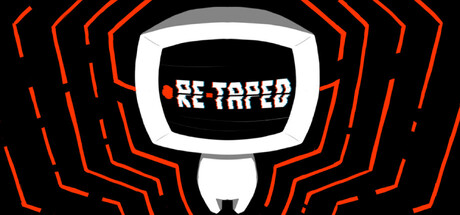
Official game
Play RE-TAPED
This game is hosted by Steam. Continue to the official page to play or download it.
View on SteamOverview
RE-TAPED is a puzzle-platformer from indie studio Logic Potion built around a single conceit: you record your own movements and play them back to progress. Create "echoes" — ghostly replays of your recorded actions — that loop while you navigate the level in real time. Coordinate two, three, or even four versions of yourself simultaneously to solve each room.
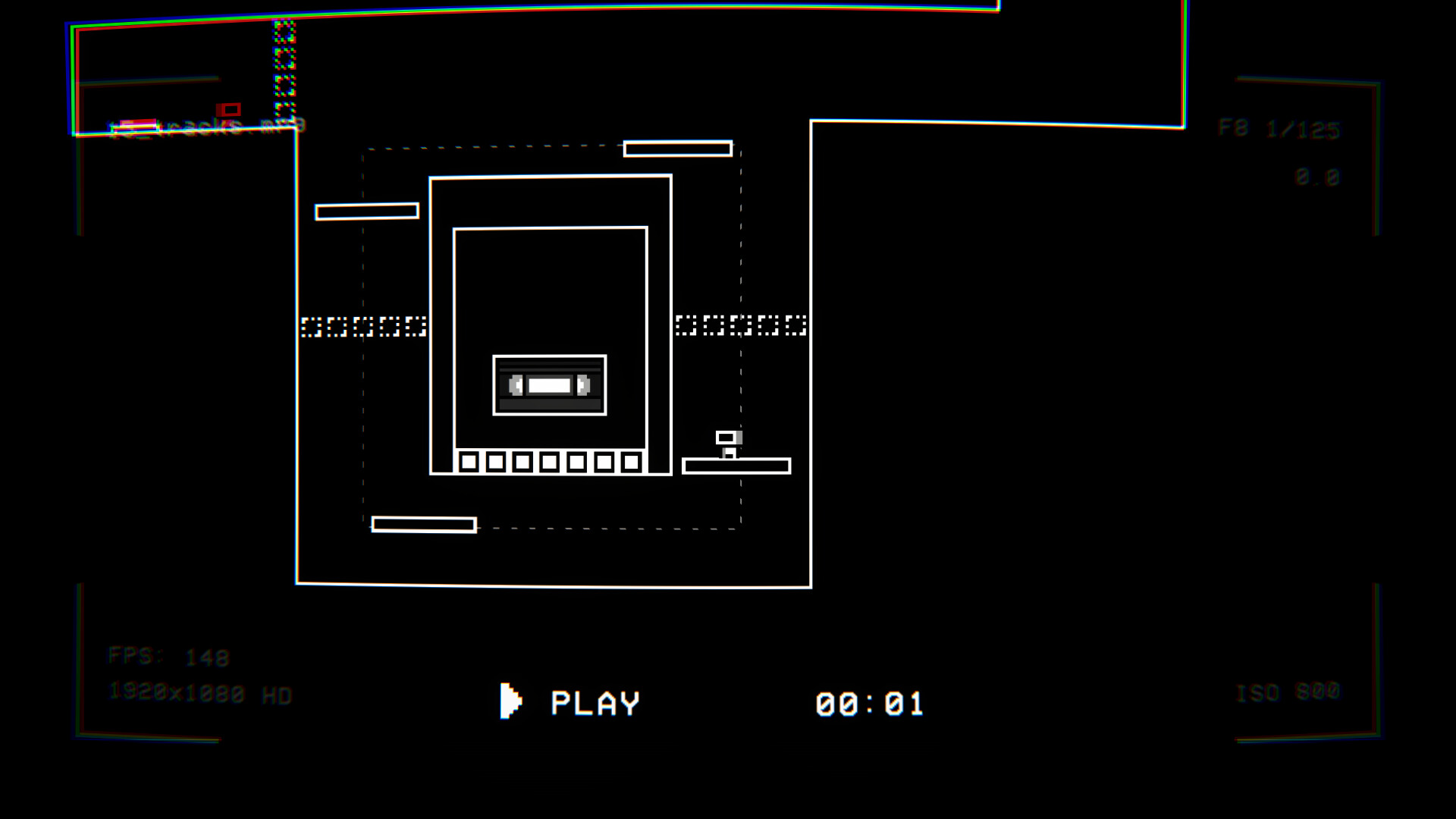
The game wears its VHS aesthetic proudly. Levels are framed like degraded tape footage, the HUD uses cassette-deck typography, and your goal on every stage is to reach a glowing VHS tape — 29 in total, one per level. The worldbuilding hints at an "analog purgatory," a liminal space of static and magnetic distortion where you're trapped reliving your recorded actions. The atmosphere recalls The Backrooms meets Braid — nostalgic and eerie.
What makes RE-TAPED special is its mechanical purity. No enemies, no dialogue trees, no inventory — just timeline puzzles: record the right movements, position your echoes, and the path opens. The difficulty curve is smooth — each new obstacle (pressure plates, lasers, springs, electric fields, moving platforms) is introduced in isolation before being combined.
At $4.99 USD with a free demo on Steam, RE-TAPED delivers roughly 5–6 hours of tightly curated puzzles (longer if you hunt every hidden collectible). It launched on June 18, 2026 to a 100% positive rating on Steam.
| Detail | Info |
|---|---|
| Genre | Puzzle / Platformer / Indie |
| Developer | Logic Potion |
| Publisher | Logic Potion |
| Engine | Proprietary |
| Platform | Windows, macOS, Linux (Steam) |
| Price | $4.99 USD |
| Players | Single-player |
| Release Date | June 18, 2026 |
| Levels | 29 hand-crafted |
| Achievements | 9 Steam Achievements |
| Controller Support | Full (Xbox, PlayStation, Steam Deck) |
| Languages | English, Simplified Chinese, Japanese, Russian, Portuguese (Brazil) |
| Demo | Available on Steam (App 4320240) |
Target Audience
RE-TAPED is for you if you:
- Love recursion puzzles — manipulating time, clones, or recordings (Braid, P.B. Winterbottom, The Swapper)
- Enjoy "one more try" puzzle design — levels are short (1–5 minutes) but demand precision
- Prefer mechanical purity — no combat, dialogue, or RPG systems; one mechanic explored to its limits
- Appreciate retro-tech aesthetics — VHS distortion, CRT scanlines, cassette-tape UI
- Want bang for your buck — $4.99 for 5+ hours of quality puzzles
It's not for you if you dislike trial-and-error gameplay or need narrative-driven experiences. Level 29 in particular has drawn comments from players who found it "too abstract."
Getting Started — First 30 Minutes
What You'll See
The game opens on a title screen that looks like a glitching VCR menu. Press any key and you're dropped into a tutorial-like first room with no text — just an unreachable door and a big red Record button icon above your character. The game trusts you to figure it out.
Your First Puzzle
Your character stands on a flat platform. Across a small gap is the exit door, blocked by a pressure plate. One plate needs weight. You can't stand on it and walk through the door simultaneously.
- Press R to start recording. A red REC indicator appears.
- Walk onto the pressure plate. The door opens.
- Press R again to stop recording.
- An echo — a translucent after-image — appears and replays your steps on loop.
- While your echo stands on the plate, walk across the gap and through the now-open door.
Done. You've just solved your first time-recursion puzzle. The game then escalates from this single-echo setup to puzzles requiring multiple layered recordings, precise timing, and creative momentum use.
What You Should Do First
- Play the first 5 levels in one sitting. They form a gentle tutorial arc teaching every core interaction: pressure plates, timed doors, lasers, and the undo system.
- Press Z often. Undoing costs nothing and saves restarting. It's per-recording, so you can rewind only the last echo.
- Watch your echo's full loop before recording the next layer. A common early mistake is assuming you know what your echo will do.
- Use Esc to restart. If recordings are a mess, a full reset takes two seconds and is often faster than undoing five layers.
Advanced Tips
| Mistake | Why It Hurts You | How to Fix It |
|---|---|---|
| Recording too much at once | Long recordings are hard to debug. If your echo does six things, you can't tell which step is misaligned. | Record one action per layer. Stand on a plate. Stop. Record walking to a switch. Stop. Let each echo be atomic. |
| Not watching the full loop | You think your echo is pressing the button, but it's arriving a half-second late because you recorded from a bad starting position. | Always let the replay run at least one full cycle before recording the next echo. |
| Standing on the recording start point | Your echo spawns exactly where you pressed R. If you're standing there when it loops back, you can bump into each other or desync your movements. | Start recordings from a neutral spot away from where your echo will need to be. |
| Ignoring the undo key (Z) | Players restart entire levels instead of rewinding one bad recording. Wastes time and breeds frustration. | Z is your best friend. Use it when a single echo is slightly off rather than restarting. |
| Jerky or rushed recordings | The echo inherits your exact momentum. If you record a frantic zigzag, your echo will zigzag. Smooth, deliberate movements make puzzles predictable. | Slow down. Record at normal walking speed, not sprinting. Precision over speed. |
| Forgetting about jump momentum | You start the recording on the ground, but jump immediately after pressing R. Your echo spawns on the ground and jumps at the same frame, creating a half-second delay if you needed it airborne instantly. | Record from a running start or jump before pressing R if you need your echo to start mid-air. |
| Not using the Esc restart strategically | Sometimes you've made so many recordings that unravelling them is more work than starting fresh. Players who "commit to the bit" waste 10 minutes on a solution that needs a clean slate. | If you've undone 3+ times and still can't fix it, restart. The level resets in one second. |
Core Mechanics
1. The Recording System (Echoes)
Press R to begin recording; every input is saved to a timeline. Press R again to stop. An echo — a ghostly semi-transparent copy — appears at the record start point and replays your inputs on an infinite loop.
Key properties:
- Spawn point = record start point. Your echo appears where you pressed R, not where you currently are.
- Momentum preserved. Sprinting when you stop recording? Your echo starts sprinting too.
- Echoes are physical. They stand on plates, block lasers, trigger springs, and collide with you or other echoes.
- Echoes are transparent for movement but solid for physics.
- Unlimited layers. All echoes run simultaneously. Managing 3–4 is typical in late levels.
2. Pressure Plates and Switches
Pressure plates need continuous weight (echo or player) to keep doors open, bridges extended, or lasers blocked. Early levels use one plate; later puzzles require multiple echoes or timed jumps to cover distant plates simultaneously.
Switches (E) are toggle-based — press once and they stay. Used for one-time actions like opening a far door or rotating a platform. Some must be triggered at a precise moment (e.g., while a moving platform is aligned).
Springs / launchers propel you upward on contact. Height depends on your velocity. Have an echo trigger a spring at the same moment you step on it to reach heights you couldn't alone.
3. Lasers and Electric Fields
Lasers travel in straight lines until hitting a solid object — including echoes. Park an echo in the beam to block it and pass safely. Later levels use intersecting lasers requiring an echo at the exact intersection point.
Electric fields are area-denial hazards. Echoes can tank them — an echo standing in an electric field isn't destroyed, and its body blocks the field, creating a safe corridor.
Visual cue: lasers are red/orange beams, electric fields are crackling blue/purple zones. Both obey the "echoes block them" rule.
4. Moving Platforms and Conveyor Belts
Moving platforms follow a preset path (horizontal, vertical, diagonal). Both you and your echoes can ride them. Key puzzle application: record an echo riding a platform to a certain point, then stopping on a pressure plate, while you ride a separate platform elsewhere.
Conveyor belts push anything standing on them in a set direction. Recording on a conveyor is tricky — your echo's path drifts. Advanced puzzles use belts to desynchronize echo timing (walking against the belt = slower, creating a natural delay).
5. The Undo and Timeline System
Press Z to remove the last echo you recorded, freeing whatever it was holding. Undo repeatedly to peel back layers, but you cannot redo. For large mistakes, restart the level (Esc → Restart) — it's often faster than undoing 6 echoes individually.
All echoes run simultaneously, not sequentially. They all loop at once, forever. This means Echo B (recorded later) can affect the environment that Echo A (recorded earlier) uses — the simultaneity is the core challenge.
Advanced Strategies
Echo Stacking (Layered Recordings)
Recording multiple echoes that build on each other's effects. Example:
- Record Echo A to stand on Plate 1 → Door 1 opens.
- With Door 1 open, record Echo B to walk through and press Switch 2 → Platform extends.
- Record Echo C to walk across Platform and trigger Spring 3.
- You walk through the entire chain while all three echoes loop.
Work backwards in logic, but record forwards in execution: Echo A first (earliest action), then B, then C, then walk yourself.
Momentum Carry
Your echo inherits the velocity you had when you pressed R:
- Running start: Sprint right, then press R. Your echo keeps sprinting on loop.
- Mid-air recording: Jump off a ledge, press R mid-air. Echo spawns already airborne.
- Spring preload: Walk onto a spring, start recording as you bounce, echo launches every loop.
Mastering momentum carry separates competent players from speed-solvers.
Negative Space Recording (Delay Windows)
Sometimes you don't want an echo to do anything useful for several seconds — you need it as a "living timer." Record an echo that stands still or walks in a circle for a few seconds before acting. This creates a delay window that lets other echoes sync up.
Example: Door A stays open for 3 seconds after its plate is pressed. You need Echo B to walk through, but its path takes 4 seconds. Solution: add a 1-second idle pause at the start of Echo A's recording. That 1-second delay means Door A opens 1 second later, perfectly aligning with Echo B's arrival.
Negative-space recording is the most overlooked technique. If your echoes are just barely missing their timing, add a deliberate pause.
Ghost-Blocking for Lasers
A single echo can block multiple lasers if positioned at their intersection point. Study laser paths before recording — sometimes an echo standing between two emitters blocks both beams simultaneously. You can also use an echo to block a laser temporarily by recording it walking through the beam (the laser is blocked for the frames it crosses). This "blinking" technique is required in at least three late-game puzzles.
Triple-Echo Coordination (Level 25+)
Late levels demand three simultaneous echoes. Workflow:
- Sketch the solution — understand the order of operations before recording.
- Record Echo 1 (longest path or earliest action). Verify two full loops.
- Record Echo 2 with Echo 1 running. Verify both.
- Record Echo 3 with both running. Walk the path yourself.
If it fails, undo in reverse order (Echo 3 → Echo 2 → Echo 1) rather than restarting, preserving correct recordings.
Using the Demo for Practice
RE-TAPED has a free demo (Steam App 4320240) with the first several levels. If you're on the fence or want to practice before buying, the demo is representative. Progress does not carry to the full game, but the skill does.
FAQ
Is RE-TAPED free? No. The full game is $4.99 USD on Steam. A free demo is available.
How long is RE-TAPED? Most players finish the 29-level campaign in 4–6 hours. Collecting all hidden cubes and all 9 achievements adds 1–2 more hours.
Does RE-TAPED have controller support? Yes — full controller support for Xbox, PlayStation, and Steam Deck. Designed with controller play in mind.
What platforms? Windows (10+ 64-bit), macOS (Big Sur 11.0+, Apple Silicon recommended), Linux (Ubuntu 22.04+ / SteamOS 3). All via Steam.
Are there achievements? Yes, 9 Steam Achievements: Cube Finder, Cube Collector, Cube Connoisseur, Cube Master, Click, Align, Power, Companion, and Redshift.
Is there a level select? Yes. Completed levels can be replayed to collect missed VHS tapes or hidden cubes.
Is the game actually about VHS tapes? Yes — the entire aesthetic is retro analog-tape. UI mimics a VCR, collectibles are VHS tapes, and the story framing is "analog purgatory" with CRT visual effects.
What's up with level 29? The final puzzle is widely considered the hardest. Players report it as significantly more abstract than the rest of the campaign. One reviewer noted it required developer help to solve.
Can I get a refund? Standard Steam refund policy: under 2 hours playtime and within 14 days of purchase.
Final Tip & Verdict
Final Tip: When you hit a wall (and you will), walk away for 5 minutes. RE-TAPED's puzzles benefit enormously from a fresh perspective. Also — use the undo key. The designers built it in because trial-and-error is part of the process.
Verdict: RE-TAPED is a gem — tightly designed, mechanically pure, and priced to deliver far more value than its $4.99 tag suggests. It scratches the same itch as Braid and P.B. Winterbottom without feeling derivative, and its VHS aesthetic gives it a distinct personality that lingers after the credits roll. The 29 levels are lean and purposeful: no filler, no grinding, just clever puzzles that respect your intelligence.
If you love the moment when a puzzle clicks into place — when your echoes, lasers, springs, and timing align into a single elegant solution — RE-TAPED will give you that feeling 29 times over. Highly recommended.
Last reviewed by Game How To Editorial. We purchase each game, verify controls against official sources, and update guides when game mechanics change. Steam data retrieved July 2026.
Screenshots