Official game
Play HYPERyuki: Snowboard Syndicate
This game is hosted by Steam. Continue to the official page to play or download it.
Wishlist on SteamOverview
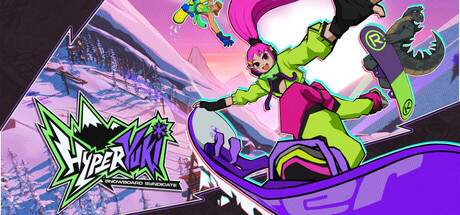
HYPERyuki: Snowboard Syndicate is an arcade snowboarder from Wabisabi Games, published by the revived Acclaim, Inc. It brings back the fast-paced, trick-heavy style of classics like SSX while adding modern mechanics, anime-inspired visuals, and a Y2K aesthetic drenched in neon colors. Think SSX Tricky crossed with Jet Set Radio.
Choose from a cast of unique riders, each with distinct stats and special abilities. Carve through dynamic mountain slopes built for racing, trick mastery, and exploration. Compete across four modes — Race, Challenge, Chill, and Multiplayer — with up to 8 players online or 4 in split-screen.
Target audience: Players who miss arcade sports games from the PS2/Xbox era. If SSX Tricky was your childhood, this is your game.
Difficulty: Easy to pick up. The skill ceiling is in mastering trick chains, learning course shortcuts, and balancing speed against style.
Getting Started — First 30 Minutes
Choose Your Rider
Each rider has a unique stat spread and special ability. Stats affect three core attributes:
| Stat | Effect | Best For |
|---|---|---|
| Speed | Base velocity and acceleration | Races, time trials |
| Control | Turning radius, landing stability, crash recovery | Technical courses, trick chains |
| Style | Trick multiplier, trick meter fill rate | Score attack, Challenge mode |
Rider specials activate when your trick meter is full. They provide temporary boosts — speed bursts, score multipliers, or defensive shields.
Starter Rider Recommendations
| Rider | Role | Why Start Here |
|---|---|---|
| Yuki | All-rounder | Best first pick. Balanced stats let you learn all systems |
| Maya | Trick specialist | High control makes landings forgiving. Great for learning trick chains |
| Ryo | Speed demon | High speed, low control. Only pick after you know the courses |
| Kaito | Score attack | High style for maximum trick scores. Low control means harder landings |
| Luna | Racing purist | High speed with Ghost ability to pass through obstacles. Expert pick |
Start with Yuki. Balanced stats let you figure out the controls, the courses, and the scoring system before you specialize.
Basic Controls
| Input | Action |
|---|---|
| Left/right | Steer |
| Tilt forward | Accelerate |
| Tilt backward | Brake |
| Jump button (A/Space) | Catch air on ramps |
| Trigger left | Grab tricks in air |
| Trigger right | Flip tricks in air |
| D-pad directions | Trick variations (adds rotation style) |
| Boost button (X/Shift) | Speed burst (uses trick meter) |
| Balance input | Stick the landing after jumps |
Core Mechanics Explained
The Trick System
Three main trick categories, each with different scoring potential and risk:
| Category | Risk | Reward | Use Case |
|---|---|---|---|
| Grabs | Low | Moderate | Consistent scoring, filling meter |
| Flips | Moderate | High | Mid-jump combos |
| Spins | High | Highest | Big air, multi-trick chains |
Trick Chaining: Chain multiple tricks in a single jump for a multiplier. Each consecutive trick adds 0.5x to the multiplier, up to 5x. The multiplier resets on landing or crash.
Example: Grab → Flip → Spin → Grab = 4 tricks in one jump = 3x multiplier.
Trick Variations: Use the D-pad while performing tricks to add rotation variations. Diagonal inputs add twists to flips and spins. A 540 with a grab is worth more than a plain grab.
The Boost System
The trick meter fills when you perform tricks and grinds. A full meter lets you activate your rider special or gives a temporary speed boost.
Boost management strategy:
- Use boost to recover speed after a crash
- Save boost for the final stretch of a race
- In Trick Attack mode, use boost to chain tricks faster, not for speed
- Boost does not refill while active — time your usage
Landing Mechanics
The landing system determines whether you stick your trick or crash. A timing window appears at the end of your jump. The window shrinks with trick complexity.
- Perfect landing: Score bonus, maintains trick chain
- Sloppy landing: No bonus, chain continues
- Crash: Chain ends, speed loss, meter drain
Pro tip: On big jumps, stop inputting tricks before you land. Give yourself time to see the snowboard and correct into position. A clean landing on a moderate trick beats a spectacular crash.
Progression Strategy — Unlock Everything
Course Progression
Courses unlock by earning medals in earlier tracks. The order is:
- Beginner slopes (3 courses) — Learn the mechanics
- Intermediate mountains (4 courses) — Introduces sharper turns and larger jumps
- Advanced peaks (4 courses) — Complex terrain with hazards
- Expert ridgelines (3 courses) — Punishing difficulty, tight shortcuts
- Secret courses (2-3 unlockable) — Found by exploring Chill mode
What to Unlock First
| Priority | Item | Why |
|---|---|---|
| 1 | Rider upgrades | Stats matter more than cosmetics |
| 2 | Board upgrades | Better boards = better stats |
| 3 | Course unlocks | More courses = more medals = more unlocks |
| 4 | Trick variations | More options for score chains |
| 5 | Cosmetics | Pure style, no mechanical benefit |
Resource Priority
The game has in-game currency earned from races and challenges.
- Buy the wax upgrade first — it increases your base speed on all courses
- Upgrade your board — better stats for your preferred playstyle
- Unlock new riders — each has unique specials that change your approach
- Save for cosmetics — some outfits have hidden stat bonuses
Builds / Playstyles — 3 Approaches
The Speed Build
Focus: Winning races, minimizing trick time Rider: Luna or Ryo Upgrades: Speed + Acceleration Strategy: Learn every shortcut. Boost on straight sections only. Skip risky tricks.
| Pros | Cons |
|---|---|
| Highest win rate | Low trick scores |
| Simple to execute | Boring to watch |
| Effective on all courses | Vulnerable to crashes |
The Style Build
Focus: Maximum trick scores, Challenge mode records Rider: Kaito or Maya Upgrades: Style + Control Strategy: Find the biggest jumps. Chain 4+ tricks per jump. Always land perfectly.
| Pros | Cons |
|---|---|
| Highest scores | Lower race placement |
| Fills meter fastest | High crash rate |
| Best for leaderboards | Requires course knowledge |
The Balanced Build
Focus: Versatility, learning new courses Rider: Yuki Upgrades: Even spread across all three stats Strategy: Adapt to the situation. Tricks on big jumps, speed on straightaways.
| Pros | Cons |
|---|---|
| Works everywhere | Masters nothing |
| Best for learning | Sub-optimal at everything |
| Forgiving playstyle | Requires reads on each course |
Step-by-Step Strategy — 7 Actionable Sequences
Sequence 1: Race Mode — The Perfect Downhill
- Start by building your trick meter on the first two jumps
- Activate boost on the first long straight section
- Hit every shortcut — each saves 1-2 seconds
- On intermediate jumps, do one grab (safe, fills meter)
- On large kickers, chain 2-3 tricks
- Save a full boost for the final 15 seconds of the race
- At the finish line, do a final trick for style points
Sequence 2: Trick Attack — Score Chaining
- Find a route that loops back to the same big jump
- On the first pass, do a simple grab to warm up
- On the second pass, chain Grab → Flip (2x multiplier)
- On the third pass, chain Grab → Flip → Spin (2.5x multiplier)
- As meter fills, activate style-focused rider special
- Chain 4+ tricks on every jump during special
- Grind every rail between jumps to maintain meter
Sequence 3: Challenge Mode — S-K-A-T-E Tile Collection
- Study the course layout before starting
- Tiles are arranged in a specific order — learn the path
- Use Chill mode to explore and memorize tile locations
- Prioritize tiles over tricks — tiles are the win condition
- If you miss a tile, do not restart — finish the run for practice
- Some tiles require specific trick types to collect (grab tiles, flip tiles)
Sequence 4: Shortcut Discovery Method
- Play Chill mode on each course first
- Explore off the main path — shortcuts are hidden behind trees, rocks, and buildings
- Look for diverging snow trails — they lead to alternate routes
- Mark shortcut entrances mentally or with screenshots
- Test each shortcut at low speed before using in a race
- Some shortcuts have hazards — learn which ones are worth the risk
Sequence 5: Rail Grind Combos
- Approach rails at a slight angle, not head-on
- Jump onto the rail with the jump button, not by riding off
- While grinding, use the balance input to stay centered
- Switch rails by jumping to adjacent rails for a style bonus
- Perform grind tricks with the trick buttons (risky, adds big points)
- Exit the rail with a jump into a trick chain for maximum points
Sequence 6: Crash Recovery
- After a crash, immediately use boost if available
- Do not try to trick immediately — build speed first
- Take the safest line for the next 3 obstacles
- If you lost the lead, focus on perfect runs, not flashy tricks
- In Trick Attack mode, a crash means the chain is gone — restart fresh
Sequence 7: Multiplayer Strategy
- In online races, the first 10 seconds determine placement — boost early
- Use defensive riding — block opponents from shortcuts
- In split-screen, watch opponents' screens for shortcut locations
- In head-to-head, psych out opponents with risky tricks on narrow sections
- Remote Play Together lets you play with friends who do not own the game
Advanced Tips — What Experienced Players Know
-
Master the flow. Arcade snowboarding is about momentum. Avoid hard braking. Wide turns at speed beat tight turns at half speed.
-
Learn one course at a time. Each course has a unique rhythm, shortcuts, and ideal trick locations. Run it 5-10 times before moving on.
-
Prioritize clean landings. A perfect landing on a simple grab is worth more than a crash on a triple spin. Build consistency, then add complexity.
-
The trick meter is a resource, not a score. A full meter gives you options — boost, special ability, or both. Do not let it sit full.
-
Shortcuts are not always faster. Some are riskier than the main path. Learn which shortcuts save time and which cost you.
-
Watch the minimap. It shows upcoming turns, jumps, and obstacles. Plan your line before you reach them.
-
Balance on rails requires active input. Small, frequent corrections work better than large ones. The balance indicator shows your position in real time.
-
Trick selection depends on jump size. On short jumps, stick to grabs and simple flips. On huge kickers, go for multi-spin combos.
-
The boost meter carries between sections. If you have a full meter and no immediate use for it, save it. The next section might have a long straight where boost matters more.
-
Race lines are different from trick lines. In a race, take the shortest path. In Trick Attack, take the path with the biggest jumps and most rails.
Course Types — How to Approach Each
Mountain Slopes
Traditional downhill courses. Key features: natural jumps, forest sections, cliff edges, ice patches.
Strategy: Stay in the center of the course for the safest line. Use ice patches for drift boosts if your control stat is high enough.
Park Courses
Man-made terrain parks designed for trick chains. Features: kickers, rails, half-pipes, boxes.
Strategy: Plan your route through the park before starting. Link each feature into a continuous combo. The highest scores come from never touching the ground between features.
City Courses
Urban environments with snow-covered streets. Features: roof jumps, street rails, traffic, alley shortcuts.
Strategy: City courses reward precision over speed. The margins are tighter. Learn the alley shortcuts — they are the difference between first and second place.
FAQ — Common Mistakes
Q: When does HYPERyuki release? Not yet released on Steam. Also announced for Xbox and PlayStation. No exact date yet.
Q: How many players in multiplayer? Up to 8 online. Up to 4 in split-screen. Steam Remote Play Together supported.
Q: Is there a singleplayer campaign? Yes. Progression through courses, unlockable riders, challenge tiers, and collectibles.
Q: What platforms? PC (Steam), Xbox Series X|S, PlayStation 5 confirmed. Nintendo Switch 2 rumored.
Q: Is there controller support? Full controller support. Gamepad recommended. DualShock, DualSense, and Xbox controllers supported.
Q: What is the price? Not yet announced. Wishlist on Steam for notification.
Q: How long is the game? 12-15 hours to unlock everything in singleplayer. Multiplayer is endless.
Q: Who is Acclaim, Inc.? The revived classic publisher backing indie arcade sports games. They also published Basketball Classics and Kidbash.
Verdict
HYPERyuki: Snowboard Syndicate is the arcade snowboarder the world has been waiting for since SSX went dormant. With its Y2K neon aesthetic, tight controls, and four distinct game modes, it captures everything that made the genre great while adding modern multiplayer and customization. The trick system has enough depth for competitive play, and Chill mode provides a surprisingly zen alternative to the high-speed racing.
If you spent your childhood playing SSX Tricky, this will feel like coming home.
Guide last updated July 17, 2026.
Screenshots