Official game
Play Toy Soldier in Trouble
This game is hosted by itch.io. Continue to the official page to play or download it.
Play on itch.ioOverview / Game Introduction
Toy Soldier in Trouble is a free, browser-based defense shooter where the toys have turned against their owner. You play as Chip Squire, a lone toy soldier who must defend the top of the screen from waves of enraged playthings that have "run amok" in the toy box.
Developed by haunt.games for the Artists Tavern Game Jam Summer 2026 (theme: "let chance decide"), the game runs entirely in your browser with no download required. A single run lasts anywhere from 30 seconds to several minutes depending on your luck and skill, and every session is unique thanks to a fully randomized weapon system.
The core twist: you don't choose your loadout. Your shot type, projectile behavior, and firing mode are all randomly assigned at the start of each game. Kill enough enemies and you earn randomized stat upgrades — but the toys get faster and stronger too. Let three enemies reach the top of the screen and it's game over.
| Detail | Info |
|---|---|
| Genre | Action / Shooter / Survival / Arcade |
| Developer | haunt.games |
| Engine | GDevelop (HTML5 Web build) |
| Platform | Browser (itch.io) |
| Price | Free |
| Players | Single-player |
| Release Date | June 21, 2026 |
| Game Jam | Artists Tavern Game Jam Summer 2026 |
| Difficulty | Easy to learn, punishing at higher waves — heavily luck-dependent |
| Session Length | 2–10 minutes per run, highly replayable |
Target audience: This game is perfect for fans of arcade shooters, browser-based time-wasters, and roguelike-adjacent "make do with what you get" gameplay loops. If you enjoy quick pick-up-and-play sessions (think Space Invaders meets The Binding of Isaac-style randomness), or if you're a fan of pixel-art game jam entries with charming toy themes, this one will click immediately. Casual players will appreciate the simple two-button controls, while high-score chasers will find depth in adapting to random loadouts and managing escalating enemy waves.
Getting Started — First 30 Minutes
What You See
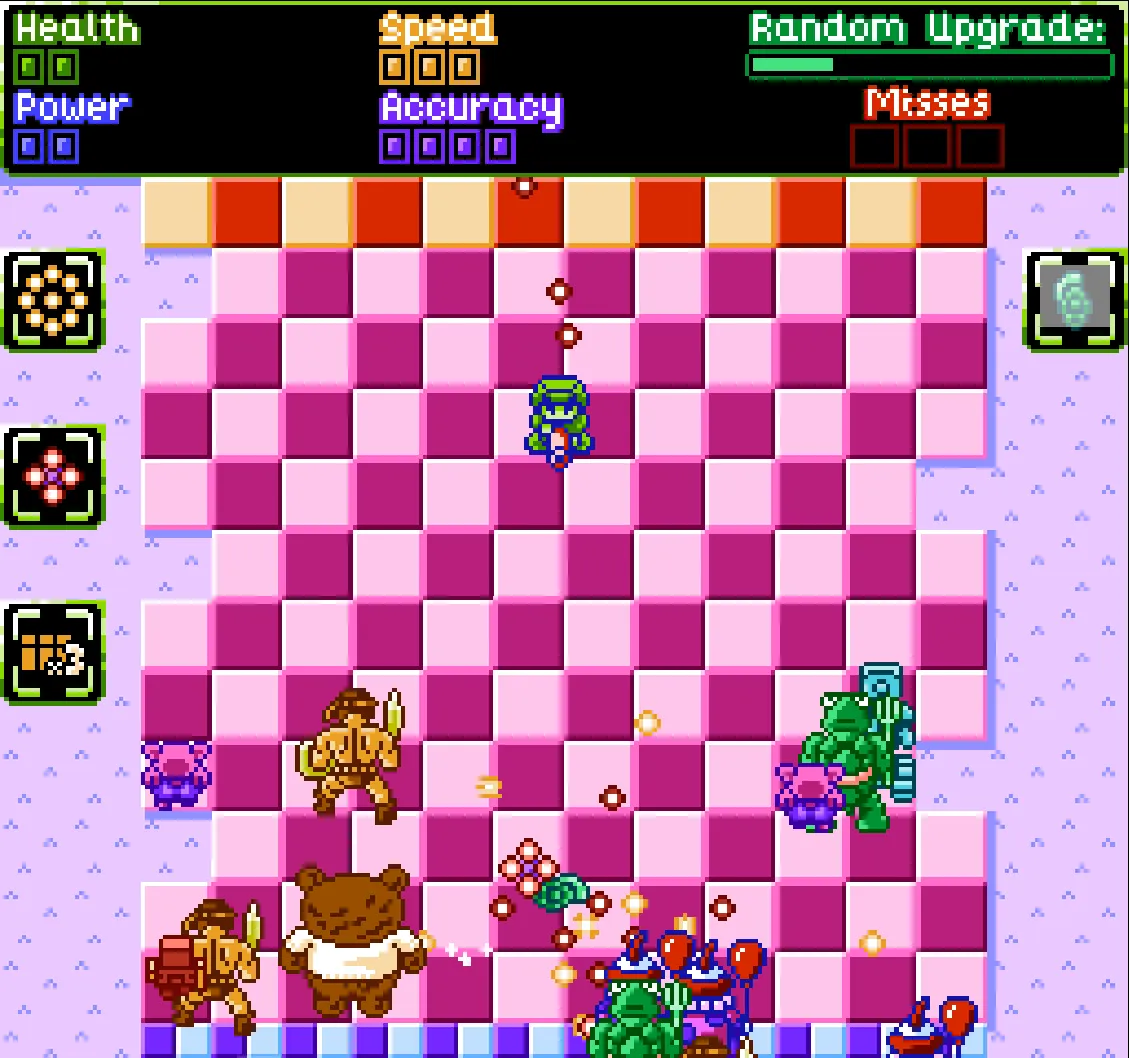
The game drops you into a pixel-art toy-box battlefield. Chip Squire, your green toy soldier, stands at the top of the screen with a gun. A HUD panel sits on the left side showing three icons that indicate your current random loadout. The bottom of the screen is where enemies spawn and begin their march upward.
Your First Run
- Click "Run Game" on the itch.io page. The game loads instantly in your browser — no downloads, no setup.
- A random loadout is assigned. You'll see three icons on the left HUD. Immediately take note of what you're working with (see "Core Mechanics" below for the full breakdown).
- Enemies appear from the bottom of the screen. They move at varied speeds. Your job is to move left and right (Arrow Keys) and shoot (Spacebar) to take them out before they reach the top.
- Three misses = game over. Each enemy that touches the top edge counts as a miss. The game ends when three have slipped past.
- Kill enemies to trigger upgrades. After a certain number of kills, a random stat boost pops up — fire rate, damage, projectile speed, or something else.
- Shoot toy boxes that appear on the battlefield. They drop randomized sub-weapons that fire automatically, adding extra firepower.
- Survive as long as you can. There's no final wave — the game continues until you let three enemies through.
What to Look For in the First 30 Minutes
- You will die fast at first. A bad weapon roll (slow projectile + narrow shot type) makes the early game much harder. Don't get discouraged — restarting is instant.
- Pay attention to your projectile behavior. Some projectiles arc, some travel in a straight line, some bounce or split. Understanding what your current gun actually does is the single most important skill.
- Enemy speed varies. Some toys crawl, others sprint. Learn to identify the fast ones immediately and prioritize them.
- The difficulty ramps. After a few upgrades, enemy spawn rate and speed noticeably increase. The game doesn't get easier — you just get better tools (hopefully).
Advanced Tips
| Mistake | Why It Hurts | How to Fix It |
|---|---|---|
| Standing still | Enemies spawn from both sides. Staying in one spot leaves half the screen undefended. | Keep moving. Stay roughly centered and sweep left and right based on enemy positions. |
| Ignoring sub-weapon boxes | Toy boxes that appear on screen drop auto-firing sub-weapons that double your firepower for free. | Shoot every box you see. Even a weak sub-weapon is better than none. |
| Spraying and praying | Ammo isn't limited, but poor aim means enemies slip through while you reload (if your firing mode has a burst delay). | Aim deliberately. Lead your shots for fast-moving enemies. Learn the rhythm of your current firing mode. |
| Panicking when enemies get close | Enemies don't actually shoot back (in the current version). The sparks on death are visual effects, not projectiles. | Stay calm. Take a breath and line up your shots. The only threat is letting them reach the top. |
| Not adapting to your loadout | Every run is different. Playing a spreadshot run the same way you'd play a splitshot run wastes the weapon's strengths. | Experiment for the first few kills to understand your shot type, projectile arc, and fire rate. Adjust your positioning accordingly. |
| Forgetting the 3-miss limit | It's easy to lose track when things get hectic. Two close calls mean the next one ends the game. | Keep a mental count. If you've already lost two, play more cautiously and prioritize the nearest threats. |
| Over-focusing on one side | Enemies come from random horizontal positions. Tunnel vision on one side lets enemies sneak through on the other. | Check the full width of the screen regularly. Use peripheral awareness to catch spawns early. |
| Holding the fire button constantly | Some firing modes (like 3-round burst) have a recovery window. Holding fire can lock you into bad timing. | Tap rhythmically. Learn your firing mode's optimal cadence to maximize shots without penalty. |
Core Mechanics
1. The Random Loadout System (Weapon Trinity)
This is the heart of the game. Every run randomly rolls three independent variables that define your weapon:
Shot Type (4 variants) Determines how your bullets behave when they hit an enemy:
| Shot Type | Behavior | Best Use |
|---|---|---|
| Normal | Single projectile, no secondary effects. | Reliable and predictable. Good for learning enemy patterns. |
| Spreadshot | Fires a fan of projectiles in a cone. | Excellent for crowd control. Position to catch multiple enemies in the spread. |
| Splitshot | The main projectile splits into smaller projectiles on impact. | Great against groups — one hit turns into multiple hits. Prioritize clustered enemies. |
| Firework Shot | The projectile explodes into a radial burst of smaller shots on impact. | The highest area damage option. Best when enemies are tightly packed. |
Projectile Type (~9 variants) Determines the physical behavior of the projectile itself. These act completely differently from one another:
- Some travel in straight lines at high speed.
- Others arc, bounce, home slightly, or travel in wave patterns.
- Projectile speed, size, and visual appearance all change based on this roll.
- The middle icon on the HUD shows your current projectile type.
Firing Mode (3 variants)
| Firing Mode | Behavior | Strategic Note |
|---|---|---|
| Normal Fire | Steady, paced rate of fire. Balanced, no surprises. | The baseline. Reliable for any situation. |
| Rapid Fire | High rate of fire. Less damage per shot but much more volume. | Melts single targets quickly but can overheat or require more precise tracking. |
| 3-Round Burst | Fires three shots with a brief recovery between bursts. | High burst damage but punishs bad timing. Wait for the recovery to end before firing again. |
Developer insight (from haunt.games): "The three icons on the left are: shot type (top), projectile type (middle), and firing mode (bottom). There are 9 projectile types, 4 shot types, and 3 firing modes — giving 108 possible combinations before upgrades."
2. Stat Upgrades
Every set number of kills triggers a random stat upgrade. The upgrade is chosen randomly and applied immediately:
- Fire Rate — Shoots faster.
- Damage — Each projectile deals more damage.
- Projectile Speed — Bullets travel faster, making it easier to hit fast enemies.
- Projectile Size — Larger projectiles are easier to land.
- Other stats — The developer has hinted at additional upgrade types.
Important: The enemies also get stronger and faster as you progress. Each upgrade cycle increases the spawn rate and movement speed of enemy toys. There is no "safe" run — the game escalates every time you improve.
3. Sub-Weapons (Toy Box Drops)
Scattered toy boxes appear periodically on the battlefield. Shooting them drops a randomized sub-weapon that:
- Fires automatically — you don't need to control it.
- Has its own random behavior — different projectile patterns and speeds.
- Stacks with your main weapon — essentially doubling your firepower for a period.
Sub-weapons are temporary but can be refreshed by collecting another box. In runs where you roll a weak main weapon combo, sub-weapons become your primary damage source. Always shoot every box you see.
4. Enemy Types and Behavior
Enemies in Toy Soldier in Trouble aren't just speed-scaled clones. Different toy types behave differently:
- Slow toys — Larger, chunky toys that move slowly but absorb more hits. They're easy to hit but demand sustained fire.
- Fast toys — Smaller, quicker toys that sprint up the screen. These are your top priority — they can reach the top in seconds.
- Mixed waves — As the run progresses, enemies spawn in increasingly mixed compositions, forcing you to split your attention between slow tanks and fast runners.
Important note: Enemies do not shoot back at you in the current version (as confirmed by the developer). The sparks and particles that emit from enemies when killed are purely visual. The only danger is enemies reaching the top of the screen. This means you can focus entirely on positioning and aim without worrying about incoming fire.
5. The Three-Miss Game Over Condition
The game ends when three enemies reach the top edge of the screen. This creates three distinct phases in any run:
| Phase | Misses Taken | Playstyle |
|---|---|---|
| Safe | 0 | Play aggressively. Take risks. Learn your loadout. |
| Warning | 1 | Start respecting the limit. Play more carefully. Don't chase kills at the edges. |
| Critical | 2 | Defensive mode. Stay centered. Prioritize the closest enemies. Every fast spawn is a potential game-ender. |
Advanced Strategies
Loadout Assessment in the First 5 Seconds
As soon as your run starts, look at the three HUD icons and ask:
- What shot type did I get? (Top icon) — If it's Normal, you'll need precision. If Spreadshot, position to maximize coverage. If Splitshot or Firework, seek crowds.
- What projectile type? (Middle icon) — Fast straight projectiles are forgiving. Slow arcing ones require leading shots. Bouncy projectiles need open space.
- What firing mode? (Bottom icon) — Rapid fire wants you holding down the trigger. Burst fire wants rhythmic tapping. Normal is flexible.
In the first 3–5 kills, experiment — fire a few shots, watch how your projectiles behave, and adjust your strategy before the wave gets dense.
Positioning Tactics by Shot Type
- Normal Shot: Stay near center. You need clear line-of-sight to every spawn point. Move to whichever side has the most enemies.
- Spreadshot: Position slightly off-center so the cone covers maximum horizontal area. Shift based on where enemies cluster.
- Splitshot / Firework: These reward enemy density. Let enemies get a little closer (but not too close!) so the split/explosion hits multiple targets. Don't stand at the far edge — you want enemies in the middle of the screen where the secondary projectiles can do work.
Sub-Weapon Priority
Not all sub-weapons are equal. Some patterns to watch for:
- High fire rate sub-weapons are excellent against fast enemies — let them cover one side while you cover the other.
- AoE sub-weapons pair perfectly with Splitshot or Firework for massive crowd clear.
- Slow projectile sub-weapons are less useful but still double your damage. Don't ignore them.
If you get a great sub-weapon, play to protect it — stay alive longer to maximize its value.
Managing the Difficulty Curve
The game escalates in distinct waves tied to your kill count. After each upgrade trigger:
- Enemy spawn rate increases.
- Enemy movement speed increases.
- Wave compositions get harder (more fast enemies mixed in).
The danger zone: After 3–4 upgrades, the screen can become chaotic. At this point:
- Stop chasing kills. Focus on preventing escapes. One missed fast enemy in a dense wave can end a strong run.
- Prioritize the left and right edges. Enemies at the edges of the screen are harder to hit and easier to miss.
- Use sub-weapon boxes as shields. If a box is between you and a fast enemy, shoot the box — the sub-weapon drop might kill the enemy for you.
Bad Roll Survival Guide
Sometimes you get Normal shot + slow projectile + burst fire. This combo is terrible. Here's how to survive:
- Let sub-weapons carry you. Prioritize every toy box that spawns. Your main weapon becomes backup.
- Play ultra-defensive. Stay dead center. Don't chase kills. Only fire when you have a clean shot.
- Accept the short run. Some combos are unwinnable past wave 3. That's the game. Restart and try again — the next roll might be Firework + Rapid Fire.
Advanced Awareness: Reading Enemy Spawns
After several runs, you'll start noticing spawn patterns:
- Enemies don't spawn at truly random horizontal positions — there's some clustering logic.
- After a kill-streak, expect a burst of fast enemies from alternating sides.
- Toy boxes tend to spawn when enemy density is about to increase — they're the game's way of giving you a lifeline.
Learn to anticipate where the next enemy will appear based on where the last one spawned. This lets you pre-position and react faster.
FAQ
Is Toy Soldier in Trouble free? Yes, it's completely free to play in your browser with no hidden costs, ads, or microtransactions.
Do I need to download anything? No. It runs entirely in the browser on itch.io. Just click "Run Game" and you're playing.
What was this game made for? It was created for the Artists Tavern Game Jam Summer 2026, where the theme was "let chance decide." The fully randomized weapon system is a direct reflection of that theme.
Who made Toy Soldier in Trouble? The game was developed by haunt.games using the GDevelop engine. haunt.games is an indie game development studio known for pixel-art browser games with arcade sensibilities.
What do the three icons on the left HUD mean? From top to bottom: (1) Shot type — Normal, Spreadshot, Splitshot, or Firework. (2) Projectile type — one of ~9 behaviors that determine how your bullets move. (3) Firing mode — Normal, Rapid fire, or 3-round burst.
Can I save my progress? No. It's an arcade-style game — each run is independent and ends when you let three enemies through. There's no save system or persistent progression.
Do enemies shoot back? Not in the current version. The developer has confirmed that enemies do not fire projectiles. The sparks and particles on enemy death are purely visual. All pressure comes from enemy speed and spawn density.
Will there be updates? The developer has indicated plans to add scoring, enemy kill counters, and additional features based on community feedback. The game was a game jam entry but may receive post-jam updates.
How many loadout combinations are there? 4 shot types × ~9 projectile types × 3 firing modes = approximately 108 unique weapon combinations, before stat upgrades further modify your build mid-run.
What platforms does it run on? It runs in any modern web browser (Chrome, Firefox, Edge, Safari) on desktop and some mobile browsers. It's an HTML5 build from GDevelop.
Is there a high score system? Not yet. The game currently tracks kills during a run but doesn't persist scores between sessions. The developer has mentioned adding scoring in a future update.
Final Tip / Verdict
Toy Soldier in Trouble is a charming, chaotic, and highly replayable browser game that turns a limitation — full randomness — into its greatest strength. It takes the familiar "defend the top of the screen" arcade formula and injects enough variety to keep you coming back for "just one more run."
The final tip: Embrace the chaos. This is not a game you master through perfect execution — it's a game you master through adaptation. The players who survive the longest are not the ones with the best aim, but the ones who can quickly assess their random loadout, adjust their positioning, and make smart decisions about when to play aggressively and when to play for survival.
A bad roll can end your run in 30 seconds. A good roll (Firework shot + fast projectile + Rapid fire) can carry you to double-digit kill streaks. The joy is in the unpredictability.
Verdict: ★★★★☆ (4/5) — A polished, addictive game jam entry with a strong core hook, charming pixel art, and genuine replay value. Loses a star only because it's light on content (no scoring, no persistent progression) — but as a free browser game you can finish in a lunch break, it's absolutely worth your time.
Last reviewed by Game How To Editorial. Data sourced from itch.io and developer comments.