Official game
Play Dungeon Automata
This game is hosted by Steam. Continue to the official page to play or download it.
Wishlist on SteamWhat Is Dungeon Automata?
Dungeon Automata is a dungeon crawler where you never control your party in combat. You write their behavior instead. Developer Medium-Rare Games, a small Japanese studio led by creator Iizuka, calls the genre mashup an "autologic": an auto battler fused with logic-based visual scripting. Originally titled Algolemeth, the game picked up its international name when publisher Raw Fury came aboard as co-publisher in September 2026. It releases on Steam on January 26, 2027, with a free demo already available.
The premise: the world of Syntaxia is in danger. Monsters have poured out alongside the Tower of Corruption, and as the alchemist, your answer is alchemy. You synthesize a party of golems, program their behavior through visual scripting, and send them into the labyrinth. Once they walk in, your job is done. You watch. If they die, you study the log, adjust the blueprints, and send them back in.
If that sounds like watching code fail tests until it passes, that is the intended experience, and it is more fun than it sounds.
| Field | Detail |
|---|---|
| Genre | Auto-battler / visual-programming dungeon crawler |
| Developer | Medium-Rare Games |
| Publisher | Raw Fury (co-publisher), Medium-Rare Games |
| Original title | Algolemeth (アルゴレメス) |
| Platforms | Windows (Steam) |
| Price | TBA |
| Release | January 26, 2027 |
| Players | Single player |
| Composer | Yuzo Koshiro (Streets of Rage, Sonic the Hedgehog-era FM classics) |
| Languages | Japanese, English, French, German, Spanish, Korean, Simplified Chinese |
| Steam App ID | 2731030 |
The soundtrack deserves its own line. All BGM is composed by Yuzo Koshiro, whose FM-synthesis work defined 16-bit action games. His involvement was announced separately and the official site credits him with every track, from mysterious dungeon ambience to battle themes.
The Core Loop: Program, Send, Analyze, Repeat
Dungeon Automata runs on trial and error, by design. The loop has four beats:
- Program blueprints. Each golem has a blueprint: a visual script of connected nodes that defines when it attacks, heals, retreats, or supports.
- Send the party in. Golems explore and fight fully autonomously. There is no mid-run input. You watch.
- Analyze what happened. Where did the party stall? Which enemy action broke the plan? Did the healer burn mana too early?
- Refine and re-run. Tweak a node, swap a targeting rule, add a support behavior, and go again.
Iizuka has said the original idea came from playing a dungeon RPG and wondering: what if I could delegate not just the battles but the exploration and the trip home to logic I designed myself? The whole game is that question turned into systems.
Blueprints and the Node System
Blueprints are the heart of the game. Confirmed mechanics:
- Nodes connect into behavior graphs. You wire together conditions and actions, like "if HP below half, retreat" or "if enemy is casting, interrupt."
- Catalysts raise a golem's raw physical stats. They are the simple power-ups.
- Logic nodes unlock new actions or targeting rules. These are the interesting pickups because they change what you can express, not just how big your numbers are.
- Party support matters. Golems can support each other, and the official materials explicitly ask you to study how members complement one another. A party of four individually perfect golems loses to a party whose blueprints cover each other's weaknesses.
The comparison everyone reaches for is Wizardry-style first-person dungeon crawling, and the media coverage leans on it too. The twist here is that Wizardry's decision space moves from combat rounds into the blueprint editor.
Exploration Is Automated Too
Most auto-battlers automate combat only. Dungeon Automata automates the walk as well. The exploration module rack controls what golems do between fights:
- Who opens treasure chests, and whether it is worth the trap risk.
- Whether the party continues deeper when wounded or retreats to the surface.
- How they route through the floor.
Every dungeon decision becomes a line of logic you wrote. A run that fails at floor 5 usually fails because some exploration rule was wrong, not because anyone missed an attack. Reading failures this way is the actual skill the game teaches.
The Tower of Corruption and Level Design
Levels are handcrafted, not procedurally generated. The store page promises each floor of the tower presents a unique set of challenges, from traps to bosses, and that you decode each one through repetition. The practical implication: solutions persist. Once you crack a floor's puzzle, your blueprint for it becomes a tool you keep, and later floors assume you have kept it.
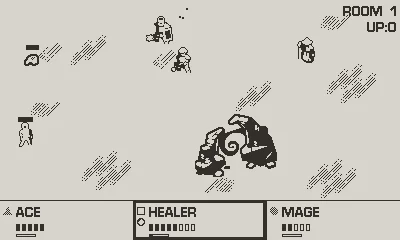
The fantasy world is rendered in handcrafted 8-bit pixel art, deliberately monochrome-leaning, which gives the FM soundtrack room to carry atmosphere. If you grew up on Wizardry and early console RPGs, the aesthetic targets you with precision.
Where the Game Came From
This is not a newcomer's first attempt. The game's track record:
- BitSummit Let's Go! 2023: nominated for the Game Design Excellence Award, Kyoto's top indie showcase.
- 2nd GYAAR Studio Indie Game Contest: contest winner in Japan.
- 2021: development started, born from Iizuka's dungeon-RPG thought experiment.
- September 2026: Raw Fury (Dome Keeper, Kingdom, Slay the Princess) joined as co-publisher and the international title Dungeon Automata was introduced.
- Demo feedback: the community playtest made the game better and slower. The team missed a 2026 release window and set January 26, 2027.
A Japanese indie with a Raw Fury partnership and Yuzo Koshiro music is a unusually strong pedigree for a game this niche.
Try the Demo First
A free demo is on the Steam page right now, and it is the right way to decide if this game is for you. Go in with the right expectations:
- You will spend more time reading and editing than watching battles.
- Losing a run is information, not failure. The game's own pitch is "conquer the dungeon through trial and error."
- If editing node graphs feels like work instead of play, this genre is not your genre. No shame in that.
System Requirements
The specs are from 2012, which fits the art style:
| Component | Minimum |
|---|---|
| OS | Windows 10 |
| CPU | Intel Core i5-3330 / AMD FX-4300 |
| RAM | 4 GB |
| GPU | GeForce GT 730 / Radeon R7 250X |
| DirectX | Version 11 |
| Storage | 5 GB |
Steam Deck is unconfirmed, but a turn-based auto-battler with controller support and light system demands is about as Deck-friendly as games get.
Getting Started: Learning to Read Failures
New players lose their first ten runs and quit, because they treat a wipe as a bad dice roll. Treat it as a log file instead:
- Run the demo with one golem. Strip your party to a single blueprint and watch exactly what it does. Complexity comes later.
- Write the simplest possible script first. "Attack the nearest enemy. If HP below 30%, retreat." Watch it succeed and fail before adding branches.
- Watch one floor three times before editing anything. The first run shows what happens, the second shows why, the third shows what to change.
- Change one node per iteration. If you rewrite half the blueprint after a wipe, you cannot tell which fix worked.
- Catalysts before cleverness. If a floor stalls on raw damage, stat catalysts buy you time while you think. Logic nodes solve design problems, not stat deficits.
Tips and Tricks
- Build the medic's script before the attacker's. Support logic that triggers on ally HP is the backbone of every deep run; offensive scripts are easy to bolt on later.
- Study enemy actions, not enemy stats. A blueprint that counters the action pattern beats one tuned against the numbers.
- Chest-opening logic deserves its own line. Dedicate one golem to lockpicking and let the fighters hold position. Mixing roles in one script creates deadlock loops.
- Retreat rules need a floor threshold. Set the HP trigger for withdrawal below the damage pattern of the current floor, or your party flees forever.
- The exploration rack is your economy. Better routing rules mean more catalysts per run, which fund the logic nodes that break the next floor.
- Re-use solved floors. Keep a working blueprint per floor archetype. The tower's later levels remix earlier challenges, and your archive is the answer key.
Should You Wishlist It?
Wishlist it if any of these describe you: you enjoy auto-battlers, you have dabbled in visual programming and liked it, you miss Wizardry-style crawling, or the Yuzo Koshiro FM soundtrack alone is worth the entry fee. Skip it if you want hands-on combat; the entire design removes your hands on purpose.
FAQ
When does Dungeon Automata release? January 26, 2027 on Steam. The team missed a planned 2026 date after demo feedback led to improvements.
What is Algolemeth? The game's original and Japanese title. Dungeon Automata is the international name introduced with the Raw Fury co-publishing deal. The studio still uses both.
Is there a demo? Yes, free on the Steam store page. It is representative of the final loop.
Is it a roguelike? It shares the trial-and-error structure and dungeon crawling, but levels are handcrafted and your blueprint knowledge persists between runs, which makes it closer to a puzzle-box strategy game than a roguelike.
Do I need to know programming? No. The scripting is visual: you connect nodes, no code syntax involved. The thinking is programmer-shaped, but the interface is not.
Is the music really by Yuzo Koshiro? Yes, all of it. Confirmed via the official announcement and the studio's site.
What languages does it support? Japanese, English, French, German, Spanish, Korean, and Simplified Chinese at launch.
Screenshots