Daily Pick
One deeply researched guide worth reading today.
A practical route through the systems that matter most, written to help new players make confident decisions quickly.
Overview
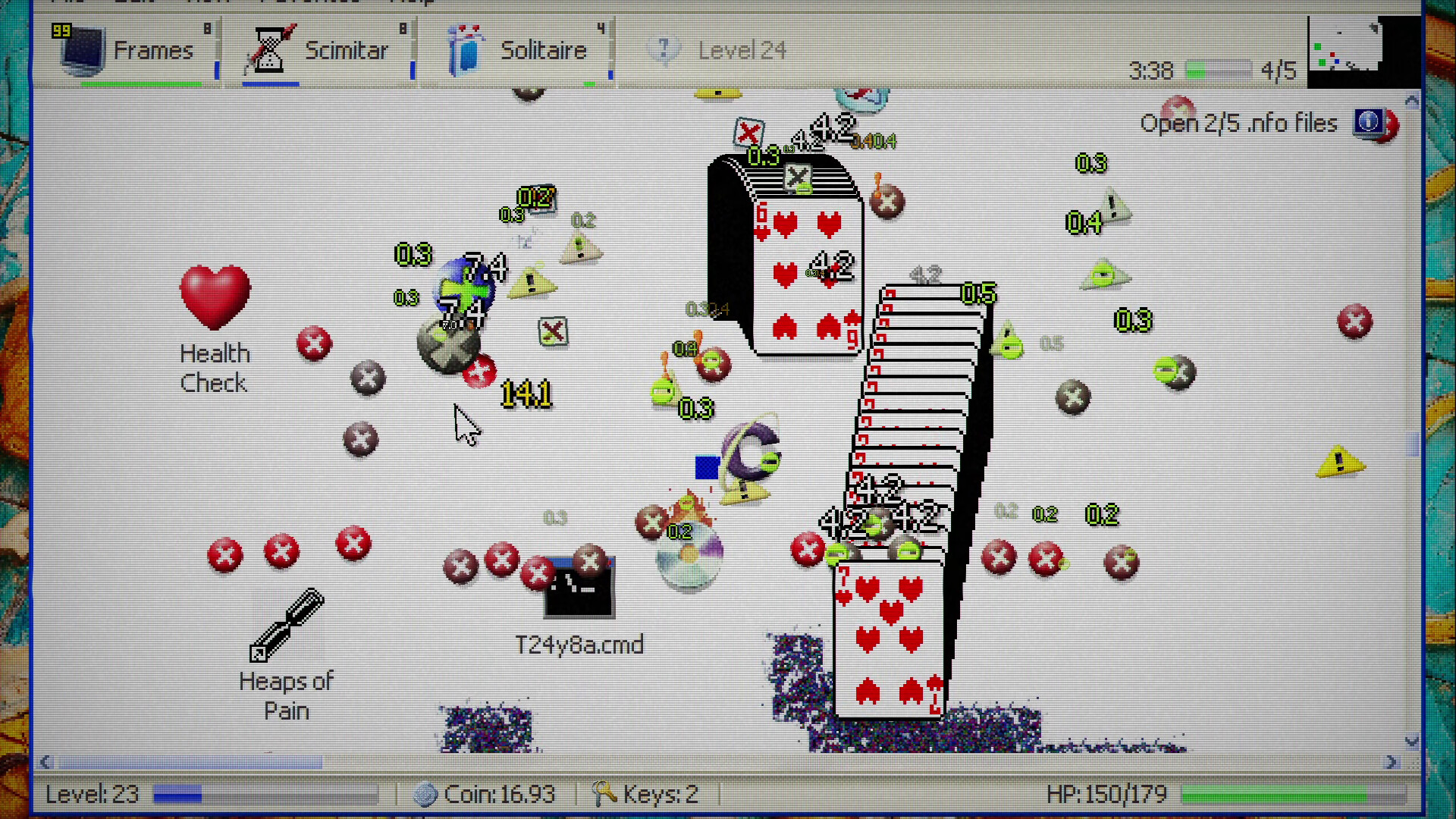
Antivirus Survivors 2003 Professional is a survivors-like from solo developer Shaun Hammond, and the pitch is exactly what the title advertises: the family computer is infected again, and you are the antivirus. You steer a cursor across a Windows XP-era desktop while waves of viruses, spam pop-ups, and voids close in, double-clicking files for XP and keys as you go. Runs last roughly 30 to 40 minutes, and every icon on screen is trying to kill you.
The game launched on September 28, 2026 after a demo that pulled over 6,000 players in Next Fest, doubled wishlists to 13,000 during the fest, and hit 38,000 by late summer. It went straight to Overwhelmingly Positive on Steam: 667 of the first 679 reviews are positive, Valve marked it Steam Deck Verified before release, and it ships with a native Linux build that runs with zero setup. Solo-developer launches rarely land this clean.
| Fact | Detail |
|---|---|
| Developer | Shaun Hammond Business Solutions |
| Genre | Survivors-like / bullet heaven |
| Platforms | Windows, macOS, Linux (native port) |
| Release | September 28, 2026 |
| Price | Around US$6 / S$6.56 at the 10% launch discount |
| Players | Single-player, Steam Deck Verified, full controller support |
| Runs | 30-40 minutes, five timed levels each |
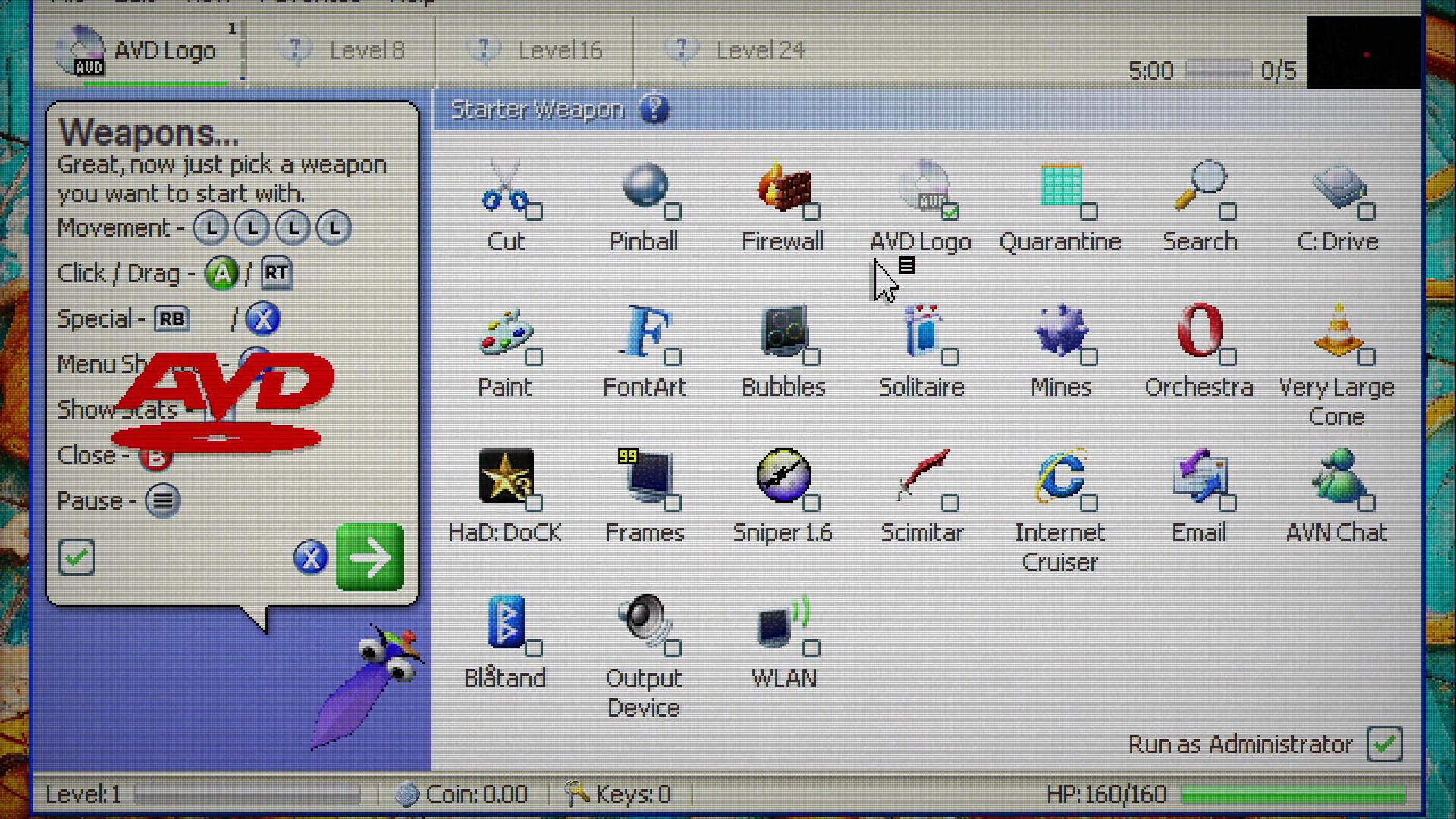
| Weapons | 24, era-themed (Pinball, Solitaire, Mines, Firewall) |
| Upgrades | 50 drivers, 62 plugins, 18 meta upgrades, 18 stats |
| Challenges | 5 protocol folders (difficulties), 15 policies |
| Cosmetics | 81 wallpapers, 8 themes |
| Achievements | 86, including 14 per-policy Protocol V challenges |
| Bosses | 6, plus Plus! mini-boss variants |
Who this is for: Vampire Survivors players who finished the base game twice, anyone who still hears dial-up in their sleep, and players who want a survivors-like that actually makes them move. Who can skip: people allergic to the survivors formula. This is a themed variant with deep tuning space, not a genre reinvention, and the joy is in the skin and the numbers.
Getting Started: Your First Runs
- Claim your tasks. The task list pays out even when a run dies early, and new players routinely miss that the rewards need claiming. Open the task panel before your first run ends.
- Run one folder below your comfort. Each run happens in a protocol folder (difficulty level). Five exist, Protocol I through V. The XP curves punish overreach harder than most survivors-likes; Protocol III alone has a 15% completion rate a week after launch.
- Open everything once. Files drop XP and keys, ZIPs pay long-term economy interest, Health Check files heal. New players lose runs by beelining; the desktop rewards a loose sweep pattern.
- Take the first driver that changes how your weapon moves, not how hard it hits. Movement-affecting drivers compound with positioning; flat damage drivers are a floor, not a build.
- Know the clock. Every one of the five levels ends at a Safe Folder with a timer. Miss the window or die early and the run ends at the Start menu. This alone kills the AFK builds other survivors-likes allow.
Beginner Mistakes to Avoid
| Mistake | Why it hurts | Fix |
|---|---|---|
| Picking three half-synergized weapons | 24 weapons exist; three lukewarm guns lose to two maxed ones | Commit to two carry weapons per run |
| Standing still with a strong build | Five timed levels mean AFK play bleeds timers | Treat the map as POIs to visit, not an arena to hold |
| Ignoring plugins | 62 plugins are the real build chassis; weapons are just the paint | Plan a plugin direction before minute ten |
| Hoarding keys and Coin | Unspent keys open nothing; shops sell permanent-in-run upgrades | Spend both the moment a payout window opens |
| Fighting AVN Buddies head-on | They fire 20+ damage projectiles with no wind-up tell | Burst them from outside projectile range or with large AOE |
| Cutting through spam swarms | Pop-up swarms body-block your routing | Circle the swarm edge, do not cross it |
Core Mechanics Explained
The Double-Click Economy
The economy runs on four currencies stacked on one desktop:
- XP drops from enemies and opened files and levels you mid-run.
- Keys drop from exploration and tasks; they open file types for rewards.
- Coin funds in-run shops (the Volume License achievement counts 100 shop purchases).
- Beanz are the meta currency, banked between runs from Safe Folders and clears.
The loop that wins runs is not kill-maximization. It is route-maximization: a path that opens files, completes tasks, and keeps the swarm at arm's length out-earns a pure murder spiral. Level-ups arrive every eight levels as a weapon choice, and you can hold click to speed up the level-up slowdown, BigWave progress, and plugin installers. Turn the animation speed option on in settings the moment you start. Minutes are the scarcest resource in a timed format.
Files, Safe Folders, and the Timer
Each stage splits into five levels. Survive the level, then reach a Safe Folder and double-click it before the timer expires. Opening one freezes the threat clock, so a late-stage panic route into the folder is the correct greedy play.
The 33 file types each want different handling:
| File | Behavior | Best play |
|---|---|---|
| ZIP | Slow to open, big payout | Drag it along while kiting; unpack where you post up |
| LemWire | Processes what is nearby | Group two or three together to process simultaneously |
| BigWave | Timed progress bar | Hold click to rush it; plan a detour back |
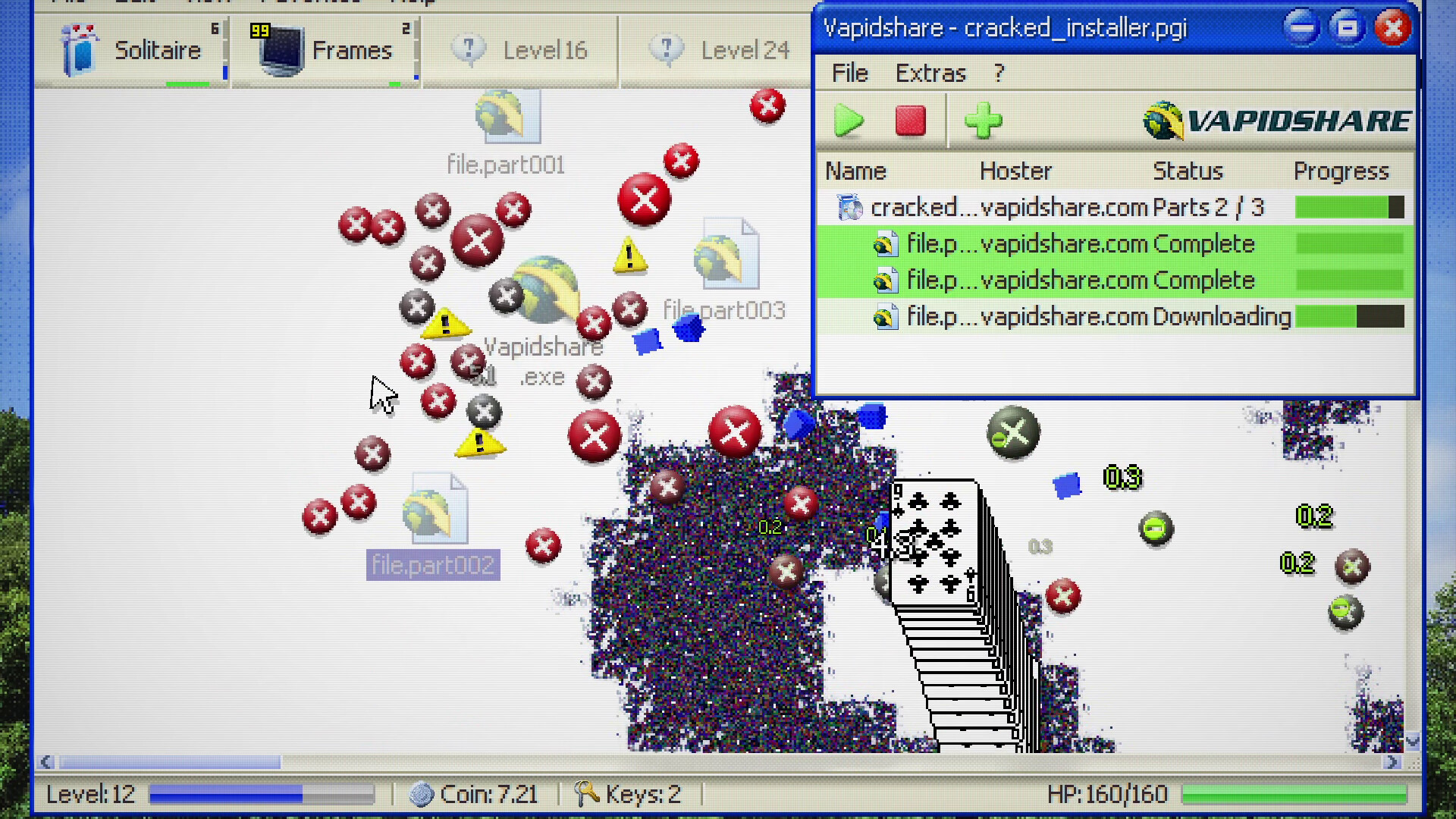
| Defrag Collector | Eats nearby files | Drag vapor.exe away before it gets consumed |
| Health Check | Heals | Open on demand, not on sight; 50 opens = an achievement |
| N2O | Buff cache | Open 10 for the Power User achievement; saves them for boss levels |
| Vapidshare.exe | Extract sequence | 40 successful extractions for Vapidshare, 8 for the Pro version |
| RAM downloader | Free upgrades | "Download More RAM" is real here; always click it |
Drivers vs Plugins: Two Different Upgrade Philosophies
This is the mechanical heart and where new players go wrong.
Drivers (50) transform how a weapon works. Think mutations: a Pinball weapon that returns to you becomes one that never returns but grows. Drivers unlock as a weapon levels and skew stats in ways simple boosts cannot. They change behavior, so they stack multiplicatively with your routing skill.
Plugins (62) install from keygens and modify weapons and player stats. Plugins are the chassis: stat lines, cooldowns, global effects. Two weapons sharing a plugin direction double-dip. There are Legendary plugins too; installing three grants the Legendary Installer achievement, and the install-count ladder runs to 600 (Task Manager, 0.5% of players).
There are no weapon fusions fusing two maxed guns into a super weapon. The full release has Weapon Drivers instead, installed when a weapon reaches certain levels. Plan around behavior transformation, not fusion recipes.
The build order that works for most of the roster:
- One weapon with a behavior driver that fixes its biggest weakness.
- Plugins that feed both weapons at once (shared stat lines).
- A second weapon that covers the first's coverage gap.
- Drivers for the second weapon only after the shared plugin layer is done.
Stats That Matter More Than You Think
The 18 player stats hide two quiet carries. Processing Speed gates your weapon fire cadence; the 2.00x achievement for it sits at 17.5% unlock, and builds that hit it early feel like a different game. Cursor Speed governs your own movement; the 2.00x achievement sits at 7.4%. In a game where the pointer is a game entity with its own speed stat, cursor speed is your movement speed investment. Crit is the third spike: the crit-count ladder runs from 80 crits (78% of players) to 80,000 (0.3%), and crit builds pair with the single-hit achievements (Sparta: 300 damage, First Strike: 1,000).
Meta Progression: Beanz, Classes, and Profiles
Between runs, Beanz buy permanent upgrades, and the launch meta layer goes deeper than the demo's: permanent stat upgrades, unlockable classes (not just weapons), new plugins, side grades, new bosses, and new difficulties. Practical ordering:
- First: anything that raises early XP gain. Survivors-likes live or die on the level-ten power spike timing.
- Second: starting weapon and class options. Choice at minute zero compounds more than power at minute thirty.
- Third: survivability floors. Bosses check these before your DPS does.
Three user profiles exist, and your demo save imports into the full game. Old demo hours convert into launch-day options.
Builds and Weapon Priorities
The 24 weapons map to era software, and their design leans into it. Achievements double as a usage census, and it tells you what the player base actually runs:
| Tier | Weapons | Why |
|---|---|---|
| S | Firewall, Pinball | Firewall melts everything (launch-overtuned, likely to be patched); Pinball scales forever with behavior drivers, 2,000 Pinball kills at 45% unlock |
| A | Solitaire, C: Drive, Cut | Solitaire cascades print screen-clears; C: Drive clears 4,000 kills for its achievement; Cut handles dense swarms |
| B | Frames, Mines, VLC cone, Quarantine | Frames is the crit carrier (400 kills = Criminal); Mines and cones want drag-and-drop herding; Quarantine's scan lines have a tiny hitbox, so never overcap its projectile speed |
| C | Everything you have not driven yet | Any weapon is S-tier with the right driver stack; do not judge a gun before its mutation |
The honest meta note: with 50 drivers and 62 plugins, the real build is the interaction graph, not the weapon list. Two directions that compound:
- The swarm printer: projectile-multiplier weapons (Solitaire cascade, Pinball splits) plus plugins that add projectiles on kill. The screen fills with friendly geometry and the XP vacuums itself.
- The zoning tyrant: Firewall zones, Mines, and Defrag collectors, played through drag-and-drop. You stop dodging enemies and start arranging their deaths. Slower, brainier, and the most original thing in the game.
- The masochist farmer: the XP-on-damage perk converts chip damage into levels. Sit in a wall of weak enemies or poison tics and out-level the run. Powerful on low protocols; on Protocol V the same trick is how you die at minute four.
Step-by-Step Strategies
Sequence 1: The First Ten Minutes of Any Run
- Sweep the starting screen in a widening spiral. Open every file once; skip nothing.
- Take your first level-up weapon pick as your carry candidate. Do not diversify yet.
- Grab the first driver that changes movement or targeting behavior.
- Route through task icons; complete and CLAIM the listed task even if it costs kills.
- Arrive at the Safe Folder with thirty seconds to spare, not three.
Sequence 2: The Plugin Rush (Minute 10-20)
- Open a keygen the first time you see one; plugin installers are your mid-game power spikes.
- Pick plugins that buff both weapons' shared stats: projectile count, area, processing speed.
- Hold click during installers; the animation skip is real time saved.
- Re-check your file inventory after each plugin: new plugins can unlock file-type rewards you could not use before.
- End this window with your second carry weapon at level parity with the first.
Sequence 3: The Policy Exam
Policies are the 15 challenge modifiers, and the launch achievement list confirms the endgame: every policy has its own "complete Protocol V with [policy]" achievement, all sitting at 0.1-0.2% unlock. The ladder:
- Clear base difficulty before touching policies.
- Add exactly one policy per run, chosen to probe your build's weakness. Low Memory tests economy, Bloatware tests scaling, Blue Screen Imminent tests survival margins.
- Treat a policy failure as diagnostics; note the minute your run collapsed.
- Fix that minute with meta upgrades, not in-run heroics.
- Save Natasha's Wrath for Beanz farm runs; it multiplies meta currency but is all-or-nothing.
Sequence 4: Boss Preparation (Minute 25+)
Both launch fan-favorite finals reward the same preparation:
- At minute 25 of a run you intend to win, stop taking upgrades that require standing still.
- Pre-clear the arena edge; the space around a boss matters more than the boss.
- Bank one N2O or Health Check file for a mid-fight open.
- Kill Plus! mini-boss spawns before the main health bar; a sub-10-second Plus! kill is itself an achievement (MorganAV.pgi, 60.8% of players have it).
- Keep the mouse moving in arcs, never zigzags; the pathing punishes direction changes, not speed.
- You can choose your boss at run end. Recycle Bin and Spinning Beach Ball of Death are the two that actually show up; pick the one your build answers. Recycle Bin punishes passive zones, so zoning tyrants should prefer the Beach Ball.
Sequence 5: The Beanz Farm Loop
- Run the highest protocol folder you clear consistently, with Natasha's Wrath active if your build tolerates it.
- Route every Safe Folder; the currency comes from folders and clears, not deep exploration.
- End runs deliberately: when the folder is cleared, jumping into the next level is optional greed.
- Spend Beanz into XP-gain meta upgrades until the early game feels trivial.
- Alternate farm runs with policy runs so the meta unlocks and your skill climb at the same rate.
Advanced Tips
Drag-and-Drop Is the Skill Ceiling
Manual file dragging turns the desktop from a battlefield into an assembly line. Drag a vapor.exe away from a Defrag Collector that would eat it, push two LemWire icons together to process simultaneously, and walk a slow ZIP across the map while it unpacks, posting up when it finishes. Practice dragging while kiting in low-stakes folders until the click-and-hold is muscle memory. Almost nobody does this well, which is exactly why it is your edge.
The Enemy Threat Dictionary
Projectiles are what actually end runs, and each shooter telegraphs differently:
| Enemy | Tell | Counter |
|---|---|---|
| Recycler | Spinning icon before firing | Back off when it spins; dodge the paper |
| AVN Buddy | None; fires on fixed intervals | Kill from range or with large AOE; do not trade into it |
| AVN Buddy Plus | Fires a fan of 3 projectiles | Sniper 1.6, driver-boosted C: Drive, or burst it first |
| Internet Crawler Plus | Loud charge telegraph, but can teleport mid-charge | After dodging the first line, keep moving; never re-anchor |
| Spam pop-ups | None; body-block | Route around, let AOE clear |
| Void | Zone denial | Do not path through; voids reward patience |
The AVN Buddy family is the game's loudest balance complaint precisely because it skips the tell every other shooter has. Respect it and your death count drops by half.
Animation Speed Is a Hidden Difficulty Setting
The hold-to-speed-up patch covers level-up slowdowns, BigWave progress, and plugin installers, plus a global animation speed option. In a timed format, playing at full animation length is a self-imposed handicap. Set it once and never think about it again. While you are in settings: the SFX slider and home-screen mute exist now, added fast after launch feedback.
The Mouse-Aiming Question, Answered
The cursor does not track your mouse 1-to-1, by design. The pointer is a game entity with its own speed stat, and the game plays like a controller game with extra precision. Stop fighting it: invest in cursor-speed stats the way you would invest in movement speed in any other survivors-like. The 2.00x Cursor Speed achievement is the moment the game stops feeling sluggish.
Controller vs Keyboard vs Steam Deck
All three inputs are first-class. Keyboard players get finer text-selection for file interactions; controller players get comfortable long sessions, and the DualSense light bar shows your health, which sounds gimmicky until a boss fight has your full attention and the glow turns red in your peripheral vision. The game is Steam Deck Verified, and the native Linux build runs clean on Ubuntu-class distros. The only Deck-era caveat in early reviews, stray touchscreen taps hijacking the cursor, was addressed on the road to Verified.
Wallpapers Are the Endgame
Eighty-one wallpapers and eight themes gate nothing, and that is the point. They are the completionist scoreboard for a game built on cosmetic nostalgia. The long tail beyond them: 250 ZIPs for RAID 0, 400 ZIPs for Dual Core, 5,000,000 damage for 5 Milli, 50 runs for Marathon and a Bit, and the 14 policy-restricted Protocol V clears. That is months of content at the price of a coffee.
Steam Achievements Worth Planning Around
The 86 achievements map directly to how the game wants to be played. The usage census (weapons kills), the economy ladder (Coin, keys, shops), and the endurance spikes (level 100 in one run, 100,000 lifetime enemies) tell you exactly where the ceiling is. A sample of the meaningful milestones:
| Achievement | Requirement | Unlock rate |
|---|---|---|
| Career Path | Reach level 30 in one run | 70.0% |
| KeyBuy | 15 keys in one run | 54.5% |
| Spinning Beach Ball of Death File | Defeat that boss | 53.0% |
| Enterprise Edition | Heal 2,500 HP total | 35.9% |
| Protocol IV | Complete Protocol III | 15.4% |
| Admin | Spend 5,000 Coin in shops | 13.9% |
| Sparta | Land a single hit of 300 damage | 12.5% |
| Service Pack | Reach level 80 in one run | 5.9% |
| Protocol V | Complete Protocol IV | 2.6% |
| 100 Bang | Reach level 100 in one run | 1.8% |
| 5 Milli | Deal 5,000,000 damage | 0.7% |
| 80,000 Crits | Crit 80,000 times | 0.3% |
| Policy V clears (14 of them) | Beat Protocol V with each policy | 0.1-0.2% |
FAQ
How much does it cost? It launched September 28, 2026 at roughly US$6 (S$6.56 with the 10% launch discount, GBP 5.29). Reviewers overwhelmingly call it underpriced for the content.
Is there weapon evolution or fusion? No two-weapon fusions. The full release has Weapon Drivers: bespoke upgrades installed when a weapon hits certain levels. Behavior transformation, not fusion.
What are Beanz and how do I earn more? Beanz are the meta currency, earned from opened Safe Folders and cleared enemies. Group Policies in the full release multiply Beanz earned per run; Natasha's Wrath is the dedicated multiplier.
Why can't I aim with my mouse directly? By design. The pointer is a game entity with its own speed stat, not a 1-to-1 mouse cursor. Invest in cursor speed stats.
Which bosses will I actually face? Six exist on the store page, and Plus! mini-bosses add variety mid-run, but players consistently report the final slot rotates mainly between Recycle Bin and Spinning Beach Ball of Death. You choose your boss; the choice matters mostly for zoning builds.
Is there an endless mode? Not at launch. The structure is five protocol folders with 15 policies, and the per-policy Protocol V achievements are the de facto endless ladder.
What are the system requirements? Minimal: 64-bit OS, 2.0 GHz CPU, 1 GB RAM, 512 MB VRAM, 256 MB storage. Windows 10 minimum. Native Linux and macOS builds ship. Late-run entity count is the only performance variable that matters.
Does the demo progress carry over? Yes. Your demo save imports into the full game as one of three user profiles.
Is it good on Steam Deck? Verified. It is the rare bullet heaven that plays better on a couch than the genre's mouse-first reputation suggests.
Quick Reference Card
- Two carry weapons max. Three half-guns lose to two maxed ones.
- Drivers change behavior, plugins build the chassis. Take behavior first.
- Claim your tasks. The payout needs a click; free Beanz die there otherwise.
- Route-maximization beats kill-maximization. Open files, hit POIs, keep moving.
- Safe Folders freeze the fight. Late entries are greed, not mistakes.
- Hold click to skip animations. Seconds are the real currency.
- Cursor Speed and Processing Speed are the quiet carries. Push both toward 2.00x.
- Respect AVN Buddies. No tell, 20+ damage; kill from range or burst first.
- One policy per run once base difficulty is clear; Natasha's Wrath on farm runs only.
- Quarantine wants projectile size, not speed. Overcapped scan lines phase through enemies.
- Endgame = 14 policy-restricted Protocol V clears. Currently the rarest feats in the game.
- Launched: September 28, 2026. Windows, macOS, Linux. Steam Deck Verified.